
As an orthopedic surgeon who treats bone and joint pain daily, I am constantly asked about the “magic pill” for skeletal health. The medical truth is straightforward: there is no magic — only science and balance. The health of your skeleton depends on a precise interplay between vitamins and lifestyle.
In this article, I share the essentials of my clinical experience on the Best Vitamins for Bones and Joints, divided into two main sections: vitamins for building bones, and the truth about joint-protective supplements.
Part 1 — The Best Vitamins for Bones and Joints
Bones are not inert stones; they are living tissue that constantly remodels itself. To maintain their strength, you need a fully integrated “team” of nutrients working together.
1. Vitamin D — The Maestro
Vitamin D is the primary driver of calcium absorption from the intestines. Without adequate vitamin D, your body cannot utilize calcium regardless of how much you consume.
Natural sources: sunlight exposure, fatty fish (salmon), egg yolks, and fortified foods.
2. Calcium — The Foundation Stone
Calcium is the principal building block of bone mass. Its deficiency leads directly to osteoporosis.
Natural sources: dairy products, sardines, dark leafy greens, and sesame seeds.
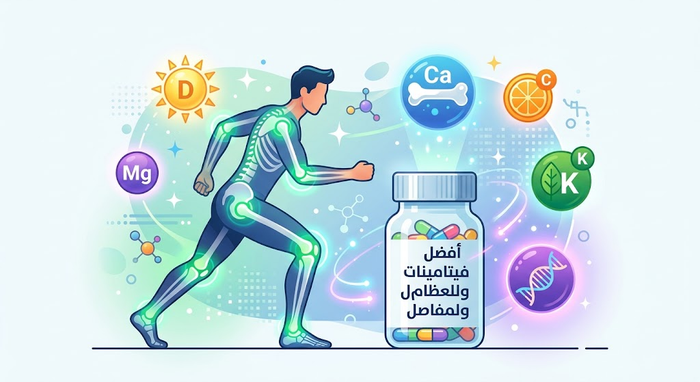
3. Vitamin K2 — The Traffic Officer
This vitamin plays a vital role: it takes calcium from the bloodstream and directs it into bones and teeth, preventing its deposition in arteries or kidneys.
Natural sources: fermented foods (such as natto), goose liver, aged cheese, and fatty meats.
4. Magnesium — The Activator
Magnesium is essential for converting vitamin D into its active form inside the body.
Natural sources: nuts (especially almonds), seeds, bananas, and spinach.
Magnesium, calcium, and vitamin D together form a powerful and synergistic combination for bone health.
5. Vitamin C — The Collagen Engineer
Vitamin C stimulates collagen production — the protein that gives bones their flexibility and prevents them from fracturing easily.
Natural sources: citrus fruits (oranges, lemons), bell peppers, and kiwi.
Part 2 — Best Supplements for Joints: The Unvarnished Truth
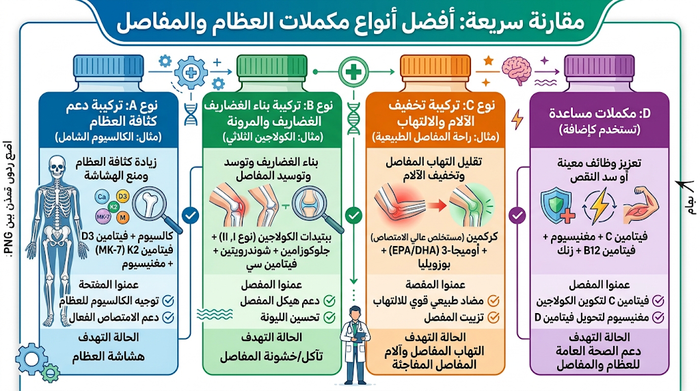
When it comes to joints and cartilage, glucosamine and chondroitin are the most commonly discussed supplements. They are medically referred to as “chondroprotective agents.”
My Honest Medical Opinion
Despite their popularity, the strong scientific evidence for these supplements’ ability to “rebuild” cartilage or truly protect joints is insufficient. Some patients may experience slight pain relief — a mild analgesic effect — but these supplements do not fundamentally treat osteoarthritis.
The Real Treatment for Joint Pain
As a physician, my golden advice for joint-pain patients is not inside a pill bottle; it lies in two steps:
- Weight loss: every kilogram you lose takes approximately four kilograms of load off your knees. This is the most powerful medicine.
- Exercise: strengthening the muscles around a joint reduces cartilage stress and increases joint stability.
The “Don’t Miss” Health Checklist
To maintain strong overall health, make sure your daily intake includes:
- Vitamin D — for robust immunity and solid bones.
- Omega-3 — for cardiovascular health and systemic inflammation reduction.
- Magnesium — for restful sleep and proper muscle function.
- Vitamin B12 — for nerve health and energy (especially important for diabetic patients).
Dietary supplements are a helpful adjunct, but they are no substitute for healthy food and regular physical activity.

Frequently Asked Questions
What are the essential vitamins and minerals required for bone and joint health?
The human musculoskeletal system requires targeted, synergistic micro-nutrients operating across two distinct biological axes:
- The Bone Mineralization Axis: Calcium forms the primary inorganic matrix (hydroxyapatite); Vitamin D3 stimulates active enterocyte calcium absorption; Vitamin K2 orchestrates calcium incorporation into bones; and Magnesium acts as an essential enzymatic cofactor for bone crystalline strength.
- The Articular Cartilage & Joint Axis: Undenatured Type II Collagen preserves cartilaginous tensile architecture; Glucosamine and Chondroitin Sulfate replenish proteoglycan shock absorbers; Methylsulfonylmethane (MSM) supplies bioavailable sulfur; and Omega-3 Fatty Acids downregulate intra-articular synovial inflammation.
Why is it clinically recommended to combine Vitamin D3 with Vitamin K2 (MK-7)?
Administering Vitamin D3 in combination with Vitamin K2 (specifically the menaquinone-7 / MK-7 isomer) resolves the clinical challenge known as the “calcium paradox”:
- Vitamin D3 Mechanism: Substantially increases the rate of intestinal calcium transport into systemic circulation.
- Vitamin K2 (MK-7) Mechanism: Functions as an indispensable cofactor for gamma-glutamyl carboxylase, activating osteocalcin to chemically fix free circulating calcium into bone lacunae while carboxylating Matrix Gla Protein (MGP) to inhibit pathological vascular calcification in coronary arteries and renal parenchyma.
Which calcium supplement form is superior: Calcium Citrate or Calcium Carbonate?
Clinical choice depends on gastric physiology, age, and gastrointestinal tolerance:
- Calcium Carbonate: Delivers 40% elemental calcium by weight and is cost-effective, but requires acidic gastric juice for solubilization (must be taken immediately with a meal) and frequently precipitates constipation, intestinal gas, and dyspepsia.
- Calcium Citrate: Yields 21% elemental calcium but provides significantly superior fractional bioavailability. Its dissolution is independent of gastric hydrochloric acid (can be taken with or without food), making it the evidence-based first line for elderly patients, individuals on gastric acid suppression (H2-blockers or PPIs), and patients with inflammatory bowel disease or chronic constipation.
How do Glucosamine and Chondroitin Sulfate protect degenerating joint cartilage?
Glucosamine and chondroitin sulfate act as structural chondroprotective nutraceuticals:
- Substrate Precursors: They deliver essential building blocks for synthesizing glycosaminoglycans (GAGs) and aggrecan, maintaining the hydrostatic swelling pressure that gives articular cartilage its elastic resilience.
- Enzyme Inhibition: Studies demonstrate their capacity to downregulate destructive matrix metalloproteinases (MMPs) and aggrecanases (ADAMTS-4 and ADAMTS-5).
- Symptomatic Relief: Continuous, long-term administration reduces joint line pain and improves functional mobility in Kellgren-Lawrence Grade 1 and 2 knee osteoarthritis.
What is the clinical role of Undenatured Type II Collagen (UC-II) in joint mobility?
Undenatured Type II Collagen (UC-II) works through an immune-mediated mechanism known as oral tolerance:
- Unlike hydrolyzed collagen peptides that serve primarily as nutritional amino acid building blocks, UC-II retains its intact, native 3D triple-helix structure.
- As it traverses gut-associated lymphoid tissue (GALT) in Peyer’s patches, it modulates immune responses, prompting regulatory T-cells to suppress autoimmune T-cell attacks against endogenous articular cartilage.
- Randomized clinical trials demonstrate that a small once-daily 40 mg dose of UC-II significantly outperforms high-dose glucosamine/chondroitin combinations in reducing joint pain and extending joint range of motion during weight-bearing exercise.
What role does Magnesium play in preventing bone loss and osteoporosis?
Magnesium is an essential mineral for structural and endocrine bone integrity:
- Enzymatic Activation: Magnesium acts as an obligatory cofactor for hepatic 25-hydroxylase and renal 1-alpha-hydroxylase enzymes, which convert circulating vitamin D into bioactive 1,25-dihydroxycholecalciferol.
- Structural Quality: Around 60% of bodily magnesium is stored directly in bone tissue, influencing the size, geometry, and mechanical elasticity of hydroxyapatite crystals to protect against micro-fractures.
- Endocrine Balance: It regulates parathyroid hormone (PTH) release, preventing secondary hyperparathyroidism and uncoupled osteoclastic bone resorption.
What is the optimal daily schedule for taking calcium, magnesium, and vitamin D supplements?
Separating doses throughout the day optimizes absorption and minimizes receptor competition:
- Vitamin D3 (+ Vitamin K2): Take midday with the largest meal of the day containing healthy dietary fats, enhancing lipophilic uptake through enterocyte micelles.
- Calcium: Ingest during daytime hours, dividing doses so no single bolus exceeds 500 to 600 mg (doses above this threshold saturate saturable active calcium transport channels, decreasing fractional absorption).
- Magnesium (Glycinate or Citrate): Best taken in the evening or 1 hour prior to sleep; it supports neuromuscular relaxation and prevents competition with calcium for shared divalent metal cation transport pathways.
Can bone and joint supplements replace total knee replacement surgery in end-stage osteoarthritis?
No. Nutritional supplements cannot substitute for joint replacement in advanced disease:
Nutraceuticals are conservative interventions designed to slow cartilage degradation, alleviate mild periarticular inflammation, and maintain functional mobility in early-to-moderate osteoarthritis (Kellgren-Lawrence Grades 1 to 3). In Grade 4 osteoarthritis (“bone-on-bone” disease), where hyaline cartilage is completely denuded, subchondral bone is eburnated, and angular axial deformities exist, oral supplements cannot regenerate new articular cartilage. At this stage, Total Knee Arthroplasty (TKR) remains the only reliable, evidence-based surgical solution to abolish chronic pain and restore ambulation.
What clinical contraindications and drug interactions should be assessed before starting joint supplements?
Clinicians must review medications and comorbidities to avoid adverse reactions:
- Oral Anticoagulants (Warfarin): Supplemental Vitamin K2 must be strictly managed or avoided because it can reverse therapeutic vitamin K antagonism and precipitate subtherapeutic INR levels.
- Shellfish Hypersensitivity: Most standard commercial glucosamine is synthesized from the exoskeletons of marine crustaceans; patients with IgE-mediated shellfish allergies should use vegan biofermented glucosamine hydrochloride instead.
- Nephrolithiasis & Hypercalcemia: High-dose calcium supplementation is contraindicated in patients with active calcium oxalate nephrolithiasis, primary hyperparathyroidism, or hypercalciuria.
- Diabetes Mellitus: Monitor fasting blood glucose during the initiation of high-dose glucosamine regimens due to theoretical interactions with hexosamine biosynthesis pathways.
How long does it take to experience clinical improvement after starting joint supplements?
Unlike rapid pharmaceutical NSAIDs or analgesics, chondroprotective nutrients function via progressive biological integration:
- Weeks 2 to 4: Early modulation of synovial fluid inflammation; patients often notice minor reductions in post-rest stiffness.
- Weeks 6 to 8: Noticeable improvements in joint ease, reduced movement crepitus, and improved endurance while walking or using stairs.
- Months 3 to 6: Peak therapeutic outcome is attained, providing sustained structural cartilage protection and improved functional mobility when combined with quadriceps strengthening and weight management.
References
Mayo Clinic — Vitamin D (2024)
https://www.mayoclinic.org/drugs-supplements-vitamin-d/art-20363792- Mayo Clinic — Bone health: Tips to keep your bones healthy (2024)
https://www.mayoclinic.org/healthy-lifestyle/adult-health/in-depth/bone-health/art-20045060 - AAOS OrthoInfo — Calcium, Nutrition, and Bone Health (2024)
https://orthoinfo.aaos.org/en/staying-healthy/calcium-nutrition-and-bone-health/ - Cleveland Clinic — What To Know About Vitamin K2 and Its Health Benefits (2024)
https://health.clevelandclinic.org/vitamin-k2 - Cleveland Clinic — Can Supplements Support Better Bone Health? (2024)
https://health.clevelandclinic.org/bone-health-supplements - NICE — Osteoarthritis in over 16s: diagnosis and management (NG226, 2022; updated 2024)
https://www.nice.org.uk/guidance/ng226 - HSS — Initial Core Management of Osteoarthritis (2024)
https://www.hss.edu/health-library/conditions-and-treatments/initial-core-management-of-osteoarthritis - Rondanelli M, et al. — Impact of magnesium on bone health in older adults: A systematic review and meta-analysis. Bone (2022)
https://pubmed.ncbi.nlm.nih.gov/34666201/