
Searching for the names and types of vitamin B12 injections is extremely common among patients suffering from peripheral neuropathy, sciatica, tingling sensations, and carpal tunnel syndrome. B12 injections for nerve support are among the most frequently prescribed treatments in orthopedic and neurology practice.
In this article, we cover all available injection types on the Egyptian market, with a focus on identifying the Best Vitamin B12 Injections for Nerves.
Why Vitamin B12 Matters
Vitamin B12 is an essential nutrient for nerve health and red blood cell formation. Its deficiency is a common cause of symptoms such as tingling, numbness in the extremities, persistent fatigue, and poor concentration. In the clinic, patients frequently ask: What is the best B12 injection? Is there a real difference between the types?
This article offers a simplified, practical explanation of the most popular B12 injection brands available in pharmacies, when injections are preferred over tablets, and which type suits each clinical scenario.
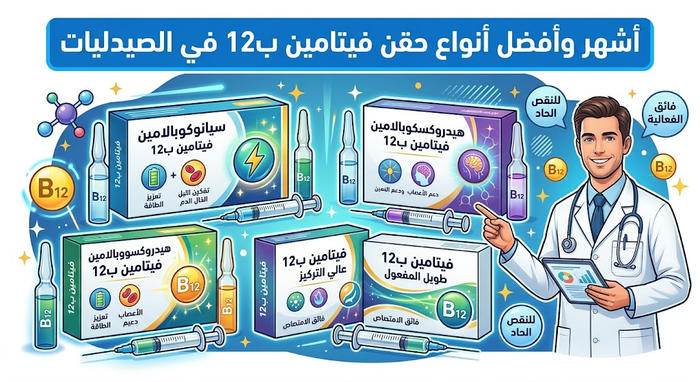
Most Popular B12 Injections in Egyptian Pharmacies
B12 injections available in Egypt can be classified into three main categories:
1. B-Complex Injections (for Nerve Inflammation)
These contain vitamins B1, B6, and B12 together, and are most commonly used for peripheral neuritis and back/neck pain.
- Neurobion: one of the most widely used, especially for peripheral neuritis.
- Neurovit: a popular and effective alternative.
- Neuroton: distinguished by the addition of vitamin B2.
- Tri-B: an affordable option with good efficacy.
This group is ideal for patients with nerve pain associated with spinal problems or disc herniation.
2. Long-Acting (Depot) B12 Injections
Used in cases of chronic deficiency, these raise the body’s vitamin stores and are administered at longer intervals.
- Depovit B12
- Biovit 12 Depot
These typically contain hydroxocobalamin, a form that remains in the body longer than other types.
3. B12 Injections with Additional Components
Some injections combine B12 with other ingredients for enhanced benefit:
- Livabion: contains folic acid — useful for anemia cases.
- Epinosine B Forte: contains ATP to support nerve cell energy.
What Is the Difference Between B12 Forms in Injections?
The key difference lies in the chemical form of the vitamin:
- Cyanocobalamin: the most common and least expensive form; requires conversion inside the body before becoming active.
- Hydroxocobalamin: lasts longer in the body; suitable for chronic deficiency and maintenance doses.
- Methylcobalamin: the active form — preferred by some physicians for neuropathy cases, particularly in diabetic patients.

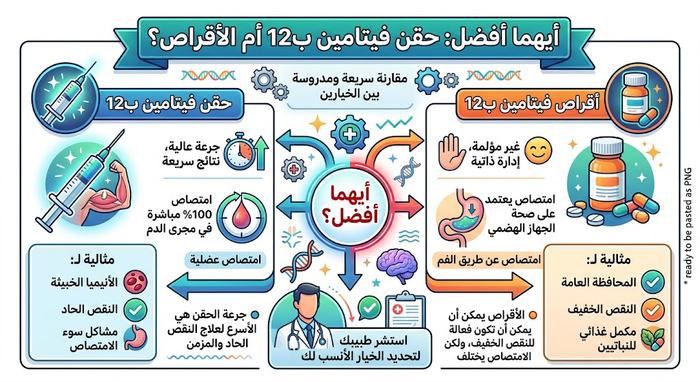
Injections vs. Tablets — Which Is Better?
Injections Are Preferred When:
- There is severe deficiency
- The patient has gastritis or gastric issues
- After bariatric (sleeve) surgery
- Acute nerve pain is present
The major advantage of injections is that they reach the bloodstream directly, bypassing gastric absorption entirely.
Tablets Are Suitable For:
- Mild cases
- Preventive doses
- Maintaining levels after completing an injection course
Recently, improved-absorption tablets such as sublingual formulations (e.g., Methyltechno) and liposomal preparations have become available.
Benefits of B12 Injections Beyond Nerve Health
- Relieving tingling and numbness symptoms
- Supporting red blood cell formation and treating anemia
- Boosting energy and reducing fatigue
- Supporting memory and concentration
- Contributing to bone health, especially in the elderly
Conclusion
Choosing the best B12 injection does not depend on the brand name alone — it depends on the diagnosis and the cause of deficiency. Some patients need B-complex vitamins, others require long-acting B12 depot injections, while tablets may suffice in certain cases. Therefore, these injections should always be used under the supervision of a qualified orthopedic specialist to determine the appropriate type and dosage for each case.
Dr. Ibrahim Shaarawi
Consultant & Lecturer of Orthopedic Surgery — Ain Shams University
Professor of Orthopedic Surgery — Ohio University Hospitals
Frequently Asked Questions
Which form of vitamin B12 injection is most effective for nerve repair and regeneration?
Methylcobalamin is widely recognized as the most effective vitamer for targeted neurological repair:
- Direct Neuro-Activity: Unlike cyanocobalamin, it does not require metabolic transformation by the liver; it crosses the blood-brain and blood-nerve barriers immediately in its bioactive coenzyme state.
- Myelin Synthesis: It functions as a primary methyl donor in transmethylation pathways, stimulating phospholipid and protein formation in Schwann cells.
- Axonal Regeneration: Clinical studies indicate that methylcobalamin enhances axonal sprouting, restores nerve conduction velocity (NCV), and mitigates neuropathic pain in peripheral neuropathies.
What are the leading brand names of vitamin B12 injections used for neuropathy?
Physicians utilize both pure cobalamin preparations and synergistic neurotropic combinations:
- Pure Vitamin B12 Formulations:
- Methycobal: Pure methylcobalamin (500 mcg per 1 mL ampoule), preferred for acute focal neuropathies and diabetic nerve pain.
- Depovit B12: Hydroxocobalamin (1000 mcg), known for long tissue retention and steady plasma release.
- Neurotropic B-Complex Formulations:
- Neurobion & Neuroton: High-potency complexes combining vitamin B12 (cyanocobalamin or hydroxocobalamin) with vitamin B1 (thiamine) and vitamin B6 (pyridoxine).
- Tri-B & Becozyme: Established supportive formulations for compressive radiculopathies (sciatica, cervical spondylosis) and peripheral neuritis.
How does vitamin B12 protect and regenerate the myelin sheath of peripheral nerves?
Vitamin B12 is an obligatory co-factor for two pivotal metabolic pathways in the nervous system:
- The Methionine Synthase Pathway: Converts homocysteine into methionine, the precursor for S-adenosylmethionine (SAMe). SAMe is essential for the enzymatic methylation of basic myelin proteins; deficiency arrests myelin synthesis and leads to progressive demyelination.
- The Methylmalonyl-CoA Mutase Pathway: Mitochondrial B12 converts methylmalonyl-CoA to succinyl-CoA. In a deficient state, accumulated methylmalonic acid (MMA) is incorporated into non-physiological, branched-chain fatty acids, disrupting the structural lipid bilayer of the peripheral nerve sheath.
What is the difference between Hydroxocobalamin and Methylcobalamin injections for nerve conditions?
Both vitamers play complementary roles in neuro-therapeutics:
- Hydroxocobalamin: Features higher affinity for circulating serum transport proteins (transcobalamin II), clearing through glomerular filtration significantly slower than cyanocobalamin. This produces a reliable depot effect, making it the international standard for pernicious anemia and long-term prophylactic maintenance (administered every 2 to 4 weeks).
- Methylcobalamin: Directly enters biochemical remyelination cycles in nervous tissue without enzymatic modification, providing rapid symptom control for acute painful diabetic polyneuropathy, entrapment syndromes (carpal tunnel syndrome), and radicular sciatic pain.
Why are intramuscular B12 injections preferred over high-dose oral supplements for severe neuropathy?
Intramuscular administration eliminates the erratic physiological barriers of the digestive tract:
Oral cobalamin absorption is a fragile multi-step process requiring pepsin digestion in the stomach, binding to R-protein, transfer to gastric intrinsic factor (IF), and specialized receptor endocytosis in the distal ileum. If this pathway is compromised—as seen in autoimmune atrophic gastritis, post-bariatric sleeve gastrectomy, Crohn’s disease, or chronic PPI therapy—oral absorption drops precipitously.
Intramuscular (IM) injection provides 100% systemic bioavailability, bypassing gastrointestinal checkpoints and rapidly elevating plasma concentrations to halt active axonal degradation.
What is the evidence-based dosing regimen of B12 injections for diabetic peripheral neuropathy?
Clinical management follows a structured, biphasic therapeutic roadmap:
- Loading / Intensive Neuro-Recovery Phase: Administer 500 to 1000 mcg intramuscularly 3 times weekly (or every other day) for 2 to 4 consecutive weeks. The objective is rapid replenishment of depleted hepatic stores and suppression of active axonal degradation.
- Consolidation & Maintenance Phase: Once subjective paresthesias and burning sensations subside, transition to 1000 mcg once weekly for 1 to 2 months, followed by long-term maintenance of 1000 mcg every 2 to 4 weeks, with periodic clinical evaluation of vibratory sense and reflexes.
Can vitamin B12 injections reverse established nerve damage and numbness?
Clinical reversibility depends heavily on the timing of therapeutic initiation:
- Early Intervention (Within 6 to 12 months of onset): When neuropathic complaints are limited to tingling, allodynia, mild stocking-glove numbness, and vibratory threshold reduction, parenterally delivered B12 can induce significant or complete symptom resolution over 3 to 6 months.
- Chronic, Neglected Neuropathy (> 1 to 2 years): If axonal death, secondary muscular atrophy, or myelopathic degeneration of the posterior and lateral columns of the spinal cord (subacute combined degeneration) have established, structural remyelination is limited, and functional deficits may become permanent.
Why do diabetic patients on long-term Metformin therapy frequently require B12 injections for their nerves?
Metformin is a recognized pharmacological cause of secondary B12 deficiency:
Metformin alters cellular membrane potentials in the terminal ileum, competitively antagonizing calcium-dependent uptake of the intrinsic factor-B12 (IF-B12) complex. Over 25% to 30% of patients taking metformin (specifically at dosages exceeding 1500 mg/day for more than 2 to 3 years) develop progressive serum B12 depletion.
Because metformin-induced neuropathic symptoms are often mistaken for progressive diabetic microvascular disease, proactive surveillance of circulating serum B12 and periodic intramuscular repletion are essential.
Are there any side effects or risks of toxicity with high-dose vitamin B12 injections?
Vitamin B12 displays an exceptional clinical safety margin:
- Absence of Hypervitaminosis: Being a water-soluble molecule, excess circulating cobalamin is freely filtered across the renal glomeruli and eliminated in urine. There is no established Upper Tolerable Limit (UL).
- Chromaturia: Patients should be informed that rapid renal elimination can tint urine reddish-pink, which is entirely benign.
- Minor Adverse Events: Mild localized injection-site soreness, rare transient acneiform skin eruptions, or mild headaches.
- Hypokalemia Alert: In severe megaloblastic anemia, rapid cellular regeneration triggered by B12 therapy can shift potassium into newly synthesized erythrocytes; serum potassium should be monitored during initial resuscitation in severe anemia.
Why is vitamin B12 combined with B1 (thiamine) and B6 (pyridoxine) in neurotropic formulations like Neurobion?
The neurotropic triad (B1, B6, and B12) targets peripheral nerve metabolism across three distinct, synergistic mechanisms:
- Vitamin B1 (Thiamine): Serves as a rate-limiting coenzyme in carbohydrate metabolism (pyruvate dehydrogenase), generating the cellular ATP required for active axonal transport and stabilizing neuronal membrane polarization.
- Vitamin B6 (Pyridoxine): Catalyzes the decarboxylation and transamination reactions required to synthesize central inhibitory neurotransmitters (such as GABA and serotonin), attenuating spinal transmission of neuropathic pain signals.
- Vitamin B12 (Cobalamin): Reconstructs and maintains the structural myelin sheath, preventing retrograde axonal degeneration and restoring normal nerve conduction.
References
NICE — Vitamin B12 deficiency in over 16s: diagnosis and management (NG239, 2024)
https://www.nice.org.uk/guidance/ng239- Mayo Clinic — Vitamin B-12 (2024)
https://www.mayoclinic.org/drugs-supplements-vitamin-b12/art-20363663 - Cleveland Clinic — Vitamin B12 Deficiency: Symptoms, Causes & Treatment (2024)
https://my.clevelandclinic.org/health/diseases/22831-vitamin-b12-deficiency - Cleveland Clinic — Vitamin B12 Injection (2024)
https://my.clevelandclinic.org/health/drugs/17995-vitamin-b12-injection - Mayo Clinic — Cyanocobalamin (intramuscular route) (2024)
https://www.mayoclinic.org/drugs-supplements/cyanocobalamin-intramuscular-route/description/drg-20137833 - Zhang M, et al. — Efficacy and Safety of Mecobalamin on Peripheral Neuropathy: A Systematic Review and Meta-Analysis of Randomized Controlled Trials. J Altern Complement Med (2020)
https://pubmed.ncbi.nlm.nih.gov/32716261/ - Niafar M, et al. — The role of metformin on vitamin B12 deficiency: a meta-analysis review. Intern Emerg Med (2015)
https://pubmed.ncbi.nlm.nih.gov/25502588/ - AAOS OrthoInfo — Carpal Tunnel Syndrome (2024)
https://orthoinfo.aaos.org/en/diseases–conditions/carpal-tunnel-syndrome/