
Ending hand numbness before it becomes permanent weakness
Treating carpal tunnel syndrome and related peripheral nerve entrapments, from night splinting and guided injection through to surgical release — with emphasis on timing, because delayed treatment can leave weakness that does not recover.
When does hand numbness need treatment?
Hand numbness is a common complaint with causes ranging from the neck to the wrist. Signs pointing to nerve entrapment at the wrist:
- Numbness in the thumb, index, middle and half the ring finger — sparing the little finger
- Repeatedly waking at night with numbness that eases on shaking the hand
- Symptoms worsening while driving or holding a phone
- Dropping objects, or weakness of thumb grip
- Visible wasting of the muscles at the base of the thumb (a late sign)
- Symptoms persisting despite several weeks of night splinting
Wasting is a late sign: visible atrophy at the base of the thumb means the nerve has been compressed for a long time, and strength may not fully return even after release. Intervening before this stage is preferable to intervening after it.
What we treat in the hand and peripheral nerves
Accurate diagnosis is half the treatment here, because similar symptoms can arise from the neck, the elbow or the wrist — each with an entirely different treatment.
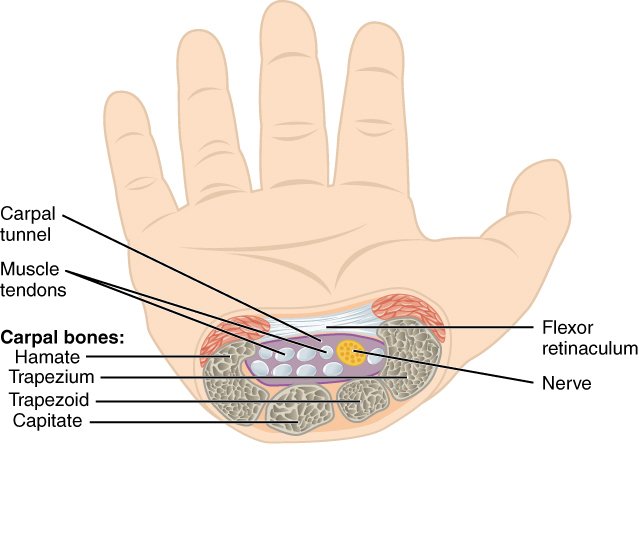
Carpal tunnel syndrome
Compression of the median nerve at the wrist, the commonest cause of nocturnal hand numbness, treated with splinting, injection or release depending on severity.
Cubital tunnel syndrome
Ulnar nerve compression at the elbow causing numbness in the little and ring fingers and weakness of grip, distinguished by the distribution of symptoms.
Trigger finger
The flexor tendon catching within its sheath causing clicking or locking on bending; many cases respond to a local injection.
Ganglion cyst
A fluid-filled swelling usually on the back of the wrist; most need no surgery unless they cause pain or press on a nerve.
De Quervain’s tenosynovitis
Pain on the thumb side of the wrist, worse with gripping and lifting — common after childbirth and with repetitive use.
Hand tendon and nerve injuries
Tendon or nerve division after lacerations, requiring precise early repair to preserve hand function.
Hand nerve and tendon guide
Detailed guides written and reviewed by Prof. Dr. Ibrahim Shaarawi for each condition we treat in the hand:
Video: median nerve release surgery
Prof. Dr. Ibrahim Shaarawi demonstrates median nerve (carpal tunnel) release (in Arabic).
Key numbers and treatment options
- Carpal tunnel syndrome is the most common peripheral nerve entrapment worldwide (Padua et al., Lancet Neurology 2016).
- In a Cochrane review of 14 randomised trials (1,231 patients, 84% women), surgery roughly doubled the chance of long-term improvement compared with splinting, and 44% of the splint group were later referred for surgery (Lusa et al., Cochrane 2024).
- A steroid injection clearly improved symptoms at 10 weeks, but 73% of patients given the higher dose still had surgery within a year, versus 92% after placebo (Atroshi et al., Annals of Internal Medicine 2013).
- Across 28 studies (2,586 hands), endoscopic and open release had the same long-term results; endoscopic patients returned to work about 8 days sooner, with 45% fewer minor complications (Vasiliadis et al., Cochrane 2014).
- Ulnar nerve entrapment at the elbow is the second most common entrapment neuropathy after carpal tunnel syndrome (Cochrane review, 2016).
- In a Cochrane review of 14 trials (1,260 patients, about 70% women), triggering returned within 6–12 months in 38.5% after a steroid injection versus only 6.5% after open release (Fiorini et al., Cochrane 2018).
At Prof. Dr. Ibrahim Shaarawi’s clinics in Nasr City, Mohandeseen and New Cairo (5th Settlement) we examine the hand and review your nerve study at the same visit, confirming where and how badly the nerve is trapped before choosing a splint, injection or release.
Treating carpal tunnel syndrome
| Treatment | When we use it | What to expect |
|---|---|---|
| Night wrist splint | Mild and moderate cases, especially night-time numbness | Reduces night waking for many patients within weeks |
| Activity changes and nerve gliding | Alongside every stage | Supports treatment but does not replace surgery in severe cases |
| Steroid injection | Mild and moderate cases, or when a splint is not enough | Clear relief within weeks; symptoms may return |
| Mini-open carpal tunnel release | Moderate to severe cases, thumb muscle wasting, or failed conservative care | Usually under local anaesthesia as a day case; night numbness improves quickly |
| Endoscopic release | Selected cases | Same long-term results with a slightly faster return to work |
Treating trigger finger
| Treatment | When we use it | What to expect |
|---|---|---|
| Rest and a finger splint | Grade I–II (pain and clicking) | Less pain and catching for some patients |
| Steroid injection into the tendon sheath | Grades I–III | Effective for many and can be repeated up to three times, but recurrence is higher than after surgery |
| Tendon release (A1 pulley release) | Failed injections, a locked finger (grade III–IV), or several fingers | A small incision under local anaesthesia; recurrence is rare |
| Trigger thumb in children | Observation first, then release if the bend persists | Injections are not usually used in children |
Your treatment pathway, step by step
Clinical examination
Mapping the exact distribution of numbness with specific nerve provocation tests, plus examination of the neck and elbow to exclude a source above the wrist.
Nerve conduction studies
The key investigation here: it confirms the site of entrapment and grades its severity, distinguishing a case that needs a splint from one that needs surgery.
Conservative treatment
A night splint holding the wrist neutral, modification of provoking activities, and anti-inflammatory medication — many mild and moderate cases improve at this stage.
Local injection
An intermediate option that is both diagnostic and therapeutic in moderate cases, but not repeated excessively because its effect is usually temporary in severe compression.
Surgical release
Dividing the ligament compressing the nerve to decompress the tunnel — a short operation usually performed under local anaesthesia as a day case.
After surgery
Early movement with nerve gliding exercises. Night numbness usually improves quickly, while recovery of full strength and sensation takes longer depending on how long the nerve was compressed.
Why timing is the decisive factor
Unlike many orthopedic operations, the result here depends less on surgical precision than on the condition of the nerve at the time of intervention.
- A nerve tolerates pressure only so farProlonged chronic compression damages the nerve sheath and then its fibres, after which release does not fully restore function.
- Nerve studies settle the decisionThe grade of compression on nerve conduction studies is the clearest indicator of whether conservative treatment suffices or surgery is due.
- Wasting does not readily recoverAtrophy at the base of the thumb signals advanced damage, and some permanent weakness of thumb grip may persist despite a successful operation.
- Excluding a cervical sourceA cervical disc prolapse can produce similar numbness, and releasing the wrist in that case will not solve the problem.
- Associated conditionsDiabetes, thyroid disease and pregnancy all affect the nerve and its response to treatment, and managing them is part of the plan.
- A short operation, but a precise oneThe proximity of the nerve to the ligament being divided makes anatomical precision important despite the operation’s brevity.
Why Prof. Dr. Ibrahim Shaarawi
✅ Last medically reviewed by Prof. Dr. Ibrahim Shaarawi, Professor of Orthopaedic Surgery, on 5 October 2026
- Assessment before any decision to operateSurgery is offered only after appropriate conservative treatment has been exhausted, because many patients improve without an operation.
- Academic backgroundMD and MSc in Orthopedic Surgery from Ain Shams University, with training in the Ain Shams University hospitals.
- International trainingVisiting professor and training at Ohio State University Hospital in the United States, applying the protocols used there.
- One plan from diagnosis to rehabilitationDiagnosis, surgery, physiotherapy and follow-up handled as a single pathway rather than split across separate providers.
Read patient success stories or review the full profile and credentials.
Cost and booking
Carpal tunnel release is a short day-case operation usually performed under local anaesthesia, and its cost is therefore considerably lower than major joint surgery. It varies with the type of anaesthesia, the hospital, and whether one or both hands are treated.
| Procedure | Approximate price |
|---|---|
| Carpal tunnel or ulnar nerve release | 35,000–50,000 EGP |
| Tendon release (trigger finger, trigger thumb, De Quervain’s) | 25,000–30,000 EGP |
Prices usually cover the operation, local anaesthesia and day-case facilities, and vary with the hospital, the type of anaesthesia and whether one or both hands are treated; the final price is confirmed after examination and nerve studies. Details in carpal tunnel release cost in Egypt.
More important than cost is establishing whether you need surgery at all — which nerve conduction studies and clinical examination settle together.
Important: bring all previous imaging and reports to your first visit, along with a list of your current medications, so an accurate plan can be made from the outset.
Frequently asked questions
Why does my hand go numb at night?
The commonest cause is carpal tunnel syndrome, where pressure inside the tunnel rises during sleep as the wrist stays flexed. The characteristic picture is repeatedly waking with numbness in the thumb, index and middle fingers that eases on shaking or hanging the hand down.
Can nerve entrapment be treated without surgery?
Yes, in mild and moderate cases. A night splint holding the wrist neutral, combined with activity modification and sometimes a local injection, produces meaningful improvement in many patients. Surgery is considered when these fail or when nerve studies show severe compression.
Why are nerve conduction studies needed first?
They confirm the symptoms arise from the wrist rather than the neck or elbow, and grade the compression objectively. This prevents an operation that would not solve the problem, and helps establish the right timing for intervention.
When can I use my hand after surgery?
Finger movement begins very early after the operation and is encouraged. Heavy loading and direct pressure on the palm are avoided for some weeks while the wound heals and tenderness over the incision settles.
Will the numbness come back after surgery?
Improvement in night numbness is usually rapid and noticeable. Residual numbness or reduced sensation occurs where the nerve was compressed for a long time before surgery; it takes longer to recover and may not resolve completely.
Could the numbness be coming from my neck?
Yes — a cervical disc prolapse is a common cause of hand numbness. The distinction usually lies in the distribution of numbness, its relationship to neck movement, and accompanying neck pain. This is why examination always includes the neck before any decision to operate.
Book a hand assessment
If you are waking at night with a numb hand, early assessment with nerve conduction studies establishes whether a splint will suffice or whether it is time to intervene before the nerve weakens.
Related reading
References
- Padua L, et al. Carpal tunnel syndrome: clinical features, diagnosis, and management. Lancet Neurol. 2016;15(12):1273-1284.
- Graham B, et al. The American Academy of Orthopaedic Surgeons Evidence-Based Clinical Practice Guideline on: Management of Carpal Tunnel Syndrome. J Bone Joint Surg Am. 2016;98(20):1750-1754.
- Atroshi I, et al. Methylprednisolone injections for the carpal tunnel syndrome: a randomized, placebo-controlled trial. Ann Intern Med. 2013;159(5):309-17.
- Shi Q, MacDermid JC. Is surgical intervention more effective than non-surgical treatment for carpal tunnel syndrome? A systematic review. J Orthop Surg Res. 2011;6:17.
- Vasiliadis HS, et al. Endoscopic release for carpal tunnel syndrome. Cochrane Database Syst Rev. 2014;(1):CD008265.
- Fiorini HJ, et al. Surgery for trigger finger. Cochrane Database Syst Rev. 2018;2(2):CD009860.
- Caliandro P, et al. Treatment for ulnar neuropathy at the elbow. Cochrane Database Syst Rev. 2016;11(11):CD006839.
- American Academy of Orthopaedic Surgeons (OrthoInfo). Carpal Tunnel Syndrome.
- American Academy of Orthopaedic Surgeons (AAOS) — Patient guidelines
- Mayo Clinic — Orthopedic procedures
- NICE — Joint replacement and arthroscopy guidance
- Cochrane Musculoskeletal reviews
- Lusa V, et al. Surgical versus non-surgical treatment for carpal tunnel syndrome. Cochrane Database Syst Rev. 2024;1(1):CD001552.
Medical disclaimer: the content on this page is provided for medical education only. It is not a substitute for consultation and clinical examination, and must not be used as a basis for self-diagnosis or self-treatment. Read the full medical disclaimer.