
A Ganglion Cyst of the Hand and Wrist is one of the most common locations for this condition. Diagnosis and management differ based on size, symptoms, and exact anatomical position.
What Is a Hand Ganglion Cyst?
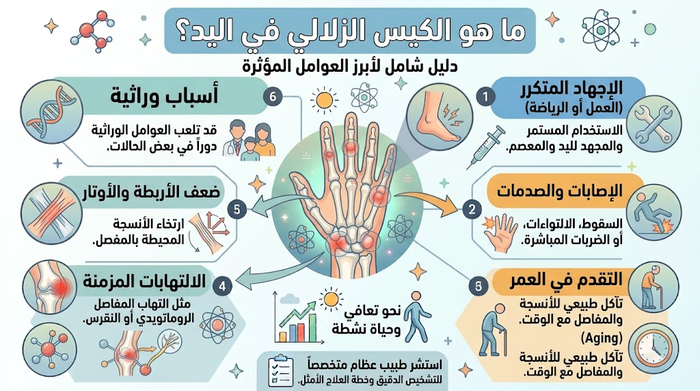
A ganglion cyst in the hand is a benign swelling that typically appears adjacent to joints or tendons. It is a fluid-filled sac containing clear, viscous fluid similar to synovial fluid — the lubricant of joints and tendon sheaths. It is not cancerous, but if it enlarges it can cause pain or nerve compression. Despite being a straightforward condition, it must be diagnosed by a specialist orthopaedic surgeon to avoid misdiagnosing a malignant tumour as a ganglion cyst.
Symptoms
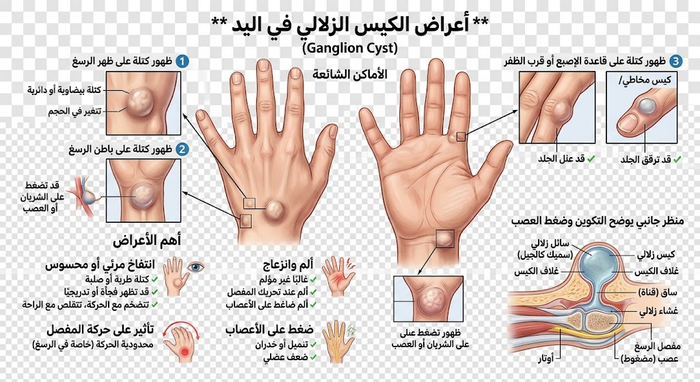
- Location: Most commonly around the wrist or hand joints; occasionally at the heel, foot, or other joints.
- Shape and size: Round or oval. Very small cysts may not be felt. Size can increase with movement and activity.
- Pain: Usually painless. If it presses on a nerve or tendon it can cause pain, tingling, or muscle weakness.
Symptom Classification by Severity
| Symptom | Severity | Impact on Daily Life | Recommended Action |
|---|---|---|---|
| Small, painless lump — no movement limitation | Mild | Cosmetic concern only | Monitoring every 6 months |
| Mild pain on direct pressure to cyst | Mild–moderate | Minimal impact | Assess within 2 weeks — splint or monitoring |
| Weak grip or hand fatigue | Moderate | Difficulty with manual work and writing | Assess within 1 week — splint or aspiration |
| Tingling or pins-and-needles in fingers | Moderate–severe | Functional hand impairment | Urgent evaluation — MRI |
| Visible finger weakness or grip failure | Severe | Clear motor disability | Immediate evaluation — nerve compression may require surgery |
| Rapidly growing or firm, non-mobile lump | Very urgent | Possible tumour — not a ganglion | Immediate evaluation — MRI + orthopaedic oncology |
| * Any tingling or muscle weakness requires urgent assessment — chronic nerve compression can cause permanent damage. Source: AAOS, Mayo Clinic, HSS. | |||
Diagnosis
The orthopaedic surgeon presses on the cyst to check for tenderness and shines a light on it to assess whether it is fluid-filled or solid. Imaging (X-ray, ultrasound, or MRI) may be ordered to confirm the diagnosis and rule out other conditions such as osteoarthritis or a tumour. If the cyst is large or growing, evaluation by an orthopaedic oncologist is recommended to exclude misdiagnosis of a tumour as a ganglion. Aspiration of fluid with a needle — which is thick, clear, and jelly-like — confirms the diagnosis.
🔴 Important Warning: Some malignant tumours in the hand appear clinically identical to a ganglion cyst — especially in early stages or when small. A firm, non-mobile, or rapidly growing lump must be evaluated by an orthopaedic oncologist immediately. Do not delay.
Differential Diagnosis — Hand and Wrist Lumps
| Lump Type | Common Location in Hand | Texture | Transillumination | Changes with Activity | Diagnostic Tool | Malignant Potential |
|---|---|---|---|---|---|---|
| Ganglion cyst | Dorsal wrist / volar wrist / finger base | Soft — fluid | Positive | Changes with rest | Clinical ± ultrasound | Zero |
| Lipoma | Any — more common in forearm | Soft, rubbery | Negative | No change | Ultrasound | Very low |
| Mucous cyst (digital) | DIP joint of fingers | Soft — fluid | Positive | Relatively stable | Clinical exam | Zero |
| Giant cell tumour of tendon sheath (GCTTS) | Along finger tendons | Firm | Negative | No change | MRI + biopsy | Rare |
| Soft tissue sarcoma | Deep in hand / forearm / arm | Firm, fixed | Negative | No change | MRI + mandatory biopsy | Yes — urgent surgery |
| Tenosynovitis | Along thumb or finger tendons | Diffuse swelling | Negative | Worsens with movement | Ultrasound + clinical | Zero — inflammation |
| * The key distinguishing feature of a ganglion: fluid + positive transillumination + size change with activity/rest. Any firm, non-mobile hand lump requires MRI and biopsy before any intervention. | ||||||
Hand Ganglion Cyst Locations — Site-Specific Guide
| Location in Hand | % of Hand Ganglions | Specific Symptoms | Nerve/Vessel Risk | Preferred Treatment |
|---|---|---|---|---|
| Dorsal wrist | 60–70% | Mild pain — interferes with keyboard / writing | Low | Observation or elective excision |
| Volar wrist | 15–20% | Pain on flexion — near radial artery | High — near artery and nerve | MRI essential before any intervention |
| Finger base (flexor tendon sheath) | 10–15% | Pain on gripping — small firm nodule | Moderate | Surgical excision recommended |
| Distal finger joint (DIP — mucous cyst) | ~10% | May press on nail root — nail deformity | Low | Excision when nail affected |
| * Volar wrist ganglion cysts require ultrasound and MRI pre-operatively to map the radial artery precisely. Source: AAOS, HSS, Journal of Hand Surgery. | ||||
Treatment — Side-by-Side Comparison
| Option | Ideal For | Symptom Relief Rate | Recurrence Rate | Recovery Time | Pros / Cons |
|---|---|---|---|---|---|
| Watchful waiting | < 1 cm, painless, no nerve compression | 30–50% resolve spontaneously | N/A | None | ✅ No risk — ⚠ Cyst may enlarge |
| Splint / compressive bandage | Activity-related painful cyst | Temporary relief | High when removed | Weeks | ✅ Non-invasive — ⚠ Muscle weakening with prolonged use |
| Aspiration | Large painful cyst — surgery declined | Immediate but temporary | 50–80% within weeks–months | 1 day | ✅ Simple — ⚠ Cyst wall remains — rapid refill |
| Open surgical excision | Recurrent / painful / nerve-compressing cyst | 85–95% | 10–15% with complete stalk removal | 2–6 weeks | ✅ Most effective — ⚠ Anaesthesia + small scar |
| Arthroscopic excision | Intra-articular wrist ganglion | 80–90% | 10–12% | 1–3 weeks | ✅ Smaller incision + faster recovery — ⚠ Requires arthroscopy expertise |
| * Recurrence rates from AAOS, Mayo Clinic, HSS, and Journal of Hand Surgery. Complete excision of the cyst stalk and capsule is the key to a durable cure — partial removal raises recurrence above 40%. | |||||
⚠ Key Point: Aspiration temporarily deflates the cyst because the cyst wall itself remains intact — the cyst typically refills within weeks to months. Recurrence after aspiration is 50–80%. Complete surgical excision with the stalk is the only path to permanent resolution.
Frequently Asked Questions
What is a ganglion cyst of the hand and wrist and how does it develop?
A ganglion cyst is the most common benign soft-tissue tumor of the hand and wrist:
- Pathophysiology: It originates from a focal herniation or weakness within a joint capsule, ligamentous interface, or tendon sheath.
- One-Way Valve Mechanism: Repetitive mechanical loading or micro-trauma forces synovial fluid through a tortuous duct (the stalk) into the periarticular tissue. The stalk acts as a one-way check valve, preventing the fluid from flowing back into the joint cavity.
- Viscous Gel: As water is resorbed by local capillaries, the trapped fluid concentrates into a clear, highly viscous mucin rich in hyaluronic acid, glucosamine, and albumin, encased by a dense fibrous pseudocapsule.
Where are ganglion cysts most frequently located on the hand and wrist?
Ganglion cysts arise adjacent to high-mobility carpal joints and tenosynovial sheaths:
- Dorsal Wrist (60% to 70%): Emerges predominantly over the scapholunate ligament between the extensor pollicis longus and extensor digitorum communis tendons.
- Volar Wrist (18% to 20%): Develops on the palmar aspect over the radioscaphoid or scaphotrapezial joint, closely abutting the radial artery and flexor carpi radialis.
- Volar Retinacular Cysts: Tiny, pea-sized, rigid nodules located at the base of fingers on the flexor tendon sheath (A1 pulley), causing focal tenderness when gripping steering wheels or tools.
- Mucous Cysts: Form at the dorsal aspect of the distal interphalangeal (DIP) joints, directly linked to underlying Heberden’s nodes and finger osteoarthritis.
What does a wrist ganglion cyst feel like during a physical examination?
Physical palpation demonstrates characteristic clinical findings:
- Texture & Consistency: Typically feels smooth, discrete, and elastic or rubbery. When internal fluid pressure is high, it can feel deceptively hard and non-compressible, often mistaken for an osseous prominence.
- Mobility: Moves slightly within the subcutaneous tissue but remains tethered at its base to the deeper capsule or tendon sheath.
- Surface Appearance: Overlying skin is unremarkable, unattached to the deeper mass, and free of inflammatory erythema or cutaneous pores.
What is an occult ganglion cyst of the wrist?
An occult ganglion is a clinically hidden source of persistent wrist pain:
- Anatomy: A tiny cyst (often only 2 to 5 mm) embedded deep within the dorsal joint capsule or intercarpal ligaments without creating a visible surface lump.
- Symptoms: Produces localized, deep dorsal wrist aching provoked by extreme extension, push-ups, or gym bench-pressing.
- Diagnosis: Undetectable on standard visual inspection; requires point-of-care high-frequency ultrasound (MSK US) or contrast-enhanced MRI to visualize the intra-capsular fluid pocket.
Why do ganglion cysts in the wrist cause dull aches, weakness, or tingling?
Symptoms result from anatomical crowding and mechanical pressure:
- Capsular Stretch: Full wrist extension or weight-bearing compresses the tense cyst against dorsal ligaments, stretching surrounding periarticular sensory fibers.
- Median Nerve Impingement: Volar cysts expanding near the carpal tunnel can compress the median nerve, causing carpal tunnel syndrome symptoms (numbness, nocturnal tingling in the thumb, index, and middle fingers).
- Ulnar Nerve Compression: Cysts expanding in or near Guyon’s canal cause hypothenar numbness and intrinsic grip weakness.
How does the transillumination test distinguish a ganglion cyst from a solid tumor?
Transillumination is a simple, highly reliable in-office diagnostic test:
- Execution: In a dimly lit clinic room, a focused fiberoptic light or clinical penlight is placed directly against the lateral margin of the mass.
- Positive Finding: The translucent, cell-free mucinous gel allows light to pass through unobstructed, causing the entire mass to glow brightly pink or red.
- Differential Value: Solid neoplasms (e.g., giant cell tumor of the tendon sheath, schwannoma, or lipoma) absorb light and remain dark, alerting the surgeon to perform advanced imaging before intervention.
Can a wrist ganglion cyst go away without surgery or needle aspiration?
Yes, natural regression is a well-documented clinical phenomenon:
- Natural history studies show that between 30% and 58% of wrist ganglion cysts resolve spontaneously without any medical intervention.
- Resolution occurs when everyday movement causes a micro-rupture in the thin cyst wall, dispersing the mucin into the subcutaneous space where it is resorbed, or when resting the wrist closes the one-way valve duct.
- If the cyst is asymptomatic and cosmetically acceptable, active observation (“watchful waiting”) is the recommended first-line approach.
What non-surgical treatment options are available for hand and wrist cysts?
Conservative therapies aim to relieve pressure and manage symptoms:
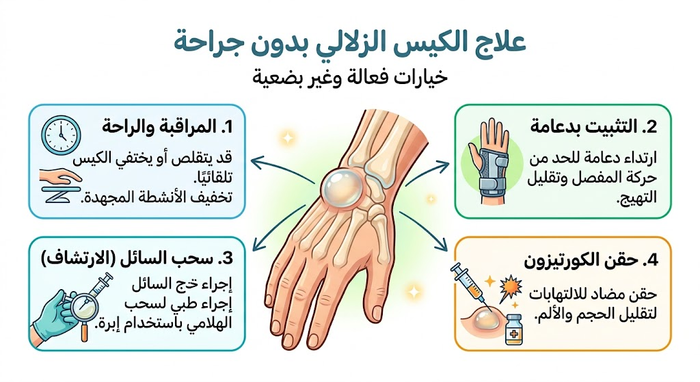
- Immobilization & Bracing: Wearing a light, contoured wrist splint during aggravating activities restricts excessive carpal excursion, decreasing fluid production.
- Sterile Needle Aspiration: Under local anesthesia, an 18-gauge needle evacuates the jelly-like fluid to collapse the mass immediately, occasionally followed by a low-dose corticosteroid injection.
- Recurrence Caveat: While aspiration provides rapid relief, recurrence rates exceed 50% because the deeper stalk, valve mechanism, and secretory lining remain intact.
How is surgical ganglionectomy performed, and what is the difference between open and arthroscopic excision?
Surgical ganglionectomy provides the most dependable cure against recurrence:
- Open Excision: Performed under regional block via a small transverse cosmetic incision. The surgeon dissects the mass, tracks the stalk down to its origin on the scapholunate ligament, and excises the cyst along with a small cuff of adjacent capsule to permanently seal the defect.
- Wrist Arthroscopy: An advanced minimally invasive approach using 2 mm puncture portals and a micro-camera inside the radiocarpal joint. The surgeon debrides the cyst stalk and intra-articular valve from within, leaving virtually no skin scar.
- Outcomes: Both techniques achieve success rates of 90% to 95%, with recurrence remaining below 5% to 10%.
Why is smashing a wrist ganglion with a heavy book (the ‘Bible bump’) strongly discouraged?
Striking the cyst with a heavy object is medically hazardous and counterproductive:
- Skeletal & Tendon Trauma: Blunt impact can cause acute fractures in small carpal bones (such as the scaphoid or lunate) or tear delicate extensor tendon slips.
- Neurovascular Damage: For volar wrist cysts, forceful impact can severely contuse or rupture the adjacent radial artery and branches of the median nerve.
- Ineffective Long-Term: Blunt trauma ruptures only the superficial dome; the cellular stalk and one-way valve remain functional, causing the cyst to refill within weeks.
References
- AAOS OrthoInfo. Ganglion Cyst of the Wrist and Hand. 2023. Available at: orthoinfo.aaos.org
- Mayo Clinic Staff. Ganglion cyst – Symptoms and causes. 2023. Available at: mayoclinic.org
- Mayo Clinic Staff. Ganglion cyst – Diagnosis and treatment. 2023. Available at: mayoclinic.org
- Cleveland Clinic. Ganglion Cyst: Causes, Symptoms, Diagnosis & Treatment. 2023. Available at: my.clevelandclinic.org
- Hospital for Special Surgery (HSS). Ganglion Cysts: Causes, Symptoms & Treatment. 2023. Available at: hss.edu
- Medscape. Ganglion Cyst Treatment & Management. 2024. Available at: emedicine.medscape.com
- Gregush RE, Habusta SF. Ganglion Cyst. StatPearls. 2024. Available at: ncbi.nlm.nih.gov
- Thornburg LE. Ganglions of the hand and wrist. Journal of the American Academy of Orthopaedic Surgeons. 1999;7(4):231–238. DOI: 10.5435/00124635-199907000-00004