
Quick answer
After carpal tunnel release you go home the same day and move your fingers immediately. Night numbness usually improves within days, stitches come out at 10–14 days, desk work resumes in 1–2 weeks and heavy manual work in 4–6 weeks. Mild swelling and pain at the base of the palm are normal and can last weeks; fever, redness, discharge or worsening numbness need prompt review.
✅ Last medically reviewed by Prof. Dr. Ibrahim Shaarawi, Professor of Orthopaedic Surgery, on 5 October 2026
The questions I hear most after surgery are “When can I use my hand?” and “Is this pain normal?”. Here is everything you need to know after carpal tunnel release and hand nerve surgery, based on my practice and current evidence.
Recovery timeline
| Time | What happens | What to do |
|---|---|---|
| Day of surgery | Home the same day with a dressing | Keep the hand raised above heart level and move the fingers |
| Days 1–3 | Mild pain and swelling; night numbness improves | Simple pain relief, keep the dressing dry |
| Weeks 1–2 | Pain settles; stitches out at 10–14 days | Light use, desk work |
| Weeks 2–6 | Pillar pain and scar tenderness may persist | Scar massage once healed, avoid heavy loads |
| 6–12 weeks | Grip strength returns gradually | Return to manual work and sport |
| 3–12 months | Persistent numbness and weakness improve in advanced cases | Follow-up; the nerve may recover slowly |
Tips after surgery
- Elevate the hand for the first 48 hours to limit swelling.
- Move your fingers fully several times a day from day one.
- Keep the wound clean and dry until the stitches are removed.
- Avoid heavy lifting and pressure on the palm for several weeks.
- Light writing and phone use are fine within days.
- Drive when you can grip the wheel safely, usually after one to two weeks.
- Massage the scar gently once healed.
Video: median nerve release surgery
What does the hand look like after surgery?
With the usual mini-open technique the scar is in the palm, about 2–3 cm long, along a natural crease. It is red at first and fades over months. The endoscopic approach leaves a smaller scar at the wrist crease — compare them in endoscopic vs mini-open carpal tunnel release.
Normal and abnormal symptoms
Normal
- Mild swelling of the hand and fingers in the first days.
- Pillar pain on either side of the scar, especially on pressure, which can last weeks to months.
- Scar sensitivity or tightness.
- Some residual numbness if the entrapment was long-standing or severe — it improves slowly.
- Temporary weakness of grip.
Call your surgeon if you notice
- Fever, spreading redness or discharge from the wound.
- Severe swelling or pain that is getting worse.
- Increasing numbness or new weakness.
- Severe pain with skin colour change and hypersensitivity (possible complex regional pain syndrome).
Key numbers to know
- Carpal tunnel syndrome is the most common peripheral nerve entrapment worldwide (Padua et al., Lancet Neurology 2016).
- In a Cochrane review of 14 randomised trials (1,231 patients, 84% women), surgery roughly doubled the chance of long-term improvement compared with splinting, and 44% of the splint group were later referred for surgery (Lusa et al., Cochrane 2024).
- A steroid injection clearly improved symptoms at 10 weeks, but 73% of patients given the higher dose still had surgery within a year, versus 92% after placebo (Atroshi et al., Annals of Internal Medicine 2013).
- Across 28 studies (2,586 hands), endoscopic and open release had the same long-term results; endoscopic patients returned to work about 8 days sooner, with 45% fewer minor complications (Vasiliadis et al., Cochrane 2014).
| Treatment | When we use it | What to expect |
|---|---|---|
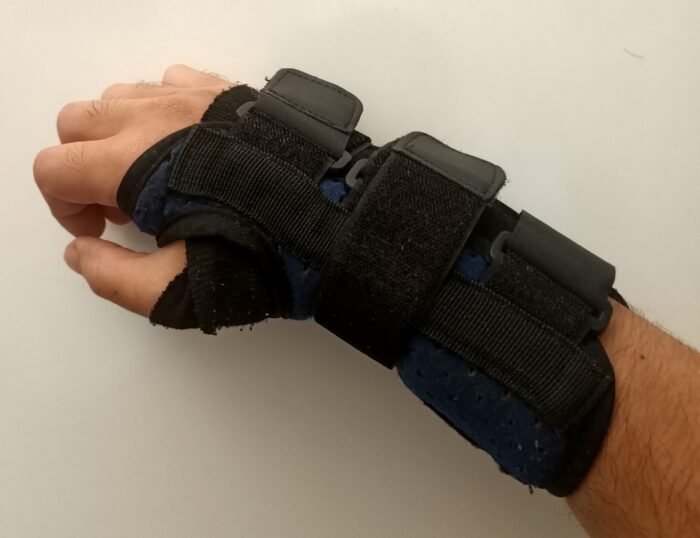
| Night wrist splint | Mild and moderate cases, especially night-time numbness | Reduces night waking for many patients within weeks |
| Activity changes and nerve gliding | Alongside every stage | Supports treatment but does not replace surgery in severe cases |
| Steroid injection | Mild and moderate cases, or when a splint is not enough | Clear relief within weeks; symptoms may return |
| Mini-open carpal tunnel release | Moderate to severe cases, thumb muscle wasting, or failed conservative care | Usually under local anaesthesia as a day case; night numbness improves quickly |
| Endoscopic release | Selected cases | Same long-term results with a slightly faster return to work |
At Prof. Dr. Ibrahim Shaarawi’s clinics in Nasr City, Mohandeseen and New Cairo (5th Settlement) we examine the hand and review your nerve study at the same visit, confirming where and how badly the nerve is trapped before choosing a splint, injection or release.
Do you need physiotherapy?
Most patients recover with simple home exercises; a Cochrane review found no strong evidence that routine formal rehabilitation benefits everyone. Therapy helps with stiffness, marked weakness or advanced cases. For long-term results see carpal tunnel release success rate.
Frequently asked questions after carpal tunnel release
When can I use my hand after carpal tunnel surgery?
Finger movement starts on day one, light tasks within days, desk work within one to two weeks and heavy work within four to six weeks.
Is swelling after carpal tunnel release normal?
Yes, mild swelling is normal in the first days and improves with elevation and finger movement. Severe swelling with increasing pain or redness needs review.
When does numbness go after surgery?
Night numbness usually improves within days; constant numbness in advanced cases can take months and may not fully resolve if the nerve was badly damaged.
Why does the base of my palm hurt after surgery?
This is pillar pain, caused by healing tissues on either side of the incision, and it gradually settles over weeks to months.
When are stitches removed?
Usually 10–14 days after surgery, depending on wound healing.
To have your hand assessed and your nerve tests reviewed, book a consultation, call +20 155 240 4488 or message us on WhatsApp at +20 155 554 7181.
Medically reviewed by Prof. Dr. Ibrahim Shaarawi, Professor of Orthopaedic Surgery. This article is general medical education and does not replace an examination or the treatment plan your surgeon sets for you. See our medical disclaimer.
Related hand nerve and tendon guides
Related guides on carpal tunnel surgery:
- Carpal tunnel release and hand nerve surgery
- Endoscopic vs mini-open carpal tunnel release
- Carpal tunnel release success rate
- Carpal tunnel release cost in Egypt
References
- Peters S, et al. Rehabilitation following carpal tunnel release. Cochrane Database Syst Rev. 2016;2(2):CD004158.
- Louie D, et al. Long-term outcomes of carpal tunnel release: a critical review of the literature. Hand (N Y). 2012;7(3):242-6.
- Padua L, et al. Carpal tunnel syndrome: clinical features, diagnosis, and management. Lancet Neurol. 2016;15(12):1273-1284.
- Zuo D, et al. Endoscopic versus open carpal tunnel release for idiopathic carpal tunnel syndrome: a meta-analysis of randomized controlled trials. J Orthop Surg Res. 2015;10:12.
- American Academy of Orthopaedic Surgeons (OrthoInfo). Carpal Tunnel Syndrome.