
Quick answer
Osteomalacia is defective mineralisation of bone in adults: bone matrix is laid down but calcium and phosphate are not deposited in it properly, so bone becomes soft and painful. The most common cause is severe, long-standing vitamin D deficiency. Unlike osteoporosis — which is silent until a fracture and usually has normal blood tests — osteomalacia causes diffuse bone pain, muscle weakness and abnormal blood tests. When caused by vitamin D deficiency it is curable.
✅ Last medically reviewed by Prof. Dr. Ibrahim Shaarawi, Professor of Orthopaedic Surgery, on 5 October 2026
Patients often come to me with “pain in every bone” and difficulty climbing stairs, having been told it is rheumatism or nerves. Blood tests then reveal osteomalacia caused by vitamin D deficiency. This article explains this frequently missed condition and how it differs from osteoporosis.
What is osteomalacia?
Bone is a protein (collagen) framework onto which calcium and phosphate are deposited to harden it. In osteomalacia the framework forms but mineralisation lags behind, leaving soft, weak bone. In children the same process also affects the growth plates and is called rickets in children.
Symptoms
- Diffuse bone pain, especially in the lower back, pelvis, hips, legs and ribs, worse on standing and walking.
- Bone tenderness when the shin or ribs are pressed.
- Proximal muscle weakness: trouble rising from a chair, climbing stairs or lifting the arms.
- A waddling gait in advanced cases.
- Cramps and tingling around the mouth if calcium is low.
- Fractures or pseudofractures after minor strain, especially of the femoral neck, pelvis and ribs.
Because the symptoms are vague, many patients are misdiagnosed with fibromyalgia. See vitamin D deficiency and bone and joint pain for how the pain patterns differ.
Video: the 50,000 IU vitamin D dose
Causes
| Cause | Examples | Notes |
|---|---|---|
| Vitamin D deficiency | Little sun, covered clothing, darker skin, obesity, older age | The most common cause worldwide and in Egypt |
| Malabsorption | Bariatric surgery, coeliac disease, Crohn’s disease, bowel resection | Needs higher doses and follow-up |
| Kidney and liver disease | Chronic kidney disease, cirrhosis | May need active forms of vitamin D |
| Medicines | Some anticonvulsants and other long-term drugs | Review with your doctor |
| Phosphate loss | Rare inherited disorders, small tumours secreting a phosphate-wasting hormone | Does not respond to vitamin D alone |
| Very low dietary calcium | Diets poor in dairy | Often combined with vitamin D deficiency |
Diagnosis
Blood tests
- 25-hydroxyvitamin D: usually very low in nutritional osteomalacia.
- Alkaline phosphatase (ALP): raised — a key marker.
- Calcium and phosphate: low or low-normal.
- Parathyroid hormone: raised in response to low calcium.
- Kidney and liver function, and coeliac screening when suspected.
X-rays
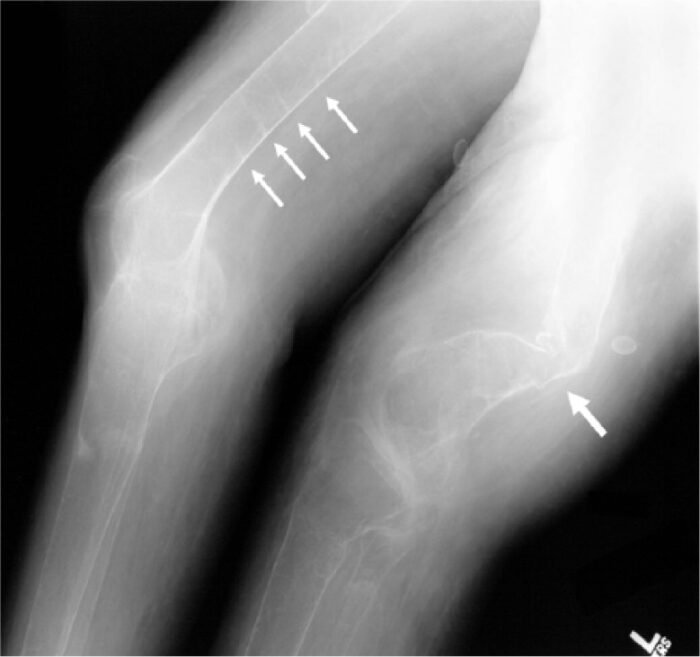
The hallmark is Looser zones (pseudofractures): lucent bands perpendicular to the bone cortex in the femoral neck, pubic rami, ribs and scapula. A bone density scan can be low and mistaken for osteoporosis, so osteomalacia must be excluded before osteoporosis drugs are started.
Osteomalacia vs osteoporosis
| Osteomalacia | Osteoporosis | |
|---|---|---|
| Core problem | Soft, poorly mineralised bone | Mineralised but thin, porous bone |
| Pain | Diffuse pain and weakness before fractures | Usually painless until a fracture |
| Blood tests | Low vitamin D, high ALP, low phosphate | Usually normal |
| X-ray | Looser zones, pseudofractures | Spinal, wrist and hip fractures |
| Treatment | Vitamin D, calcium and treating the cause | Osteoporosis drugs plus vitamin D and calcium |
| Outlook | Usually curable | Chronic, controlled with treatment |
The two can coexist, especially in older people. Osteoporosis injections such as the 6-monthly osteoporosis injection (Prolia) or zoledronic acid should not be started before vitamin D and calcium are corrected, because dangerous hypocalcaemia can result.
Key numbers to know
- In a study of Egyptian women of childbearing age, 43% were vitamin D deficient and 13% insufficient; only 44% had normal levels (Gerges et al., 2021).
- The Endocrine Society (2024) suggests vitamin D supplements for children aged 1–18 to prevent rickets, for adults over 75, and during pregnancy (Demay et al., Endocrine Society 2024).
| Treatment | When we use it | Notes |
|---|---|---|
| Treatment doses of vitamin D with calcium | Osteomalacia or rickets due to vitamin D deficiency | Pain and blood tests improve over weeks to months |
| Treating the cause | Malabsorption, kidney or liver disease, certain medicines | Essential to prevent recurrence |
| Follow-up blood tests and X-rays | Throughout treatment | Calcium, phosphate, alkaline phosphatase and vitamin D |
| Surgical correction of bowing | Severe bowing that persists after treating the cause (rare) | Most cases improve with medical treatment |
At Prof. Dr. Ibrahim Shaarawi’s clinics in Nasr City, Mohandeseen and New Cairo (5th Settlement) we review your vitamin D, calcium and bone density results and examine the cause of pain or fracture before deciding on the right dose or osteoporosis treatment.
Treatment
- Vitamin D repletion at treatment doses set by your doctor, e.g. 50,000 IU weekly for 8 weeks or 6,000 IU daily, then maintenance; malabsorption may need higher doses or vitamin D injections.
- Calcium to reach 1,000–1,200 mg daily from food and supplements.
- Treating the cause: gluten-free diet in coeliac disease, medication review, kidney care.
- Fracture care if needed — a femoral neck fracture may need surgical fixation.
- Physiotherapy to rebuild muscle strength once pain settles.
Pain and weakness usually improve within weeks, while full bone mineralisation takes several months. We monitor blood tests every few months until they normalise.
Frequently asked questions about osteomalacia
What causes osteomalacia?
Most often severe, long-standing vitamin D deficiency, followed by malabsorption after bariatric surgery or coeliac disease, kidney and liver disease, some medicines and phosphate-wasting disorders.
Is osteomalacia the same as osteoporosis?
No. Osteomalacia is soft, poorly mineralised bone with pain, weakness and abnormal blood tests; osteoporosis is low bone mass that is painless until a fracture and usually has normal tests.
Does osteomalacia cause joint pain?
It mainly causes pain in the bones themselves — back, pelvis and legs — which may be felt around joints. Localised joint pain with stiffness usually has another cause such as osteoarthritis.
Can osteomalacia be cured?
Yes, in most cases caused by vitamin D deficiency; pain improves within weeks and bone heals over months with treatment and follow-up.
Which tests diagnose osteomalacia?
25-hydroxyvitamin D, calcium, phosphate, alkaline phosphatase, parathyroid hormone and kidney function, plus X-rays of painful areas.
To have your bones assessed and your tests reviewed, book a consultation, call +20 155 240 4488 or message us on WhatsApp at +20 155 554 7181.
Medically reviewed by Prof. Dr. Ibrahim Shaarawi, Professor of Orthopaedic Surgery. This article is general medical education and does not replace an examination or the treatment plan your doctor sets for you. See our medical disclaimer.
Related vitamin D and bone health guides
Related guides on osteomalacia and vitamin D:
- Vitamin D deficiency
- Vitamin D injections
- Vitamin D deficiency and bone and joint pain
- Rickets in children
- Calcium injections for bones
- Vitamin D for infants and children
- The best vitamins for bones and joints
- Osteoporosis
- The bone density (DEXA) test
References
- Bhan A, et al. Osteomalacia as a result of vitamin D deficiency. Endocrinol Metab Clin North Am. 2010;39(2):321-31.
- Minisola S, et al. Osteomalacia and Vitamin D Status: A Clinical Update 2020. JBMR Plus. 2021;5(1):e10447.
- Uday S, Högler W. Nutritional Rickets and Osteomalacia in the Twenty-first Century: Revised Concepts, Public Health, and Prevention Strategies. Curr Osteoporos Rep. 2017;15(4):293-302.
- Demay MB, et al. Vitamin D for the Prevention of Disease: An Endocrine Society Clinical Practice Guideline. J Clin Endocrinol Metab. 2024;109(8):1907-1947.
- Holick MF, et al. Evaluation, treatment, and prevention of vitamin D deficiency: an Endocrine Society clinical practice guideline. J Clin Endocrinol Metab. 2011;96(7):1911-30.
- Kanis JA, et al. European guidance for the diagnosis and management of osteoporosis in postmenopausal women. Osteoporos Int. 2019;30(1):3-44.