
Quick answer
Exercises after knee replacement start on day one: ankle pumps, thigh squeezes, straight-leg raises and gradual knee bending. The aim is about 90° of bending in the first weeks with a fully straight knee, then strengthening and walking. Regular home exercise works as well as clinic sessions for most patients.
✅ Last medically reviewed by Prof. Dr. Ibrahim Shaarawi, Professor of Orthopaedic Surgery, on 12 October 2026
Exercise is half the success of the operation. The new joint works well, but the muscles and tissues around it need training to regain movement and strength. This is the staged programme we use with our patients, part of our guide to total knee replacement surgery. Stop any exercise that causes sharp pain and ask your surgeon.
Phase 1: weeks 1–2
- Ankle pumps: move the foot up and down 20 times every hour.
- Thigh squeezes: press the back of the knee into the bed for 5 seconds, 10 times.
- Straight-leg raises: lift the leg 20 cm with the thigh tight, 10 times.
- Heel slides: slide the heel towards your bottom, 10 times.
- Knee straightening: rest a towel under the ankle and let the knee straighten for 5 minutes.
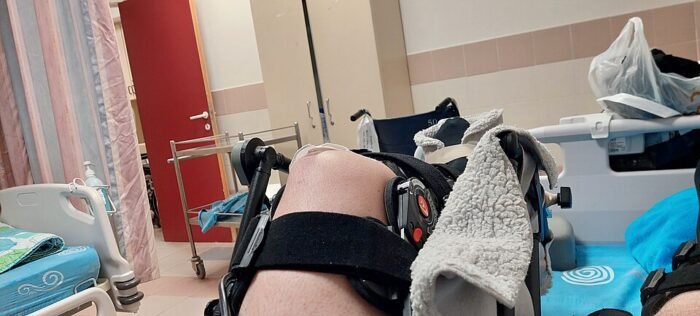
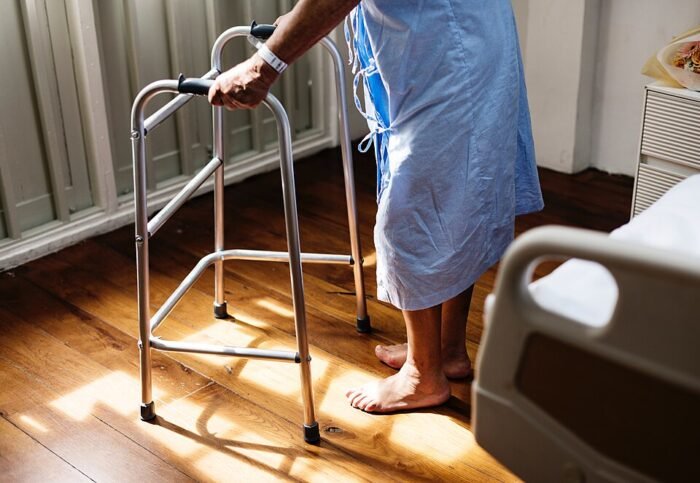
Phase 2: weeks 3–6
- Seated knee bends, sliding the foot back under the chair.
- Single steps up and down in the right order (up with the good leg, down with the operated one).
- A static bike without resistance once bending allows.
- Increasing walking distances indoors, then outdoors.
- Standing weight shifts for balance.
In this phase we move from the frame to a stick and then to walking unaided, as in walking after knee replacement.
Video: Walking on the same day as knee replacement
Phase 3: months 2–3 and beyond
- Supported mini-squats.
- Climbing stairs foot over foot.
- Static cycling with light resistance.
- Single-leg balance exercises.
- Brisk walking and swimming once the wound has healed.
Key numbers to know
- Across 18 randomised trials (1,739 patients), physiotherapy improved function and pain at 3–4 months after knee replacement, and home exercise worked as well as clinic sessions (Artz et al., 2015).
- In a randomised trial, knee replacement improved pain and function by 18.3 points more than non-surgical care alone, yet two in three eligible patients delayed surgery for at least two years with structured non-surgical treatment (Skou et al., 2018).
At Prof. Dr. Ibrahim Shaarawi’s clinics in Nasr City, Mohandeseen and New Cairo (5th Settlement) we examine the knee and review standing X-rays at the same visit, then decide on conservative care, osteotomy, or a partial or total knee replacement according to the arthritis grade, your age and activity.
How far should the knee bend?
| Time after surgery | Target bend |
|---|---|
| End of week 1 | 70–80° |
| End of week 3 | 90° |
| End of month 3 | 110° or more |
Full straightening matters as much as bending; a knee that will not straighten makes walking tiring. If bending has not improved by 6 weeks despite exercise, see your surgeon to assess stiffness.
Common mistakes
- Skipping exercise for fear of pain — take your painkiller half an hour before.
- Sleeping with a pillow under the knee, which lets it stiffen bent.
- Overdoing it one day and stopping for days.
- Long periods sitting still.
For the full recovery timeline see knee replacement recovery time, and for daily-life tips tips after knee replacement.
Looking for an experienced knee surgeon? Read our guides to the best knee specialist in Egypt and the best orthopaedic surgeon in Egypt to see how to choose.
Frequently asked questions about exercises after knee replacement
When do I start exercising after surgery?
On day one: ankle pumps and thigh squeezes, then gradual bending supervised by a physiotherapist.
Do I need physiotherapy at a centre?
Most patients do well with regular home exercise once it is taught well; we add centre sessions if progress is slow or the knee is stiff.
How often should I exercise each day?
Usually 2–3 times a day for 20–30 minutes in the early weeks, plus frequent short walks.
Is pain during exercise normal?
Stretching and mild pain are expected; sharp pain or marked swelling afterwards means easing off and checking with your surgeon.
When can I return to sport?
Walking, swimming and cycling usually after 6–12 weeks; we avoid running, jumping and contact sports.
To have your knee assessed and your X-rays reviewed, book a consultation, call +20 155 240 4488 or message us on WhatsApp at +20 155 554 7181.
Medically reviewed by Prof. Dr. Ibrahim Shaarawi, Professor of Orthopaedic Surgery. This article is general medical education and does not replace an examination or the treatment plan your surgeon sets for you. See our medical disclaimer.
Related knee replacement guides
Guides to help during rehabilitation:
- Total knee replacement surgery
- Knee replacement recovery time
- Walking after knee replacement
- Tips after knee replacement
- When you need a knee replacement
- Knee replacement cost in Egypt
- Knee replacement success rate
References
- Artz N, et al. Effectiveness of physiotherapy exercise following total knee replacement: systematic review and meta-analysis. BMC Musculoskelet Disord. 2015;16:15.
- Skou ST, et al. Total knee replacement and non-surgical treatment of knee osteoarthritis: 2-year outcome from two parallel randomized controlled trials. Osteoarthritis Cartilage. 2018;26(9):1170-1180.
- American Academy of Orthopaedic Surgeons (OrthoInfo). Total Knee Replacement Exercise Guide.
- NHS. Knee replacement.