
Quick answer
A partial knee replacement (unicompartmental) replaces only the worn part of the knee — usually the inner side — and keeps the ligaments and healthy compartments. It suits arthritis confined to one compartment with an intact ACL, and gives a faster recovery and a more natural-feeling knee, while total knees last longer on average.
✅ Last medically reviewed by Prof. Dr. Ibrahim Shaarawi, Professor of Orthopaedic Surgery, on 12 October 2026
Not everyone with knee arthritis needs the whole joint replaced. When wear is limited to half of the knee and the rest is healthy, that part alone can be resurfaced. Here is who suits a partial knee and how it compares with a total knee, as part of our guide to total knee replacement surgery.
What is a partial knee and how does it differ from a total knee?
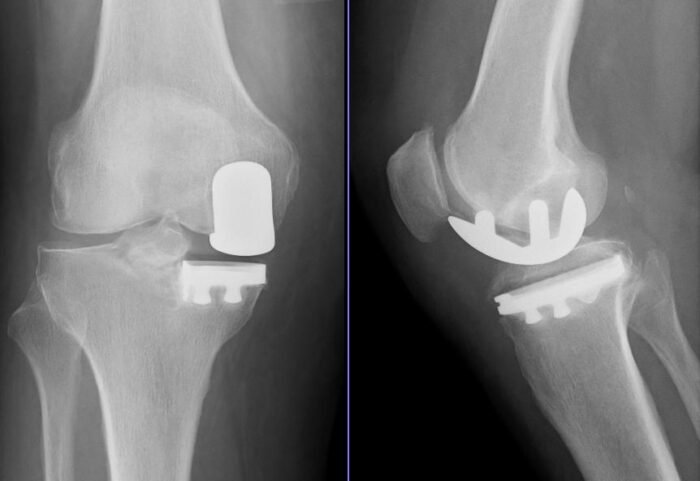
The knee has three compartments: inner, outer and behind the kneecap. A total knee resurfaces all of them; a partial knee replaces only the worn compartment with a small metal-and-plastic implant, keeping both cruciate ligaments and the healthy cartilage elsewhere.
| Partial knee | Total knee | |
|---|---|---|
| What is replaced | One compartment | All joint surfaces |
| Incision and blood loss | Smaller | Larger |
| Recovery | Usually faster | A little longer |
| How the knee feels | Closer to natural | Good, sometimes feels artificial |
| 25-year survival (registries) | About 70% | About 82% |
| Who it suits | One-compartment arthritis, healthy ligaments | Arthritis in several compartments or major deformity |
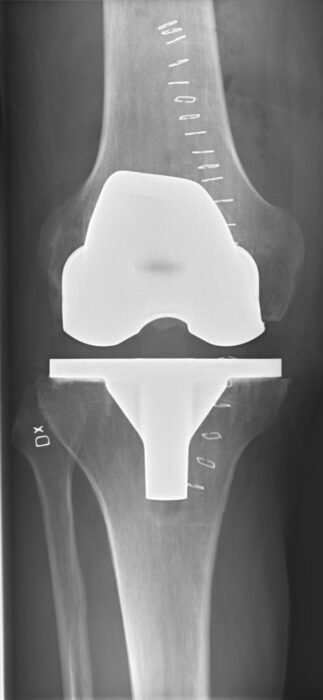
Who is suitable for a partial knee replacement?
- Arthritis limited to the inner (or outer) compartment on X-ray.
- An intact anterior cruciate ligament and a stable knee.
- Mild, correctable bowing and good knee movement.
- No inflammatory arthritis affecting the whole joint.
It does not suit arthritis in more than one compartment, a torn ACL or a very stiff knee. Sometimes the final decision is made during surgery after seeing the cartilage directly.
Video: Treating knee arthritis with a modern artificial joint, and recovery after surgery
Key numbers to know
- In the TOPKAT trial of 528 patients, partial and total knee replacement gave similar function at 5 years, with partial knees costing less and having similar reoperation and complication rates (Beard et al., The Lancet 2019).
- Partial knees had fewer post-operative complications, but survival at 7 years was 80.9% versus 95.7% for total knees in a large cohort (Hansen et al., 2019).
- National registry data show that 82% of total knee replacements last 25 years, compared with 70% of partial knee replacements (Evans et al., The Lancet 2019).
| Treatment | When we use it | What to expect |
|---|---|---|
| Conservative care: exercise, weight loss, topical pain relief | Grade 1–3 arthritis | Better pain and movement; many patients delay surgery |
| Joint injections (steroid, hyaluronic acid or PRP) | Persistent pain despite conservative care | Temporary relief that varies between patients |
| High tibial osteotomy (HTO) | Active patients under 60 with bow legs and arthritis on the inner side only | Realigns the leg and keeps the natural knee |
| Partial knee replacement | Arthritis limited to one compartment with healthy ligaments | Faster recovery and a more natural-feeling knee |
| Total knee replacement | Severe (grade 4) arthritis with pain limiting daily life | Pain usually resolves; walking on day 1–2 |
| Revision knee replacement | Loosening, infection or instability of a previous knee replacement | Bigger surgery with special components to restore stability |
At Prof. Dr. Ibrahim Shaarawi’s clinics in Nasr City, Mohandeseen and New Cairo (5th Settlement) we examine the knee and review standing X-rays at the same visit, then decide on conservative care, osteotomy, or a partial or total knee replacement according to the arthritis grade, your age and activity.
Advantages and drawbacks
Advantages
- Smaller incision, less bleeding and less pain.
- Better movement and a more natural feel.
- Fewer general complications and a shorter hospital stay.
Drawbacks
- A higher long-term chance of revision than a total knee.
- Other compartments may wear over time, needing conversion to a total knee.
- Requires surgical precision and careful patient selection.
Partial knee or high tibial osteotomy (HTO)?
For younger, active patients with bow legs and inner-side arthritis, osteotomy keeps the natural knee entirely. For those over 60 with moderate activity, a partial knee usually relieves pain better. Details in alternatives to knee replacement.
Recovery and cost
Most patients walk with a frame on the first day, and many return to daily activities sooner than after a total knee. Cost depends on the implant and hospital — see the knee replacement cost in Egypt (EGP 120,000–200,000 for a total knee). For the full timeline see knee replacement recovery time.
Looking for an experienced knee surgeon? Read our guides to the best knee specialist in Egypt and the best orthopaedic surgeon in Egypt to see how to choose.
Frequently asked questions about partial knee replacement
Is a partial knee better than a total knee?
Not for everyone; it is best when arthritis is in one compartment and the ligaments are healthy, giving faster recovery, while total knees last longer on average.
How long does a partial knee last?
Registry data suggest about 70% of partial knees are working at 25 years, compared with about 82% of total knees.
Can a partial knee be converted to a total knee later?
Yes — if other compartments wear or the implant loosens, it can be revised to a total knee.
Is a partial knee suitable for older people?
Yes, if arthritis is confined and the ligaments are intact; the faster recovery is an advantage in older adults.
Do you perform partial knee replacement?
Yes. We perform partial (unicompartmental) knee replacement for suitable patients after examination and standing X-rays.
To have your knee assessed and your X-rays reviewed, book a consultation, call +20 155 240 4488 or message us on WhatsApp at +20 155 554 7181.
Medically reviewed by Prof. Dr. Ibrahim Shaarawi, Professor of Orthopaedic Surgery. This article is general medical education and does not replace an examination or the treatment plan your surgeon sets for you. See our medical disclaimer.
Related knee replacement guides
Guides to help you compare the options:
- Total knee replacement surgery
- When you need a knee replacement
- Alternatives to knee replacement
- Knee replacement cost in Egypt
- Knee replacement success rate
- Knee replacement recovery time
References
- Beard DJ, et al. The clinical and cost-effectiveness of total versus partial knee replacement in patients with medial compartment osteoarthritis (TOPKAT): 5-year outcomes of a randomised controlled trial. Lancet. 2019;394(10200):746-756.
- Hansen EN, et al. Unicondylar Knee Arthroplasty Has Fewer Complications but Higher Revision Rates Than Total Knee Arthroplasty in a Study of Large United States Databases. J Arthroplasty. 2019;34(8):1617-1625.
- Evans JT, et al. How long does a knee replacement last? A systematic review and meta-analysis of case series and national registry reports with more than 15 years of follow-up. Lancet. 2019;393(10172):655-663.
- Ma X, et al. High tibial osteotomy versus unicompartmental knee arthroplasty for medial compartment knee osteoarthritis: a comprehensive meta-analysis with patient-specific stratification by age, BMI, and preoperative activity levels. BMC Musculoskelet Disord. 2026;27(1).
- American Academy of Orthopaedic Surgeons (OrthoInfo). Unicompartmental Knee Replacement.