
A meniscus tear is one of the most common knee injuries — and one of the most misunderstood. The diagnosis immediately conjures images of operating rooms and months on crutches. But here is the reality that evidence-based orthopedics has reinforced over the past decade: Non-Surgical Treatment for a Meniscus Tear is not wishful thinking — it is the first-line approach for a substantial proportion of patients, and a successful one.
If you have been diagnosed with a meniscus tear, or if knee pain is pointing in that direction, this guide covers the anatomy behind the injury, there is Non-Surgical Treatment for a Meniscus Tear, and how structured rehabilitation gets you back to full activity.
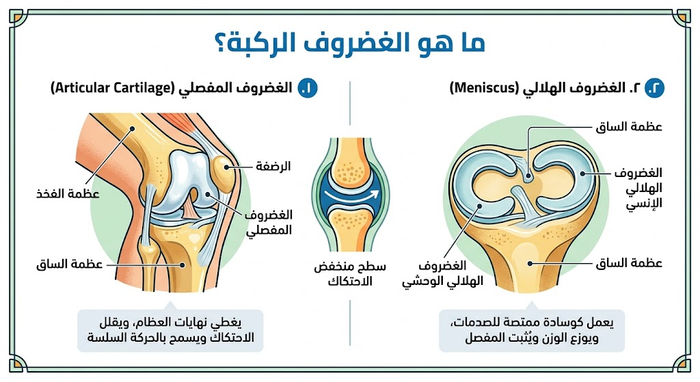
What Is the Knee Meniscus?
Each knee contains two C-shaped wedges of fibrocartilage — a medial (inner) and a lateral (outer) meniscus. Together, they serve three critical functions:
- Shock absorption: distributing compressive forces during walking, running, and jumping across the joint surface rather than concentrating them on one point
- Joint stability: deepening the tibial plateau to prevent the femur from sliding
- Lubrication: facilitating smooth articular cartilage gliding
When a meniscus tears, one or more of these functions is compromised — but the degree of compromise depends entirely on the tear’s type, location, and size.
Symptoms of a Meniscus Tear
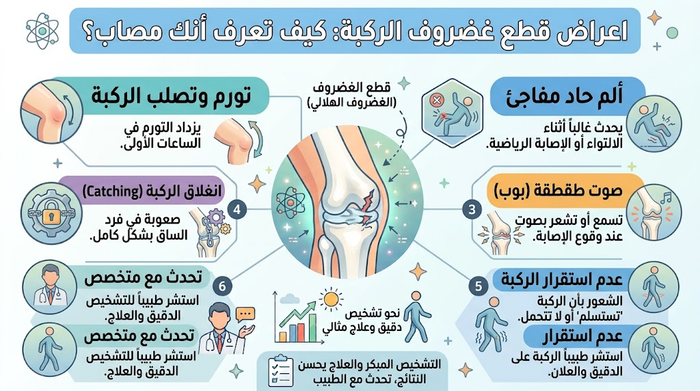
Symptoms vary with tear severity. Small degenerative tears may cause no symptoms for weeks, while large traumatic tears produce immediate pain. The most common signs include:
- Pain: especially with twisting or deep knee flexion
- Swelling: typically developing within 24 to 48 hours
- A “pop” at the moment of injury
- Mechanical locking: the knee catches or cannot fully extend — a displaced fragment is physically blocking movement
- Giving way: a sensation that the knee is about to buckle
- Joint-line tenderness: pain with palpation along the medial or lateral joint line
Meniscus Tear Grading
MRI grading guides — but does not dictate — treatment decisions:
- Grade I and II: intrasubstance signal changes that do not extend to the articular surface. These are not true tears in the surgical sense and respond well to conservative management.
- Grade III: signal extending to the articular surface — a true tear. Even here, small stable grade III tears, particularly in older patients, can be managed without surgery.
Does Every Meniscus Tear Need Surgery?
No. The decision hinges on three factors beyond the MRI image:
1. Vascular zone. The outer third of the meniscus (the “red zone”) has blood supply and the potential to heal. The inner two-thirds (the “white zone”) does not, so tears here cannot regenerate — but they can become asymptomatic with rehabilitation.
2. Degenerative versus traumatic origin. Degenerative tears — the kind that develop gradually in patients over 45 — are part of the ageing process, much like skin wrinkles. Multiple randomized controlled trials have shown that arthroscopic surgery for degenerative tears offers no long-term advantage over structured physiotherapy.
3. Mechanical symptoms. The decisive clinical question is whether the knee locks — physically unable to fully flex or extend because a displaced fragment is obstructing the joint. Without locking, the likelihood of successful conservative treatment is high.
Non-Surgical Treatment for a Meniscus Tear
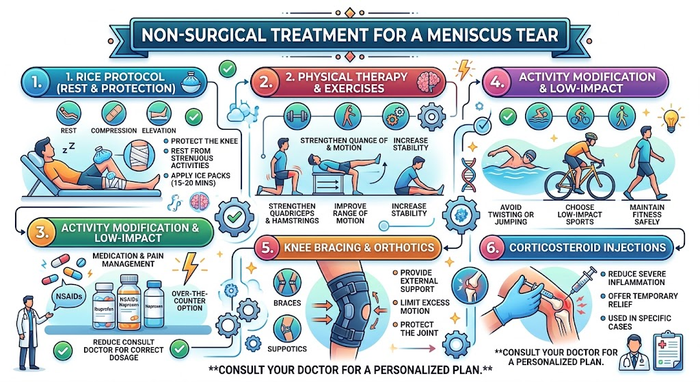
Phase 1 — Acute Management (R.I.C.E Protocol)
Rest from aggravating activities (not complete bed rest), ice application for 15 minutes several times daily, compression bandaging, and leg elevation to control swelling.
Phase 2 — Medications
Medications manage symptoms to enable rehabilitation — they do not repair the tear:
- NSAIDs (ibuprofen, naproxen): reduce pain and inflammation
- Corticosteroid injection: rapidly suppresses severe inflammation when oral medications are insufficient, opening a window for physiotherapy
- Hyaluronic acid injection: provides viscosupplementation when concurrent cartilage wear is present
- PRP (Platelet-Rich Plasma): may promote a healing environment in red-zone tears — evidence is promising but not yet definitive
Phase 3 — Physiotherapy: The Cornerstone
The goal is not to strengthen the meniscus — cartilage does not strengthen — but to build the muscular framework around it so the knee functions despite the tear:
- Quadriceps strengthening: the single most important muscle group for knee support. Exercises include isometric quad sets and straight leg raises.
- Hamstring strengthening: creates balanced knee mechanics. Prone hamstring curls are the starting point.
- Hip and gluteal strengthening: controls lower-limb alignment. Weakness here increases knee load disproportionately.
- Range-of-motion restoration: gentle flexion and extension exercises prevent stiffness and adhesion.
When Does Arthroscopic Surgery Become Necessary?
Surgery is reserved for specific scenarios:
- Persistent pain and swelling despite several months of committed physiotherapy
- Recurrent mechanical locking that does not resolve
- Large, unstable tears — particularly the bucket-handle pattern, which displaces into the joint and physically blocks motion
- Young athletes returning to pivoting or cutting sports who may benefit from meniscal repair to preserve long-term joint health
Conclusion: Diagnosis First, Surgery Last
A meniscus tear diagnosis is not a one-way ticket to the operating room. For a large proportion of patients — especially those with degenerative or stable tears — structured conservative treatment produces outcomes comparable to surgery, without surgical risk and at a fraction of the cost. Success depends on an accurate diagnosis, patience, and disciplined adherence to a rehabilitation program that systematically strengthens the muscles supporting the joint. The first step is always a thorough clinical evaluation by a specialist orthopedic surgeon who can determine whether your tear is one that heals with time and effort — or one that genuinely requires arthroscopic intervention.
Frequently Asked Questions
Can a meniscus tear really heal without surgical intervention?
Yes, high-level orthopedic randomized controlled trials establish that surgery is not mandatory for all meniscus tears:
- Many patients with tear configurations that do not cause mechanical obstruction achieve equivalent long-term pain relief and functional scores through non-operative management compared to arthroscopic partial meniscectomy.
- Joint preservation is the primary modern objective. Leaving stable, non-displaced fibrocartilaginous tissue intact protects joint kinematics and helps guard against early post-surgical osteoarthritis.
Which types of meniscus tears are the best candidates for conservative management?
A non-surgical pathway is the initial gold standard for specific diagnostic categories:
- Degenerative Meniscus Tears: Gradual wear tears (frequently horizontal or complex) in patients over 40 that reflect age-related collagen fraying rather than high-energy trauma.
- Small Longitudinal Tears (< 1 cm): Stable tears that retain circumferential hoop stresses and do not wobble into the joint space.
- Partial-Thickness Tears: Tears that do not penetrate completely through both the superior and inferior articular surfaces.
- Absence of True Locking: Joints that maintain full extension without sudden, painful mechanical blocking or entrapment.
How does the vascular anatomy (Red-Red vs. White-White zones) affect non-surgical healing?
Perfusion determines whether a tear can form biological repair tissue:
- Red-Red Zone (Outer 10%–30%): Bordering the vascular synovial capsule, this peripheral rim receives direct capillary perfusion. Fibrin clots and fibrochondrocytes can successfully seal tears located in this zone through non-operative protocols.
- Red-White Zone (Middle 30%): Features transitional, sparse vascularity. Healing is inconsistent but can be augmented with biological regenerative injections.
- White-White Zone (Inner 60%): Entirely avascular and reliant on passive diffusion from synovial fluid. Tears here do not biologically knit back together; conservative care focuses on reducing inflammation, offloading mechanical friction, and building muscular support so the tear remains clinically silent.
What role does physical therapy play in avoiding meniscus surgery?
Structured rehabilitation acts as an internal biological brace for the knee joint:
- Quadriceps Strengthening: Building strong vastus medialis oblique (VMO) and rectus femoris muscles stabilizes the patellofemoral tracking axis and absorbs up to 40% of ground impact force.
- Posterior Chain & Core Stability: Strengthening hamstrings, gluteus medius, and calves prevents dynamic knee valgus collapse during ambulation.
- Sensorimotor Proprioception: Balance and wobble-board training retrain unconscious postural adjustments, eliminating sudden translational micro-shearing forces across the torn meniscus.
How do Platelet-Rich Plasma (PRP) injections assist in non-operative meniscus healing?
PRP delivers concentrated autologous bioactive signals to accelerate tissue repair:
- Growth Factor Cascades: Centrifuged platelets release concentrated TGF-β, PDGF, VEGF, and IGF-1, which stimulate cellular proliferation and extracellular matrix deposition.
- Synovial Modulation: PRP reduces pro-inflammatory cytokines (IL-1β, TNF-α), lowering synovial fluid effusion and mitigating secondary cartilage degradation.
- Ultrasound Guidance: Utilizing high-resolution point-of-care ultrasound ensures that the cellular concentrate is delivered precisely into the perimeniscal rim and joint capsule.
How do hyaluronic acid (viscosupplementation) injections help patients with a torn meniscus?
Hyaluronic acid functions as a biomechanical lubricant and shock buffer:
- Boundary Lubrication: Coats the fraying fibrocartilaginous edges of the meniscus and adjacent femoral condyle cartilage, reducing frictional wear during leg flexion.
- Elastoviscous Damping: Supplements thin, inflamed joint fluid with high-molecular-weight hyaluronan, dampening vertical impacts during walking and stair climbing.
- Facilitates Active Rehab: Provides 6 to 12 months of joint comfort, allowing patients to execute strengthening exercises without acute flares.
When does conservative treatment fail, making arthroscopic surgery necessary?
Certain mechanical and structural presentations mandate surgical intervention:
- Acute Locked Knee (Bucket-Handle Tear): A large longitudinal fragment flips into the intercondylar notch, physically preventing full knee extension; forced motion risks crushing the displaced tissue and requires urgent arthroscopic reduction and repair.
- Meniscal Root Disruptions: Avulsion of the anterior or posterior meniscal attachment causes radial extrusion, eliminating all shock-absorbing hoop stresses and mimicking a total meniscectomy.
- Refractory Symptoms: Persistent sharp pain, recurring synovial effusions, or dynamic instability that fails to improve after 8 to 12 weeks of structured therapy.
Is walking or exercising safe when managing a meniscus tear non-operatively?
Activity modification requires distinguishing joint-friendly loading from destructive shear:
- Encouraged Low-Impact Activities: Walking on flat, shock-absorbent surfaces, stationary upright cycling (adjusting seat height to prevent deep flexion), and pool-based aquatic exercises to nourish chondrocytes.
- Prohibited High-Risk Maneuvers: Running on pavement, jumping/plyometrics, deep bodyweight squats or lunges past 90 degrees, and sudden cutting/pivoting sports (soccer, tennis, basketball), which place extreme rotational strain on healing fibrocartilage.
What daily lifestyle modifications accelerate non-surgical meniscus recovery?
Simple daily adjustments significantly reduce mechanical stress on the healing joint:
- Weight Management: Reducing body mass lowers mechanical joint loads exponentially—every 1 kg lost removes up to 4 kg of repetitive force during each stride.
- Ergonomic Elevation: Avoid low sofas, low toilet seats, and kneeling on hard surfaces; use elevated seating to avoid deep knee flexion.
- Supportive Footwear & Bracing: Wear cushioned, supportive running shoes with slight heel drop, and use an unloader or compressive patellar knee sleeve during prolonged standing.
- Post-Activity Cryotherapy: Apply an ice pack wrapped in a cloth for 15 minutes after extended walking to prevent reactive inflammatory fluid accumulation.
How long does it take to recover from a meniscus tear without surgery?
A successful non-operative recovery pathway typically spans 2 to 4 months:
- Initial Phase (Weeks 1 to 4): Focuses on relative rest, swelling reduction, isometric quadriceps activation, and restoring passive knee extension.
- Intermediate Phase (Weeks 4 to 8): Progressive closed-chain strengthening, stationary cycling, dynamic balance exercises, and evaluation for adjunctive biological injections.
- Advanced Phase (Weeks 8 to 16): Functional integration, restoration of full walking tolerance, and gradual return to low-impact recreational activities, verifying joint stability and long-term comfort without surgical exposure.
References
AAOS OrthoInfo — Meniscus Tears (2024)
https://orthoinfo.aaos.org/en/diseases–conditions/meniscus-tears/- Cleveland Clinic — Torn Meniscus: Causes, Symptoms, Treatment & Prevention (2024)
https://my.clevelandclinic.org/health/diseases/17219-torn-meniscus - Mayo Clinic — Torn Meniscus: Diagnosis & Treatment (2024)
https://www.mayoclinic.org/diseases-conditions/torn-meniscus/diagnosis-treatment/drc-20354823 - HSS — Meniscus Tear: Symptoms & Treatment (2024)
https://www.hss.edu/health-library/conditions-and-treatments/list/meniscus-tear - Medscape — Meniscal Injury: Practice Essentials (2024)
https://emedicine.medscape.com/article/308054-overview - AAOS OrthoInfo — Knee Arthroscopy (2024)
https://orthoinfo.aaos.org/en/treatment/knee-arthroscopy/ - PubMed — Khan M, et al. Arthroscopic Surgery for Degenerative Tears of the Meniscus: A Systematic Review and Meta-Analysis (2016)
https://pubmed.ncbi.nlm.nih.gov/27474105/ - Cleveland Clinic — Knee Arthroscopy (Knee Scope): What It Is & Recovery (2024)
https://my.clevelandclinic.org/health/treatments/17153-knee-arthroscopy