
Millions of people worldwide deal with knee pain — from sports injuries and age-related osteoarthritis to post-surgical recovery. In the search for relief and restored mobility, knee brace rank among the most commonly recommended solutions. But with hundreds of designs flooding the market, choosing the right one can be paralyzing — and getting it wrong doesn’t just waste money; it can worsen the very injury you’re trying to fix.
This guide, informed by evidence-based orthopedic practice, walks through the landscape of knee support devices: what a knee brace actually is, how each type works, and — most importantly — how to match the right brace to your specific condition.
What Is a Knee Brace?
A knee brace (or knee support) is a medical device worn around the knee joint. Depending on its design, it serves one or more of these functions:
- Support: reinforcing a weakened or injured joint
- Pain relief: through compression, warmth, or load redistribution
- Immobilization: restricting motion to allow healing after surgery or severe injury
- Stability: preventing the joint from buckling or moving in unintended directions — critical in ligament injuries
Knee braces range from a simple elastic sleeve pulled over the knee to rigid frames with metal hinges and heavy-duty straps.
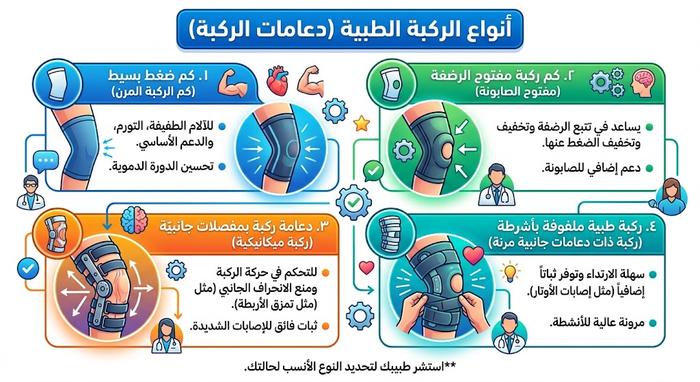
Types of Knee Braces: From Light Support to Complete Immobilization
1. Knee Sleeve (Elastic Support)
The simplest type — typically neoprene or elastic fabric. Provides mild compression and warmth. Best for early-stage osteoarthritis, minor pain, and mild tendinitis. Improves the subjective sense of joint stability without restricting range of motion.
2. Hinged Knee Brace
Features rigid hinges (metal or polymer) on both sides that deliver strong lateral support while controlling the arc of flexion and extension. The standard choice for moderate-to-severe instability, particularly after ACL reconstruction or collateral ligament injuries. Range-of-motion stops can be adjusted weekly during rehabilitation.
3. Functional / Prophylactic Brace
The rigid brace seen on professional athletes. Designed to protect the knee’s ligaments from initial injury or re-injury during high-impact sport. Used prophylactically — as in American football — or as a return-to-play brace after ligament repair.
4. Knee Immobilizer
Not a “brace” in the conventional sense but a soft splint extending from upper thigh to lower leg, locking the knee at full extension. Reserved for post-operative immobilization (e.g., quadriceps tendon repair) and select periarticular fractures. Duration is strictly limited because immobilization-induced quadriceps atrophy begins within 72 hours.
Choosing the Right Brace: Diagnosis First, Always
The most critical insight: the brace follows the diagnosis, not the other way around. Each condition demands a fundamentally different level of support:
- Mild osteoarthritis (grade I–II): An elastic sleeve paired with quadriceps-strengthening exercises is usually sufficient.
- Advanced osteoarthritis with varus malalignment (grade III–IV): An unloader brace mechanically shifts load away from the worn compartment, potentially delaying total knee replacement by 18 to 24 months.
- Post-ACL reconstruction: An immobilizer for the first few days, transitioning to a hinged brace with incrementally increasing range of motion during rehabilitation.
- Return to sport after ACL repair: A custom-fitted functional brace for 12 to 18 months post-surgery.
- Patellar tendinitis (jumper’s knee): A simple patellar strap positioned two finger-widths below the kneecap offloads the tendon during jumping activities.
Risks of Incorrect Brace Use
Despite their benefits, knee braces carry real risks when misused:
- Muscle atrophy: Over-reliance on external support causes the quadriceps and hamstrings to weaken, paradoxically increasing injury risk once the brace is removed.
- Skin irritation and pressure sores: Prolonged contact and friction, especially with non-breathable materials.
- Circulatory compromise: An overly tight brace can impede venous return, causing distal swelling and, in severe cases, deep vein thrombosis.
- False sense of security: Overconfidence leads to movements that exceed the brace’s protective capacity, risking complete ligament or meniscal tears.
- Condition aggravation: An immobilizer used where motion is needed (or vice versa) produces joint stiffness or failed healing.
This is precisely why knee braces — particularly hinged and immobilizer types — should never become a permanent solution. They are a temporary component of a comprehensive treatment plan that includes physical therapy and progressive muscle strengthening, always under the supervision of a specialist orthopedic surgeon.
Conclusion: A Knee Brace Is a Medical Tool, Not a Magic Fix
A knee brace is highly effective when prescribed correctly. It is not something to buy from a pharmacy on a friend’s recommendation. Selecting the right one requires an understanding of knee anatomy and the nature of your specific injury. A clinical examination by a specialist orthopedic surgeon remains the only reliable way to arrive at the correct diagnosis — and therefore the correct brace — that helps you heal rather than hurt.

Frequently Asked Questions
What is a medical knee brace and what are its primary clinical functions?
A medical knee brace is an external biomechanical orthosis engineered to augment joint kinetics:
- Structural Stabilization: Supplements compromised capsular, cruciate, and collateral ligaments against excessive shear and translational loads.
- Articular Offloading: Rebalances axial body weight away from degenerate hyaline cartilage or repair sites to relieve localized mechanical contact pressures.
- Proprioceptive Enhancement: Constant cutaneous pressure stimulates mechanoreceptors, improving sensorimotor feedback, stabilizing gait symmetry, and controlling inflammatory joint effusions.
What are the four primary types of knee braces and their clinical indications?
Orthopedic braces are grouped into four functional categories based on treatment objectives:
- Prophylactic Braces: Constructed with bilateral rigid uprights to protect uninjured knees from valgus stress injuries during high-impact athletics (e.g., football, skiing).
- Functional Braces: Designed for knees with confirmed ligament pathology (ACL, PCL, MCL, or LCL tears) to provide rotatory stability and prevent subluxation during daily activities.
- Rehabilitative / ROM Braces: Feature adjustable range-of-motion locking hinges to restrict flexion and extension angles following reconstructive surgery or fracture reduction.
- Unloader / Offloader Braces: Utilize dynamic three-point leverage systems to unload single-compartment osteoarthritis and restore joint clearance during ambulation.
How does an unloader knee brace relieve pain in unicompartmental osteoarthritis?
Unloader braces apply corrective biomechanical vector forces across the tibiofemoral axis:
- Mechanism of Action: In medial compartment osteoarthritis, progressive cartilage erosion creates a varus (“bow-legged”) deformity, concentrating body weight onto denuded bone surfaces.
- Three-Point Leverage: The brace introduces a dynamic valgus counter-force through dynamic straps and a contoured lateral hinge, widening the collapsed medial joint space.
- Clinical Efficacy: This offloading dampens subchondral impact stress, eases weight-bearing pain, improves walking tolerance, and can delay the need for total knee arthroplasty (TKA).
What is the difference between open-patella and closed-patella knee sleeves?
The choice between open and closed designs depends on patellar involvement:
- Open-Patella Braces: Feature an anatomical opening supported by a contoured silicone buttress. This configuration relieves direct axial pressure on the patellar apex and stabilizes tracking inside the femoral trochlea. They are ideal for patellofemoral pain syndrome, lateral patellar subluxation, and patellar tendinitis.
- Closed-Patella Braces: Consist of unbroken compressive material over the anterior knee. They deliver uniform circumferential compression and thermal retention, making them well-suited for generalized tibiofemoral osteoarthritis and diffuse swelling without focal anterior patellar pain.
Why is a hinged ROM knee brace essential after ACL or meniscus surgery?
Range-of-Motion (ROM) hinged braces shield biological tissue repairs during early healing:
- Protection of Meniscal Repairs: Deep knee flexion beyond 90 degrees generates peak compressive shear loads on posterior horn meniscus sutures; setting dial hinges to restricted angles preserves suture integrity during the first 4 to 6 weeks.
- Protection of ACL Grafts: Restricting terminal hyperextension and blocking varus/valgus stress prevents excessive graft stretching while the autograft or allograft undergoes bone-tunnel incorporation.
- Rotational Stability: Rigid bilateral uprights block unexpected twisting moments, preventing graft laxity and supporting safe, progressive weight-bearing protocols.
How do you accurately measure for a properly fitting knee brace?
Precise anatomical measurement prevents brace migration and localized neurovascular compression:
- Measurement Positioning: The patient should stand upright with weight distributed evenly and the knee flexed to roughly 15 to 20 degrees.
- Mid-Patellar Circumference: Measure around the direct center of the knee joint across the apex of the patella.
- Thigh Circumference: Measure around the leg precisely 15 cm (6 inches) above the center of the patella.
- Calf Circumference: Measure around the widest portion of the gastrocnemius muscle, roughly 12 to 15 cm (5 to 6 inches) below the center of the patella.
- Compare these values to the specific sizing grid of the manufacturer; avoid selecting an undersized brace that can obstruct venous return.
Can wearing a knee brace lead to muscle weakness or quadriceps atrophy?
Yes, improper or prolonged continuous use can cause secondary neuromuscular inhibition:
When external structural uprights continually bear joint loads, the surrounding stabilizers—most notably the vastus medialis oblique (VMO) and rectus femoris—are deprived of physiologic activation signals. Over several weeks, this learned disuse can result in measurable muscle atrophy and reduced joint stability.
To avoid this, braces should serve as supportive tools during demanding tasks, rather than passive substitutes for muscular function. They should always be paired with active quadriceps, hamstring, and gluteal physical rehabilitation.
Should you wear a knee brace all day or sleep with it on?
Braces are designed for targeted, active functional use rather than continuous wear:
- Daytime Ambulation: Wear the brace during active standing, walking, occupational lifting, and prescribed rehabilitation, and loosen or remove it when resting in a seated position.
- Sleeping Protocols: Sleeping with a brace is contraindicated for routine arthritis or general sprains, as it can cause skin breakdown and venous stasis.
- Post-Surgical Exception: Locked ROM braces are kept on overnight only when explicitly ordered by the orthopedic surgeon during the initial postoperative phase (typically weeks 1 to 4) to protect healing tissue from involuntary nocturnal twisting.
What clinical warning signs indicate that a knee brace is improperly fitted?
Patients should remove the orthosis and seek clinical evaluation if they observe:
- Peripheral Nerve Compromise: Tingling, “pins-and-needles,” numbness, or foot-drop weakness resulting from pressure on the common peroneal nerve as it courses over the fibular head.
- Venous Impairment: Swelling, coldness, or dusky discoloration in the foot and ankle, indicating tight distal strap constriction.
- Cutaneous Irritation: Skin maceration, blisters, or erythema that does not resolve within 30 minutes of brace removal.
- Brace Migration: The brace repeatedly slips downward onto the tibial crest, indicating an oversized frame or mismatched calf contouring.
How should a medical knee brace be cleaned and maintained?
Proper hygiene and maintenance preserve mechanical function and extend product lifespan:
- Hinge Detachment: Unfasten and remove all bilateral aluminum, steel, or carbon-fiber mechanical hinges prior to washing.
- Hand Washing: Wash fabric components, neoprene sleeves, and soft straps in lukewarm water using a gentle, hypoallergenic soap.
- Avoid Harsh Solvents: Do not use bleach, chemical solvents, or machine spin-cycles, which degrade elastic polymer binders.
- Air Drying: Lay all components flat to air dry in a well-ventilated, shaded area. Avoid tumble dryers, radiators, or direct sunlight, which can warp thermal plastics and weaken hook-and-loop velcro closures.
References
Cleveland Clinic — Knee Braces, Sleeves & Support: Types & How To Use (2024)
https://my.clevelandclinic.org/health/treatments/21034-knee-brace- AAOS OrthoInfo — Arthritis of the Knee (2024)
https://orthoinfo.aaos.org/en/diseases–conditions/arthritis-of-the-knee - Mayo Clinic — Osteoarthritis: Diagnosis & Treatment (2024)
https://www.mayoclinic.org/diseases-conditions/osteoarthritis/diagnosis-treatment/drc-20351930 - AAOS OrthoInfo — Anterior Cruciate Ligament (ACL) Injuries (2024)
https://orthoinfo.aaos.org/en/diseases–conditions/anterior-cruciate-ligament-acl-injuries/ - Mayo Clinic — ACL Injury: Diagnosis and Treatment (2024)
https://www.mayoclinic.org/diseases-conditions/acl-injury/diagnosis-treatment/drc-20350744 - Cleveland Clinic — Knee Osteoarthritis: Symptoms, Stages, Causes & Treatment (2024)
https://my.clevelandclinic.org/health/diseases/21750-osteoarthritis-knee - PubMed — Defined D, et al. Offloader Knee Braces for Knee Osteoarthritis: A Systematic Review (2021)
https://pubmed.ncbi.nlm.nih.gov/34038401/ - Mayo Clinic — Knee Pain: Diagnosis and Treatment (2024)
https://www.mayoclinic.org/diseases-conditions/knee-pain/diagnosis-treatment/drc-20350855