
Exercises after hip replacement start on the day of surgery with bed exercises (ankle pumps, thigh and buttock squeezes), then supported standing exercises, then walking and strengthening. Aim for 20–30 minutes, two to three times a day in early recovery, without bending the hip beyond 90 degrees. Check with your surgeon before doing any of the exercises below.
Early exercises (in bed)
These improve circulation in the legs and feet, which helps prevent clots, strengthen the muscles and improve hip movement. Start as soon as you can — even in the recovery room. They may feel uncomfortable at first but speed recovery and reduce pain.
Ankle pumps
Slowly push your foot up and down. Repeat several times every 5–10 minutes, starting straight after surgery and continuing until you have fully recovered.
Ankle rotations
Move your ankle inwards towards the other foot and then outwards. Repeat 5 times in each direction, 3–4 times a day.
Bed-supported knee bends
Slide your foot towards your buttocks, bending the knee and keeping the heel on the bed; do not let the knee roll inwards. Hold 5–10 seconds, straighten, and repeat 10 times, 3–4 times a day.
Buttock squeezes
Tighten your buttock muscles and hold for a count of 5. Repeat 10 times, 3–4 times a day.
Abduction
Slide your leg out to the side as far as you can and then back. Repeat 10 times, 3–4 times a day.
Quadriceps sets
Tighten your thigh muscle and try to straighten the knee; hold 5–10 seconds. Repeat 10 times over 10 minutes, rest a minute and repeat until the thigh feels tired.
Straight-leg raises
Tighten the thigh with the knee fully straight on the bed, lift the leg a few inches, hold 5–10 seconds and lower slowly. Repeat until the thigh tires.
Video: how a hip replacement is performed
Standing exercises
Soon after surgery you will stand up — with help at first, then on your own. Always hold a stable surface such as a bed rail, a wall or a person beside you.
Standing knee raises
Lift the operated leg towards your chest, but not higher than your waist — the hip must stay below 90 degrees. Hold 2–3 counts, lower, and repeat 10 times, 3–4 times a day.
Standing hip abduction
Keep hip, knee and foot pointing forwards and your body upright. With the knee straight, lift the leg to the side and lower slowly. Repeat 10 times, 3–4 times a day.
Standing hip extension
Slowly lift the operated leg backwards, keeping your back straight. Hold 2–3 counts and return. Repeat 10 times, 3–4 times a day.
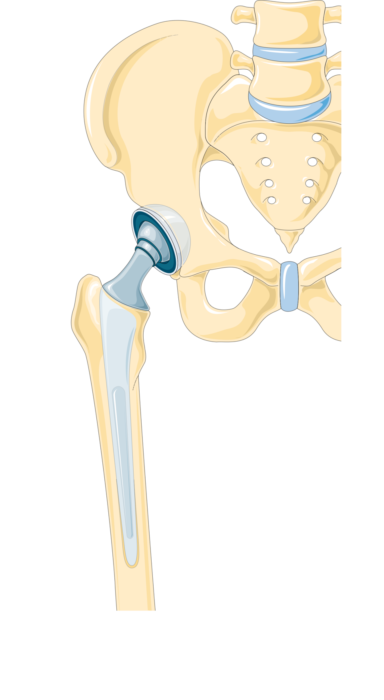
Exercise programme by stage
| Stage | Exercises | Goal |
|---|---|---|
| Days 0–7 | Ankle pumps and rotations, thigh and buttock squeezes, bed knee bends | Circulation and clot prevention |
| Weeks 1–6 | Abduction, straight-leg raises, the three standing exercises, walking | Strength and movement |
| Weeks 6–12 | Light resistance, stationary bike, step-ups | Strength and balance |
| After 3 months | Longer walks, swimming, balance work | Return to normal activity |
- Stop if you feel sharp or unusual pain.
- Do not bend the hip beyond 90 degrees or cross your legs in the early weeks.
- Increase repetitions gradually rather than suddenly increasing intensity.
Early activity
Soon after surgery you will walk short distances in your room and do light daily activities, which helps the hip regain strength and movement. Walking technique is covered in walking after hip replacement and daily precautions in sleeping and sitting after hip replacement.
Frequently asked questions about exercises after hip replacement
When do I start exercises after hip replacement?
On the day of surgery with simple bed exercises such as ankle pumps and thigh squeezes, then standing exercises and walking.
How often should I exercise?
20–30 minutes, two to three times a day in early recovery, as your surgeon and physiotherapist advise.
What are the most important exercises?
Ankle pumps, buttock and thigh squeezes, abduction, straight-leg raises and the standing exercises (knee raise, abduction, extension).
Which movements should I avoid?
Bending the hip beyond 90 degrees, crossing the legs and turning the leg inwards in the early weeks.
When can I return to sport?
Light activities such as walking, swimming and cycling after the wound heals and as advised; avoid high-impact sport and jumping.
To have your hip assessed, book a consultation, call +20 155 240 4488 or message us on WhatsApp at +20 155 554 7181.
Medically reviewed by Prof. Dr. Ibrahim Shaarawi, Professor of Orthopaedic Surgery. This article is general medical education and does not replace an examination or the plan your surgeon sets for you. See our medical disclaimer.
Related hip replacement guides
Exercises are part of recovery after hip replacement surgery. Read also:
- Hip replacement surgery
- Sleeping and sitting after hip replacement
- Hip replacement recovery time
- Walking after hip replacement
- Leg swelling after hip replacement