
An ACL tear and a meniscus tear often happen together, and the best practice is usually to treat both in one arthroscopic operation. Meniscus repairs heal better in a knee that has just been stabilised by ACL reconstruction, and the patient avoids a second operation and a second rehabilitation.
✅ Last medically reviewed by Prof. Dr. Ibrahim Shaarawi, Professor of Orthopaedic Surgery, on 5 October 2026
Why does the meniscus tear with the ACL?
The same twisting force that ruptures the ACL can trap and tear the meniscus. Later, every episode of the knee giving way puts the meniscus — especially the inner (medial) one — at risk again, which is why meniscus damage becomes more common the longer an unstable knee goes untreated.
How do you know you have both injuries?
- A pop, rapid swelling and later instability suggest the ACL.
- Pain on the joint line, catching or locking suggest the meniscus.
- An MRI confirms both, and the final assessment happens during arthroscopy.
How is the operation done?
- The knee is examined arthroscopically through small incisions.
- The meniscus tear is assessed and repaired with sutures whenever the tear pattern allows.
- The ACL is reconstructed with a tendon graft placed in anatomical bone tunnels.
- Rehabilitation is adjusted to protect the meniscus repair.
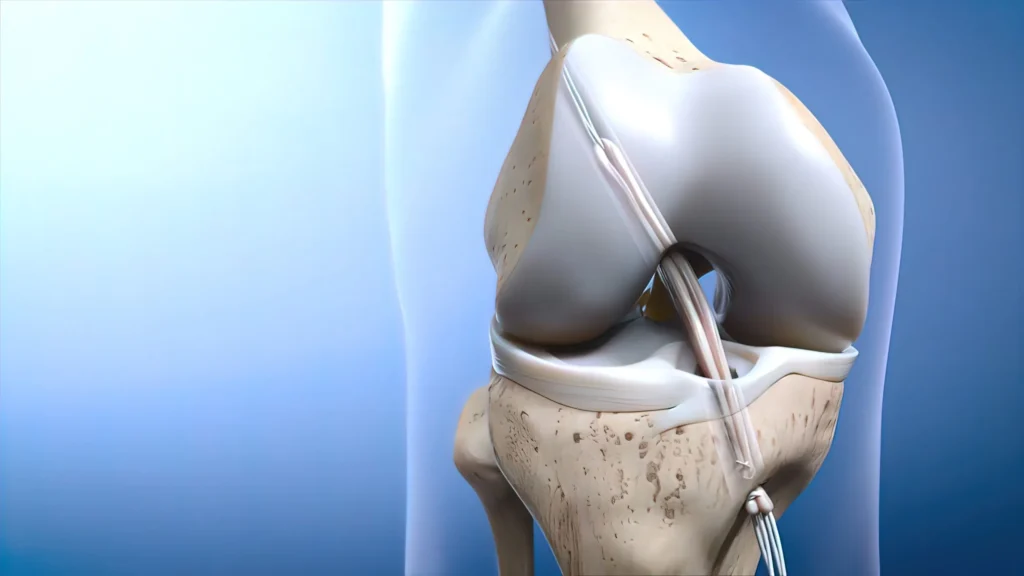
Repair or remove the meniscus?
| Meniscus repair (sutures) | Partial meniscectomy (trimming) | |
|---|---|---|
| Goal | Save the meniscus | Remove the torn part |
| Long-term knee protection | Better — the cushion is preserved | Less — higher load on cartilage |
| Rehabilitation | Slower, with protected bending at first | Faster |
| When chosen | Repairable tear with good blood supply | Tear that cannot be repaired |
For meniscus treatment on its own, see arthroscopic meniscus surgery.
Key numbers to know
- In an analysis of 51 studies (3,931 menisci), meniscal repair failed in 8.5% when done with ACL reconstruction versus 14% without it (Schweizer et al., AJSM 2024).
- In a Cochrane review of 19 trials (1,597 patients), patellar tendon and hamstring grafts did not differ in function or re-rupture, with more anterior knee pain after patellar tendon grafts (Mohtadi et al., Cochrane 2011).
- The rate of a second ACL injury (same or other knee) was 15% overall and 23% in athletes under 25 returning to sport — nearly one in four (Wiggins et al., AJSM 2016).
| Treatment | When we use it | What to expect |
|---|---|---|
| Structured rehabilitation | Partial tears, or complete tears with a stable knee and low-pivoting activity | Some patients avoid surgery, with stability monitored |
| Arthroscopic ACL reconstruction | Knee instability, pivoting and jumping sports, or an associated meniscal tear | Graded return to sport over roughly 9–12 months |
| ACL reconstruction + meniscal repair | A repairable meniscal tear with the ACL tear | Preserves the meniscus and lowers arthritis risk |
| ACL reconstruction + lateral tenodesis (LET) | Young athletes, high-grade rotational laxity, or revision | Lower risk of graft re-rupture |
| Revision ACL reconstruction | A failed previous reconstruction with instability | Careful tunnel planning, sometimes in two stages |
At Prof. Dr. Ibrahim Shaarawi’s clinics in Nasr City, Mohandeseen and New Cairo (5th Settlement) we test knee stability and review your MRI at the same visit, then decide on rehabilitation or reconstruction according to your activity and any associated meniscal injury.
Recovery and cost
Recovery follows the ACL programme with extra protection for the meniscus repair in the first weeks — see ACL surgery recovery and exercises after ACL surgery. In Egypt, ACL reconstruction with meniscus repair usually costs 75,000–95,000 EGP, depending on the tear and fixation devices; see ACL surgery cost in Egypt.
Video: arthroscopic meniscus repair
Frequently asked questions about ACL and meniscus surgery
Can the ACL and meniscus be fixed in the same operation?
Yes, and in most cases this is the best option: meniscus repairs heal better in a newly stabilised knee and you avoid two operations.
Can I treat only the meniscus and leave the ACL?
In an unstable knee, a meniscus repair without ACL reconstruction has a higher failure rate, because the knee keeps shifting.
What is the difference between the meniscus and the ACL?
The ACL is a ligament that stabilises the knee; the meniscus is a cartilage cushion that absorbs shock. They are often injured together.
When can I walk after ACL and meniscus surgery?
Usually straight away with crutches; weight-bearing and bending may be limited for a few weeks to protect the meniscus repair.
How much does ACL and meniscus surgery cost in Egypt?
Usually 75,000–95,000 EGP, confirmed after examination and MRI.
To have your knee assessed, book a consultation, call +20 155 240 4488 or message us on WhatsApp at +20 155 554 7181.
Medically reviewed by Prof. Dr. Ibrahim Shaarawi, Professor of Orthopaedic Surgery. This article is general medical education and does not replace an examination or the plan your surgeon sets for you. See our medical disclaimer.
Related ACL guides
This guide links our ACL reconstruction and arthroscopic meniscus surgery pages. Read also:
- ACL reconstruction surgery
- ACL treatment without surgery
- ACL surgery risks and complications
- Lateral extra-articular tenodesis (LET)
- Arthroscopic meniscus surgery
References
- Schweizer C, et al. Meniscal Repair Outcome in 3829 Patients With a Minimum Follow-up From 2 Years Up to 5 Years: A Meta-analysis on the Overall Failure Rate and Factors Influencing Failure. Am J Sports Med. 2024;52(3):822-831.
- Kopf S, et al. Management of traumatic meniscus tears: the 2019 ESSKA meniscus consensus. Knee Surg Sports Traumatol Arthrosc. 2020;28(4):1177-1194.
- Getgood AMJ, et al. Lateral extra-articular tenodesis reduces failure of hamstring tendon autograft ACL reconstruction: 2-year outcomes from the STABILITY study randomized clinical trial. Am J Sports Med. 2020;48(2):285-297.
- American Academy of Orthopaedic Surgeons (OrthoInfo). Anterior Cruciate Ligament (ACL) Injuries.