
Quick answer
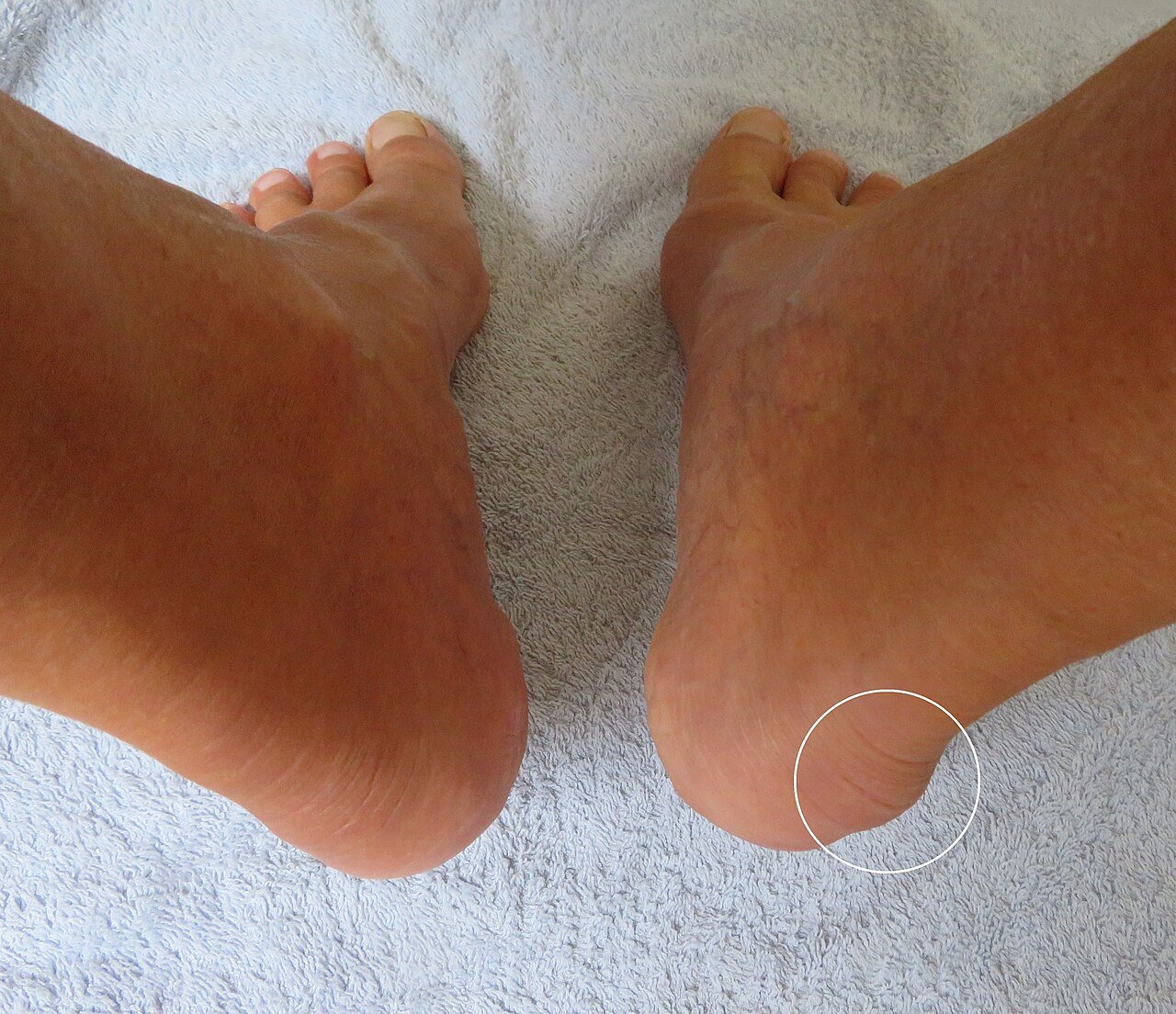
Haglund’s deformity is a bony bump on the upper back of the heel bone where the Achilles tendon attaches. Shoes rub on it, the skin reddens, the bursa behind the heel becomes inflamed, and the tendon itself may become painful. Treatment starts with shoes open at the back, a heel lift and Achilles exercises; the bump is removed surgically, endoscopically or through an open incision, if pain lasts several months.
✅ Last medically reviewed by Prof. Dr. Ibrahim Shaarawi, Professor of Orthopaedic Surgery, on 28 October 2026
It is also called a pump bump because it is common with stiff-backed shoes. It is one of the most common bone spurs of the heel, and it differs from the spur under the heel in both site and treatment. This article is part of our guide to bone spurs.
What is Haglund’s deformity?
The heel bone has an upper back edge next to the Achilles tendon, with a small bursa between them. When this edge enlarges, the tendon, bursa and shoe all rub against it. The American Academy of Orthopaedic Surgeons describes it as enlargement of the bone at the back of the heel that can rub on the Achilles tendon and cause inflammation and pain (OrthoInfo).
Causes
- Shoes with a stiff back, the main factor that increases rubbing.
- Tight calf muscles and Achilles tendon.
- A high-arched foot, which tilts the heel backwards.
- Running and sports that load the tendon.
- Inherited heel shape.
It usually appears in young and middle-aged adults, especially women who wear closed-back shoes and athletes.
Symptoms
- A visible hard bump at the back of the heel.
- Redness and pain where the shoe rubs.
- Soft swelling over the bump from an inflamed bursa.
- Pain and stiffness at the end of the Achilles tendon with the first steps in the morning.
- Pain that increases on stairs or when running.
Pain under the heel on getting up usually points to heel spur and plantar fasciitis, while pain at the back of the heel in shoes points to Haglund’s. The two can coexist. Pain a few centimetres above the heel, in the middle of the tendon, is usually the non-insertional form of Achilles tendonitis.
Video: Heel pain on getting out of bed in the morning
Diagnosis
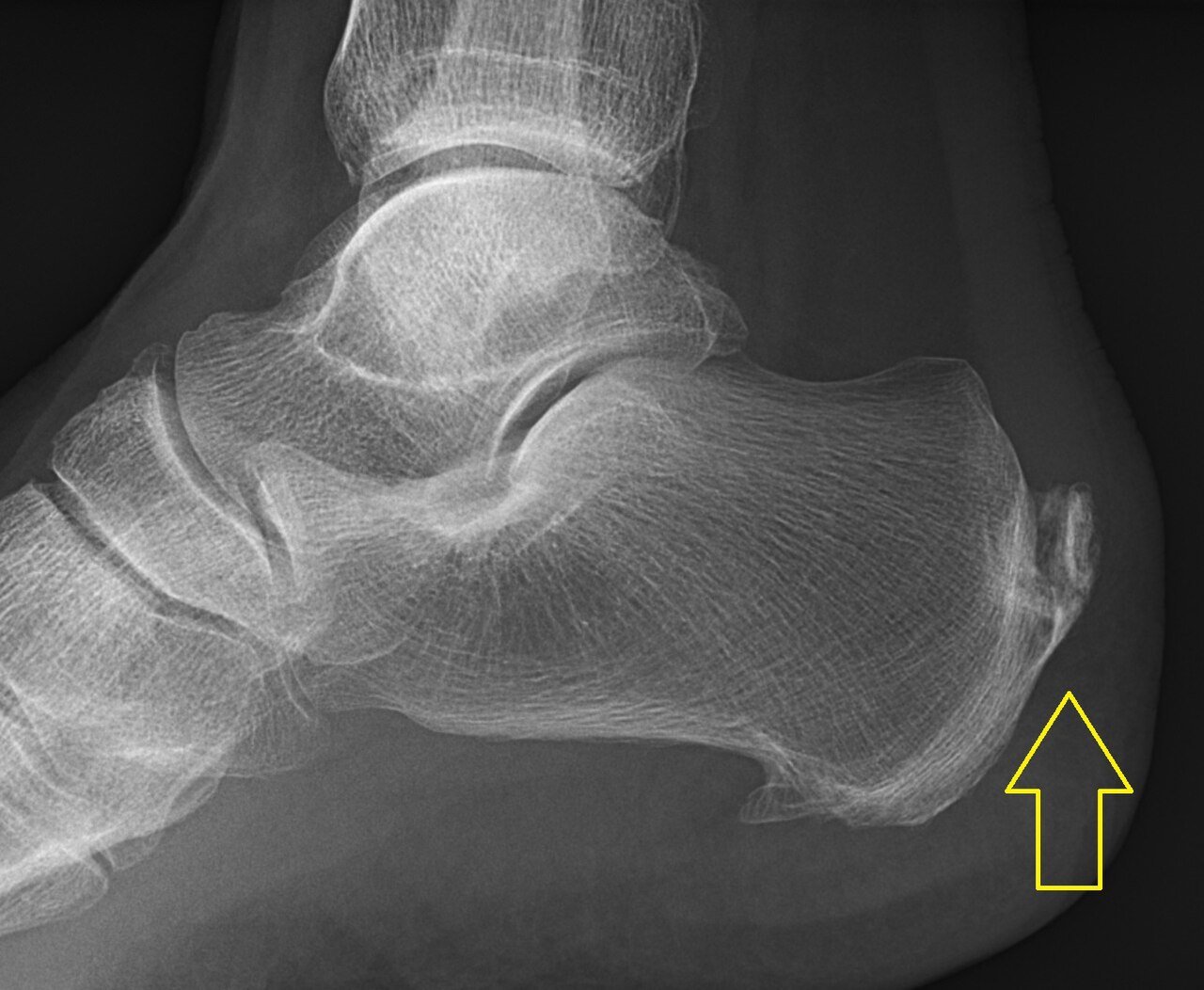
Examination is usually enough to suspect it: a tender bump at the back of the heel with pain on pressing the tendon insertion. A side X-ray of the heel shows the size of the bump, calcification inside the tendon, and any spur under the heel. We order an MRI if we suspect tearing or degeneration at the tendon insertion, because that changes the operation.
Key numbers to know
- Haglund’s deformity appeared on the X-rays of 65.4% of patients with insertional Achilles tendinopathy versus 15.4% of controls, and a plantar heel spur often sat alongside it (Dadir, 2026).
- In a review of 35 studies covering 1,260 ankles, complications after endoscopic Haglund resection were 4.1% versus 15.5% for open surgery, and return to daily activities took 6.3 versus 17.2 weeks (Alessio-Mazzola et al., 2021).
- In a randomised trial of 119 patients, adding shockwave therapy to eccentric exercises gave no clear extra benefit at 24 weeks (Mansur et al., 2021).
| Treatment | When we choose it | What to expect |
|---|---|---|
| Shoes open at the back or without a stiff counter | Everyone at first | Less rubbing and redness within days |
| Heel lift and Achilles exercises | Insertional pain and tight calves | Gradual improvement over about 3 months for most |
| Pain relief, ice and physiotherapy | An acute flare | Settles pain and swelling |
| Shockwave therapy | Pain that persists despite exercises | Mixed results; may add little to exercise |
| Endoscopic resection | Pain for 6 months despite treatment, with a healthy tendon | Small incisions and a faster return to activity |
| Open resection with tendon repair | Calcification or tearing at the tendon insertion | Longer recovery in a cast or boot |
At Prof. Dr. Ibrahim Shaarawi’s clinics in Nasr City, Mohandeseen and New Cairo (5th Settlement) we examine the heel and the Achilles tendon, review a side X-ray of the heel, and usually start without surgery.
Treatment without surgery
- Shoes: open-backed or soft-backed shoes; avoid tight closed-back styles.
- Heel lift: a small insert that reduces tension on the tendon.
- Achilles exercises: calf stretching and slow lowering exercises daily for 12 weeks.
- Ice and pain relief: for flares.
- Physiotherapy and shockwave therapy: for patients who do not improve with exercise.
We do not inject steroid into the Achilles tendon, because it weakens the tendon and can lead to rupture. The NHS advises seeing a doctor if heel pain has not improved after two weeks of home treatment (NHS).
Surgery: when and how
We consider surgery if pain lasts about 6 months despite regular treatment. The operation shaves the bony bump and removes the inflamed bursa, and treats the tendon end if it is calcified or torn.
- Endoscopic: two small incisions, suitable when the tendon is healthy, with a faster return to activity.
- Open: when the tendon needs debriding or reattaching to the bone with an anchor; recovery needs a cast or boot for several weeks.
Recovery after surgery
After endoscopic surgery most patients walk in a boot within days and return to daily activities within weeks. After open surgery with tendon repair, a cast and then a boot are needed, physiotherapy is built up gradually, and running takes several months.
Frequently asked questions about Haglund’s deformity
Is Haglund’s deformity the same as a heel spur?
No. Haglund’s is a bump at the back of the heel by the Achilles tendon; a heel spur is under the heel at the plantar fascia. They can occur together.
Does a Haglund bump go away without surgery?
The bony bump stays, but pain and inflammation improve for most people with a shoe change, heel lift and exercises.
Can steroid be injected into the tendon?
We advise against it, because steroid inside the Achilles tendon weakens it and increases the risk of rupture.
Which is better, endoscopic or open surgery?
Endoscopic surgery suits a healthy tendon and has fewer complications; open surgery is needed when the tendon must be cleaned or reattached.
When can I return to sport after surgery?
Return is several weeks faster after endoscopic surgery; after open surgery with tendon repair, running takes several months.
To have your foot, heel or knee checked by Prof. Dr. Ibrahim Shaarawi, book a consultation, call +20 155 240 4488 or message us on WhatsApp at +20 155 554 7181. Bring any previous X-rays with you.
Medically reviewed by Prof. Dr. Ibrahim Shaarawi, Professor of Orthopaedic Surgery. This article is general medical education and does not replace an examination or the plan your own doctor sets for you. See our medical disclaimer.
Related bone spur guides
Related heel and Achilles guides:
References
- American Academy of Orthopaedic Surgeons (OrthoInfo). Achilles Tendinitis.
- NHS. Heel pain.
- Zhi X, et al. Nonoperative treatment of insertional Achilles tendinopathy: a systematic review. J Orthop Surg Res. 2021;16(1):233.
- Dadir İH. Haglund Deformity and Plantar Calcaneal Spur in Insertional Achilles Tendinopathy: Prevalence, Coexistence, and Radiographic Characteristics. J Foot Ankle Res. 2026;19(4):e70228.
- Alessio-Mazzola M, et al. Endoscopic calcaneoplasty for the treatment of Haglund’s deformity provides better clinical functional outcomes, lower complication rate, and shorter recovery time compared to open procedures: a systematic review. Knee Surg Sports Traumatol Arthrosc. 2021;29(8):2462-2484.
- Mansur NSB, et al. Shockwave Therapy Plus Eccentric Exercises Versus Isolated Eccentric Exercises for Achilles Insertional Tendinopathy: A Double-Blinded Randomized Clinical Trial. J Bone Joint Surg Am. 2021;103(14):1295-1302.