
Quick answer
Bunion treatment without surgery works by taking pressure off the bump: shoes with a wide toe box and low heel, a pad over the bump, a toe spacer, a night splint and foot exercises. These measures ease pain for most people, but they do not straighten the big toe or remove the bump. Surgery is considered only when pain persists despite them.
✅ Last medically reviewed by Prof. Dr. Ibrahim Shaarawi, Professor of Orthopaedic Surgery, on 28 October 2026
I start most bunion patients on non-surgical treatment, because many feel better with a change of shoes alone. It helps to know what each option can and cannot do, so you do not buy a splint that promises to straighten the toe and then feel let down. This article is part of our guide to bone spurs and follows on from bunion (hallux valgus).
What non-surgical treatment can achieve
The target is pain, not the shape of the foot. The bump comes from a change in the bones, and shoes or splints do not change bone direction in adults. What does improve is shoe friction over the bump, inflammation of the bursa and pressure under the ball of the foot.
- Usually improves: pain when walking, redness over the bump, calluses.
- Usually unchanged: the big toe angle on X-ray and the size of the bump.
Shoes: the most important step
- A wide, deep toe box so the toes move without pressing on the bump.
- A low heel, because high heels push the foot forwards onto the big toe.
- A cushioned sole.
- Soft leather or stretch fabric over the bump.
- Buying shoes late in the day, when the foot is at its largest.
The American Academy of Orthopaedic Surgeons recommends wider shoes as the first treatment and notes that most patients’ pain is relieved by them and other simple measures (OrthoInfo).
Pads and toe spacers
A silicone or felt pad over the bump reduces friction inside the shoe. A spacer between the big and second toes takes pressure off the second toe and may ease pain, but its effect on the angle disappears when it comes off. Choose a size that does not squeeze the toes, and check the skin, especially if you have diabetes.
Night and dynamic splints
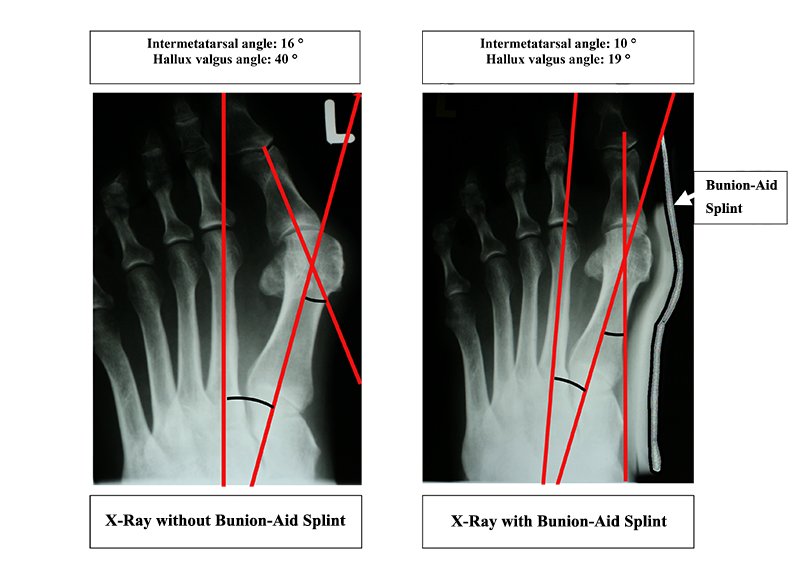
A splint holds the big toe in a straighter position during sleep or walking. Studies show it eases pain for some patients without a lasting change in the deformity. I suggest it for mild to moderate pain, or for patients waiting for surgery.
Key numbers to know
- A Cochrane review of 25 randomised trials with 1,597 patients notes that non-surgical care treats pain rather than the deformity, and surgery is considered when pain persists (Dias et al., Cochrane 2024).
- In a randomised trial of 70 patients, a dynamic bunion splint reduced pain when walking and running but did not change the angle on X-ray (Plaass et al., 2020).
- In a network meta-analysis of 11 randomised trials, exercise with a toe separator, night splints and dry needling ranked best for small improvements in the angle, though the authors call the evidence limited (Ying et al., 2021).
| Treatment | When we choose it | What to expect |
|---|---|---|
| Wide toe box, low heel shoes | Everyone | The biggest difference to daily pain, and less rubbing on the bump |
| Bunion pad and toe separator | Redness or a corn over the bump | Relief from friction in shoes |
| Night or dynamic splint | Mild to moderate pain | Less pain, without a lasting change in the angle |
| Foot muscle exercises | A flexible foot with pain when walking | Better foot balance and less pain over time |
| Insoles | Flat feet or pain under the ball of the foot | Pressure moved away from the forefoot |
| Pain relief or a local injection | An inflamed bursa over the bump | Settles a flare only |
At Prof. Dr. Ibrahim Shaarawi’s clinics in Nasr City, Mohandeseen and New Cairo (5th Settlement) we start with shoes, splints and exercises, and follow the pain before any talk of surgery.
Foot exercises
- Spread the toes like a fan, 10 times, three times a day.
- Gently pull the big toe away from the others and hold for 10 seconds.
- Pick up a small towel or marbles with the toes.
- Short-foot exercise: lift the arch without curling the toes.
- Stretch the calf, because a tight calf adds pressure to the forefoot.
These exercises strengthen the small muscles of the foot and improve its balance; the benefit shows after weeks of regular practice.
Insoles, pain relief and injections
Insoles help when the foot is flat or the pain is under the ball of the foot. Pain relief and cold packs settle flares. We sometimes inject an inflamed bursa over the bump, but we avoid repeated steroid injections here because they thin the skin and soft tissue. No cream dissolves bone. If the pain is under the heel rather than at the big toe, the cause may be a heel spur and plantar fasciitis.
Video: Big toe drift (hallux valgus): cause and treatment
When non-surgical treatment is not enough
- Pain lasting 3 to 6 months despite proper shoes and the measures above.
- Difficulty walking or finding shoes that fit.
- The big toe crossing the second toe, or a dislocated second toe.
- Repeated inflammation or a sore over the bump.
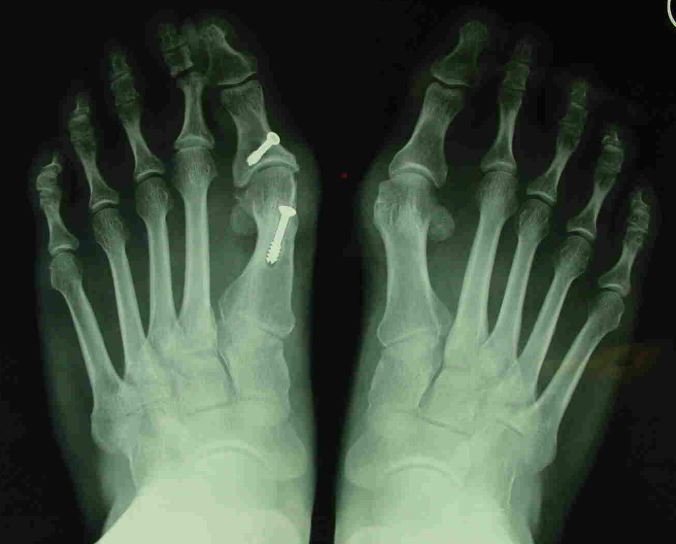
At that point we discuss bunion (hallux valgus) and the type of operation based on the X-ray angles.
A common mistake: putting off the right shoes
I see patients who have taken painkillers for months while still wearing narrow shoes. The tablet hides the pain while the friction continues. Changing shoes is the cheapest and most effective step, so start there.
Frequently asked questions about bunion treatment without surgery
Can a splint cure a bunion?
No. A splint eases pain for some people, but the toe returns to its position when it comes off, because the deformity is in the bone.
What are the best shoes for a bunion?
Shoes with a wide, deep toe box, a low heel, a cushioned sole and soft material over the bump.
Do creams or herbal remedies shrink a bunion?
No. Pain-relief creams may ease pain for a while but have no effect on the bone.
Do exercises stop a bunion getting worse?
Exercises strengthen the foot and ease pain; there is no strong evidence that they stop the drift in adults.
When should I think about surgery?
If pain lasts 3 to 6 months despite proper shoes and pads, walking becomes difficult, or the big toe crowds the other toes.
To have your foot, heel or knee checked by Prof. Dr. Ibrahim Shaarawi, book a consultation, call +20 155 240 4488 or message us on WhatsApp at +20 155 554 7181. Bring any previous X-rays with you.
Medically reviewed by Prof. Dr. Ibrahim Shaarawi, Professor of Orthopaedic Surgery. This article is general medical education and does not replace an examination or the plan your own doctor sets for you. See our medical disclaimer.
Related bone spur guides
Related foot and heel guides:
References
- American Academy of Orthopaedic Surgeons (OrthoInfo). Bunions.
- NHS. Bunions.
- Perler A, et al. Hallux Valgus. In: StatPearls. Treasure Island (FL): StatPearls Publishing; 2026.
- Dias CG, et al. Surgical interventions for treating hallux valgus and bunions. Cochrane Database Syst Rev. 2024;7(7):CD013726.
- Plaass C, et al. Short term results of dynamic splinting for hallux valgus – A prospective randomized study. Foot Ankle Surg. 2020;26(2):146-150.
- Ying J, et al. Adjusted Indirect and Mixed Comparisons of Conservative Treatments for Hallux Valgus: A Systematic Review and Network Meta-Analysis. Int J Environ Res Public Health. 2021;18(7).