
Quick answer
Bunion (hallux valgus) is the bony bump on the side of the foot at the base of the big toe: the toe drifts towards the other toes and the head of the first metatarsal pushes outwards. It is the most common bone spur of the foot and affects women more than men. Wider shoes and pads ease the pain, and surgery is the only way to correct the deformity when pain persists.
✅ Last medically reviewed by Prof. Dr. Ibrahim Shaarawi, Professor of Orthopaedic Surgery, on 28 October 2026
Many people who search for a bump on the side of the foot mean a bunion. It starts small and painless, then grows over the years until ordinary shoes become uncomfortable. Here I explain why it happens, how we measure it and when surgery makes sense. This article is part of our guide to bone spurs.
What is a bunion?
The big toe has two joints; the larger one connects it to the first metatarsal. In a bunion the metatarsal angles inwards and the toe angles outwards, so the head of the bone sticks out on the side of the foot. The American Academy of Orthopaedic Surgeons describes hallux valgus as a progressive condition (OrthoInfo).
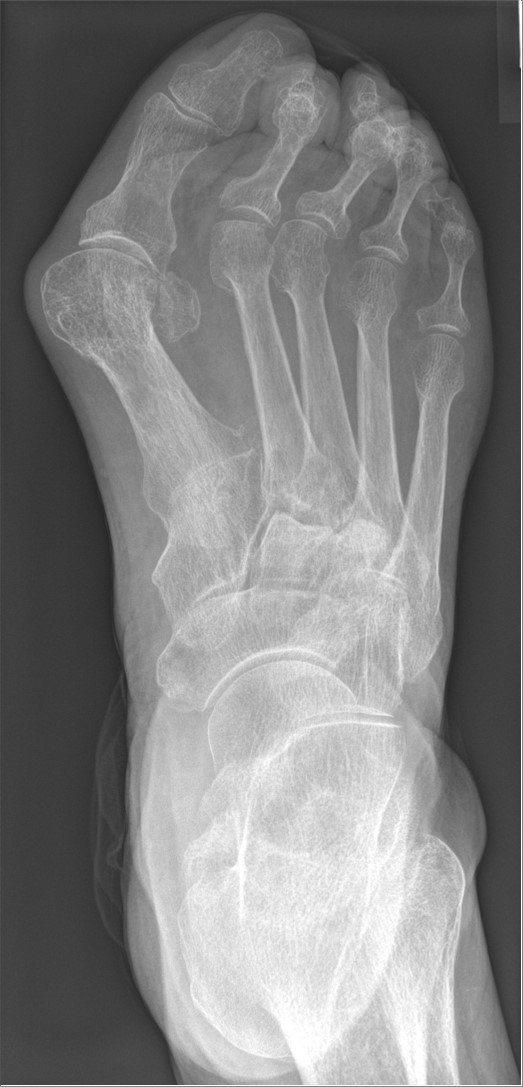
Causes
- Inherited foot shape, the strongest factor.
- Narrow shoes and high heels, which speed up the drift and increase pain.
- Flat feet and loose ligaments.
- Rheumatoid arthritis.
- An old injury to the big toe joint.
Bunions also appear in teenagers. The joint usually still moves well at this age, but the bump can hurt and make shoes difficult (OrthoInfo).
Symptoms
- A hard bump on the side of the foot at the base of the big toe.
- Redness and swelling over the bump after wearing shoes.
- Pain that gets worse with walking and tight shoes.
- The big toe crossing over or under the second toe.
- Calluses under the ball of the foot.
A bunion flare can look like gout, but gout comes in hot, red attacks that settle; see gout. A soft lump on top of the foot is more likely a ganglion cyst of the foot than a bone spur.
Key numbers to know
- In a meta-analysis covering 496,957 people, hallux valgus was found in 23% of adults aged 18 to 65 and 35.7% of those over 65, in 30% of women and 13% of men (Nix et al., 2010).
- A Cochrane review of 25 randomised trials with 1,597 patients notes that non-surgical care treats pain rather than the deformity, and surgery is considered when pain persists (Dias et al., Cochrane 2024).
- A meta-analysis of comparative studies found minimally invasive bunion surgery no better than open surgery for pain, function or the final angle (12° in both groups), with similar complication rates (Alimy et al., 2023).
| Treatment | When we choose it | What to expect |
|---|---|---|
| Wide shoes, pads and toe separators | Any stage, and always the first step | Less pain and rubbing without changing the deformity |
| Splints and foot exercises | Mild to moderate pain | Pain improves for many, while the angle usually stays the same |
| Osteotomy (cutting and realigning the bone) | Persistent pain despite proper shoes, or trouble walking | Walking in a surgical shoe from the first days, normal shoes after about 6 to 8 weeks |
| Minimally invasive surgery | Selected mild to moderate deformities | Results similar to open surgery in comparative studies |
| Big toe joint fusion | Severe arthritis of the joint or a very severe deformity | Pain relief at the cost of movement in that joint |
At Prof. Dr. Ibrahim Shaarawi’s clinics in Nasr City, Mohandeseen and New Cairo (5th Settlement) we examine the foot standing, measure the big-toe angle on X-ray, and agree with you on the right treatment.
Diagnosis: how we measure it
We examine the foot standing, because the drift increases under load, then take weight-bearing X-rays. We measure two angles: the big toe angle and the angle between the first and second metatarsals. These numbers grade the bunion as mild, moderate or severe and decide the type of operation if one is needed. We also check the big toe joint for arthritis, which changes the plan.
Video: Big toe drift (hallux valgus): cause and treatment
Treatment without surgery
The NHS states that surgery is the only way to get rid of a bunion, but simple measures ease the pain (NHS):
- Shoes with a wide, deep toe box, a low heel and a soft sole.
- A pad over the bump and a spacer between the big and second toes.
- Insoles if the foot is flat.
- Ice and pain relief when the bursa over the bump flares.
These options, splints and exercises are covered in detail in bunion treatment without surgery.
Bunion surgery
We operate when pain persists despite proper shoes, walking becomes difficult, or the big toe crowds the other toes. We do not operate for appearance alone. Most operations cut the first metatarsal, realign it and fix it with a small screw or plate, then remove the bump and balance the soft tissues (OrthoInfo).
- Mild to moderate: a cut near the metatarsal head, open or minimally invasive.
- Severe: a cut nearer the base of the bone, or fusion of a midfoot joint.
- Arthritis of the big toe joint: fusion of that joint.
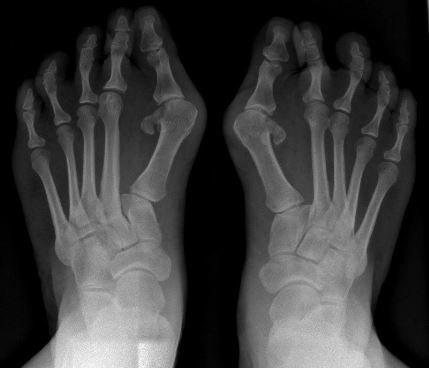
Patients usually walk in a special post-operative shoe from the first days, return to normal shoes after about 6 to 8 weeks, and have some swelling for several months.
Can a bunion come back after surgery?
It can partly return in some patients, especially if the bone alignment was not fully corrected or narrow shoes are resumed. That is why we choose the operation from the X-ray angles, not from the size of the bump.
Frequently asked questions about bunions
Can a bunion be fixed without surgery?
Pain can be eased with shoes, pads and splints, but the bump and the drift of the toe only go with surgery.
When do I need bunion surgery?
When pain persists for several months despite proper shoes, walking becomes difficult, or the big toe crowds the other toes.
How long is recovery?
Walking in a surgical shoe usually starts in the first days, normal shoes after about 6 to 8 weeks, and swelling settles over months.
Is minimally invasive surgery better?
Comparative studies found no clear difference in pain or final result compared with open surgery; the choice depends on the deformity.
Do children get bunions?
Yes, especially teenagers with a family history. We prefer to wait until growth is nearly complete unless pain is severe.
To have your foot, heel or knee checked by Prof. Dr. Ibrahim Shaarawi, book a consultation, call +20 155 240 4488 or message us on WhatsApp at +20 155 554 7181. Bring any previous X-rays with you.
Medically reviewed by Prof. Dr. Ibrahim Shaarawi, Professor of Orthopaedic Surgery. This article is general medical education and does not replace an examination or the plan your own doctor sets for you. See our medical disclaimer.
Related bone spur guides
Related foot guides:
References
- American Academy of Orthopaedic Surgeons (OrthoInfo). Bunions.
- American Academy of Orthopaedic Surgeons (OrthoInfo). Bunion Surgery.
- NHS. Bunions.
- Perler A, et al. Hallux Valgus. In: StatPearls. Treasure Island (FL): StatPearls Publishing; 2026.
- Nix S, et al. Prevalence of hallux valgus in the general population: a systematic review and meta-analysis. J Foot Ankle Res. 2010;3:21.
- Dias CG, et al. Surgical interventions for treating hallux valgus and bunions. Cochrane Database Syst Rev. 2024;7(7):CD013726.
- Alimy AR, et al. Does Minimally Invasive Surgery Provide Better Clinical or Radiographic Outcomes Than Open Surgery in the Treatment of Hallux Valgus Deformity? A Systematic Review and Meta-analysis. Clin Orthop Relat Res. 2023;481(6):1143-1155.