
Quick answer
Knee replacement failure is relatively uncommon: about 90% of total knees are still working at 20 years. The main causes are infection, loosening, fractures around the implant and instability. Treatment is usually revision knee replacement with special components — sometimes in two stages for infection — once the cause has been identified precisely.
✅ Last medically reviewed by Prof. Dr. Ibrahim Shaarawi, Professor of Orthopaedic Surgery, on 12 October 2026
New pain years after a successful operation, swelling and warmth that will not settle, or a knee that feels unstable — these are messages not to ignore. Here are the signs and causes of a failing knee replacement and how we treat it, as part of our guide to total knee replacement surgery.
Signs that the implant needs assessment
- New or increasing pain after a long period of improvement.
- Swelling, warmth, redness or wound discharge, sometimes with fever.
- The knee feeling unstable or giving way.
- Stiffness that stops the knee bending despite physiotherapy.
- Clicking with pain, or a change in the shape of the leg.
Not all pain after surgery means failure; pain and swelling in the first weeks are normal — see pain after knee replacement.
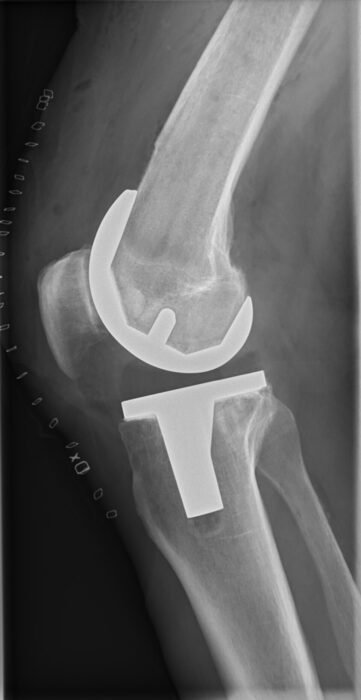
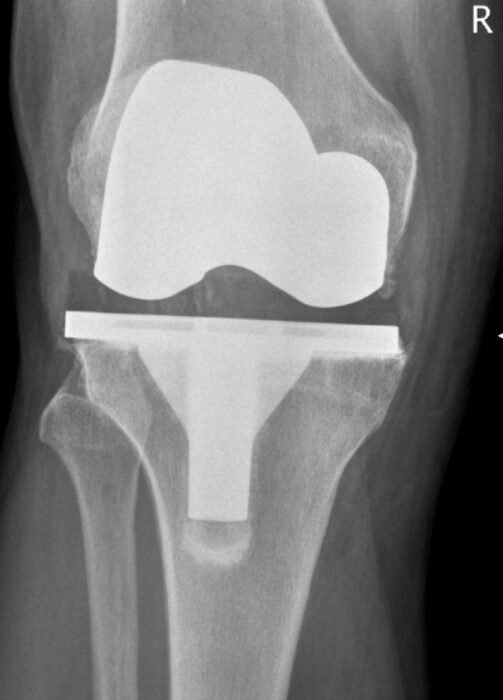
Why do knee replacements fail?
| Cause | How it shows | Usual treatment |
|---|---|---|
| Early infection (weeks) | Warmth, redness, discharge, fever | Washout and liner exchange with antibiotics (DAIR) |
| Late infection | Persistent pain, raised inflammatory markers | Revision, usually in two stages |
| Component loosening | Pain on walking, changes around the implant on X-ray | Revision with longer-stemmed components |
| Instability | Giving way or a sliding sensation | Component adjustment or a more constrained implant |
| Periprosthetic fracture | Sudden pain after a fall | Fixation or component exchange depending on stability |
| Stiffness | Limited bending | Intensive physiotherapy, sometimes manipulation under anaesthesia |
Video: Knee replacement success rate
How we find the cause
- Comparing current X-rays with earlier films to detect loosening or change in position.
- Inflammatory blood tests (ESR, CRP) and joint aspiration with culture when infection is suspected.
- CT to assess component rotation and bone loss.
- Examining ligaments, stability and movement.
Identifying the cause before any intervention is the most important step; revising a knee without a clear reason rarely solves the problem.
Key numbers to know
- At a specialist revision centre, the reasons for revision were infection (36.1%), aseptic loosening (21.9%) and periprosthetic fracture (13.7%) (Postler et al., 2018).
- Total knee replacement survival was 96.1% at 10 years and 89.7% at 20 years; the lifetime revision risk is about 5% after age 70 but up to 35% for men in their early 50s (Bayliss et al., The Lancet 2017).
- National registry data show that 82% of total knee replacements last 25 years, compared with 70% of partial knee replacements (Evans et al., The Lancet 2019).
| Treatment | When we use it | What to expect |
|---|---|---|
| Conservative care: exercise, weight loss, topical pain relief | Grade 1–3 arthritis | Better pain and movement; many patients delay surgery |
| Joint injections (steroid, hyaluronic acid or PRP) | Persistent pain despite conservative care | Temporary relief that varies between patients |
| High tibial osteotomy (HTO) | Active patients under 60 with bow legs and arthritis on the inner side only | Realigns the leg and keeps the natural knee |
| Partial knee replacement | Arthritis limited to one compartment with healthy ligaments | Faster recovery and a more natural-feeling knee |
| Total knee replacement | Severe (grade 4) arthritis with pain limiting daily life | Pain usually resolves; walking on day 1–2 |
| Revision knee replacement | Loosening, infection or instability of a previous knee replacement | Bigger surgery with special components to restore stability |
At Prof. Dr. Ibrahim Shaarawi’s clinics in Nasr City, Mohandeseen and New Cairo (5th Settlement) we examine the knee and review standing X-rays at the same visit, then decide on conservative care, osteotomy, or a partial or total knee replacement according to the arthritis grade, your age and activity.
What revision knee replacement involves
We remove the failed components carefully to preserve as much bone as possible, then fit a new implant with longer stems anchored in healthy bone, filling bone loss with metal augments or grafts when needed. For late infection we usually operate in two stages: removing the implant and placing an antibiotic spacer, then fitting the new knee once the infection has cleared.
Revision is bigger surgery than the first operation and needs experience, but it restores a stable, pain-free knee for many patients. Its cost depends on the case and is set after assessment.
How to lower the risk of failure
- Control diabetes and weight before and after surgery.
- Treat infections anywhere in the body (teeth, urinary tract) promptly.
- Keep up physiotherapy and exercises after knee replacement.
- Attend regular X-ray follow-up and report any new pain or swelling.
- Avoid high-impact sports.
For success rates and implant lifespan see knee replacement success rate, and for general risks knee replacement complications.
Looking for an experienced knee surgeon? Read our guides to the best knee specialist in Egypt and the best orthopaedic surgeon in Egypt to see how to choose.
Frequently asked questions about failed knee replacement
How often does knee replacement fail?
Survival is about 96% at 10 years and 90% at 20 years; the lifetime revision risk is about 5% for people over 70.
What is the commonest reason for revision?
Infection and loosening are the commonest causes, followed by instability and fractures around the implant.
Can an infected knee replacement be treated without removing it?
Early infections in the first weeks can often be treated by washout and liner exchange with antibiotics; late infections usually need revision.
Is revision harder than the first operation?
Yes — it is longer, needs special components and experience, and recovery is a little slower.
Do you perform revision knee replacement?
Yes. We perform revision knee replacement after identifying the cause of failure with examination, blood tests and imaging.
To have your knee assessed and your X-rays reviewed, book a consultation, call +20 155 240 4488 or message us on WhatsApp at +20 155 554 7181.
Medically reviewed by Prof. Dr. Ibrahim Shaarawi, Professor of Orthopaedic Surgery. This article is general medical education and does not replace an examination or the treatment plan your surgeon sets for you. See our medical disclaimer.
Related knee replacement guides
Guides on results and risks:
- Total knee replacement surgery
- Knee replacement success rate
- Knee replacement complications
- Pain after knee replacement
- When you need a knee replacement
- Knee replacement cost in Egypt
- Knee replacement recovery time
References
- Postler A, et al. Analysis of Total Knee Arthroplasty revision causes. BMC Musculoskelet Disord. 2018;19(1):55.
- Bayliss LE, et al. The effect of patient age at intervention on risk of implant revision after total replacement of the hip or knee: a population-based cohort study. Lancet. 2017;389(10077):1424-1430.
- Evans JT, et al. How long does a knee replacement last? A systematic review and meta-analysis of case series and national registry reports with more than 15 years of follow-up. Lancet. 2019;393(10172):655-663.
- American Academy of Orthopaedic Surgeons (OrthoInfo). Revision Total Knee Replacement.