
Quick answer
A Baker’s cyst is a collection of joint fluid in a sac behind the knee, usually caused by a problem inside the knee such as osteoarthritis or a meniscal tear that increases joint fluid. It causes swelling and tightness behind the knee. Treatment focuses on the cause inside the knee; the cyst itself is rarely removed. Sudden calf pain and swelling may mean rupture — a blood clot must be excluded by ultrasound.
✅ Last medically reviewed by Prof. Dr. Ibrahim Shaarawi, Professor of Orthopaedic Surgery, on 4 October 2026
Many patients arrive very worried about a “lump behind the knee”. Reassuringly, most are benign Baker’s cysts — but they are a message that something inside the knee needs attention. Here are the causes and treatment, as part of our guide to ganglion cysts.
What is a Baker’s cyst?
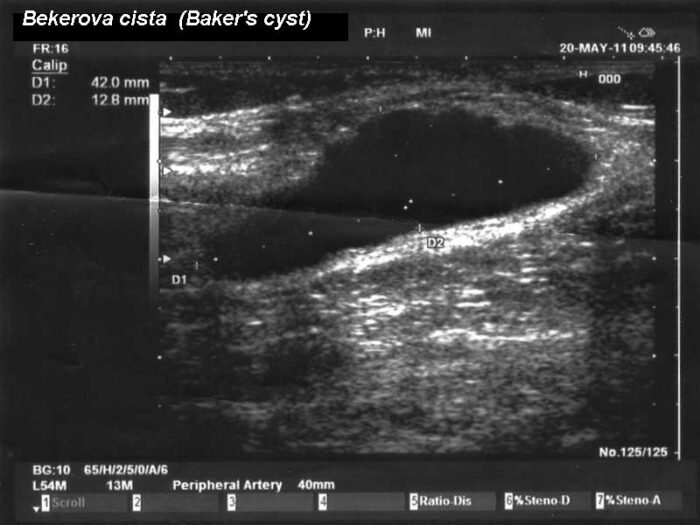
Behind the knee lies a small natural bursa between two muscles. When fluid builds up in the knee from inflammation, arthritis or a meniscal tear, it is pushed into this bursa through a one-way valve-like opening, which distends to form a Baker’s (popliteal) cyst.
Causes
- Knee osteoarthritis — the commonest cause in adults.
- Meniscal tears, especially posterior.
- Rheumatoid arthritis and gout.
- Knee injuries.
- In children: usually an isolated cyst without an internal knee problem that often resolves on its own.
Symptoms
- A soft swelling behind the knee, more obvious when standing.
- Tightness behind the knee, especially on full bending or straightening.
- Knee pain from the underlying cause.
- Occasionally leg swelling if the cyst presses on veins.
Video: a lump behind the knee — Baker’s cyst
When is a Baker’s cyst serious? Rupture versus a blood clot
The cyst can rupture and leak fluid into the calf, causing sudden calf pain, swelling and redness that look exactly like a deep vein thrombosis. A Doppler ultrasound of the leg veins is needed promptly to exclude a clot.
| Ruptured Baker’s cyst | Deep vein thrombosis | |
|---|---|---|
| Pain | Sudden in the calf, often after exertion | Usually gradual |
| Swelling | In the calf; bruising may appear near the ankle | Whole-leg swelling and warmth |
| Diagnosis | Ultrasound shows fluid | Doppler ultrasound shows the clot |
| Treatment | Rest, pain relief, treat the cause | Anticoagulation immediately |
Diagnosis
- Examination: a lump behind the knee, more obvious with the knee straight.
- Ultrasound: confirms a fluid cyst and excludes clot or aneurysm.
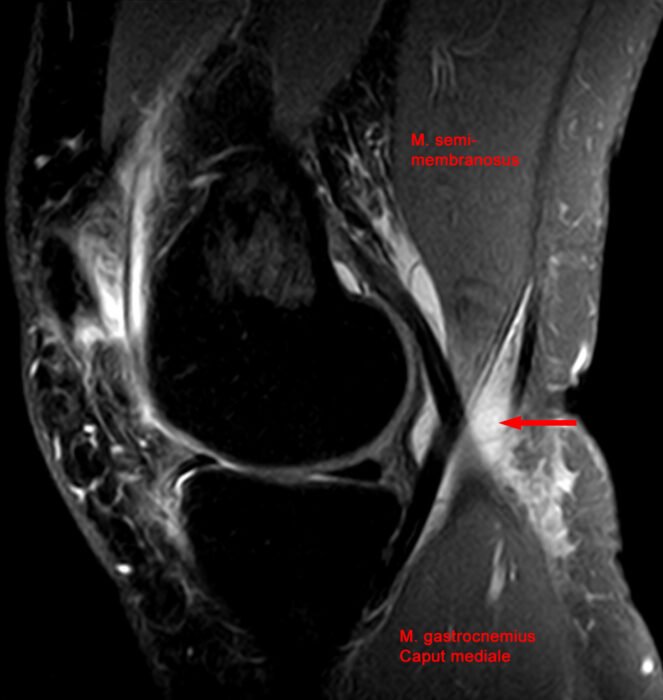
- MRI: identifies the cause inside the knee.
- X-ray to assess arthritis.
Key numbers to know
- In 297 painful knees examined by ultrasound, a Baker’s cyst was the second most common finding (16%) after medial meniscal tears (20%), and the two together were the commonest combination (Artul et al., 2014).
- A Baker’s cyst is a distension of a normal bursa behind the knee, most often the gastrocnemio-semimembranosus bursa (Herman and Marzo, 2014).
- Ganglion cysts are the most common soft-tissue masses of the hand and wrist and also occur in the knee and foot (StatPearls, 2023).
At Prof. Dr. Ibrahim Shaarawi’s clinics in Nasr City, Mohandeseen and New Cairo (5th Settlement) we examine the knee and scan the cyst, then identify the cause inside the joint before choosing treatment.
Treatment
| Treatment | When |
|---|---|
| Observation | Small, symptom-free cysts and most children’s cysts |
| Treat knee arthritis (medication, physiotherapy, injections) | Patients with osteoarthritis |
| Knee aspiration with intra-articular injection | Selected cases to settle fluid and inflammation |
| Knee arthroscopy for the meniscus and cyst opening | Meniscal tears or persistent symptoms |
| Surgical excision of the cyst | Rarely, when other treatment fails or the cyst is very large |
Removing the cyst without treating the problem inside the knee makes recurrence likely, so we always start by diagnosing the knee itself.
Other cysts around the knee
- Meniscal cyst: at the side of the knee along the joint line, linked to a meniscal tear.
- Prepatellar bursitis: swelling at the front of the knee from frequent kneeling.
- True ganglion near the knee: rare; may arise from ligaments or tendons.
Frequently asked questions about Baker’s cysts
What is a Baker’s cyst?
A collection of knee joint fluid in a sac behind the knee, usually caused by osteoarthritis or a meniscal tear increasing fluid inside the knee.
Is a Baker’s cyst dangerous?
Usually not, but it can rupture, causing calf pain and swelling that mimics a blood clot, so an ultrasound is needed to exclude one.
Does a Baker’s cyst go away on its own?
It may shrink or disappear once the cause inside the knee is treated, and often resolves on its own in children.
How is a Baker’s cyst treated?
By treating the cause: arthritis with medication, physiotherapy and injections, and meniscal tears with arthroscopy. Surgical removal is rarely needed.
What is the difference between a Baker’s cyst and a ganglion?
A Baker’s cyst is knee fluid in a bursa behind the knee; a ganglion is a jelly-filled cyst usually arising from the wrist or foot.
To have your cyst assessed, book a consultation, call +20 155 240 4488 or message us on WhatsApp at +20 155 554 7181.
Medically reviewed by Prof. Dr. Ibrahim Shaarawi, Professor of Orthopaedic Surgery. This article is general medical education and does not replace an examination or the treatment plan your surgeon sets for you. See our medical disclaimer.
Related ganglion cyst guides
Related ganglion and knee guides:
- Ganglion cysts
- Ganglion cyst of the hand and wrist
- Ganglion cyst of the foot and ankle
- Is a ganglion cyst a tumour?
- Ganglion cyst treatment without surgery
- Ganglion cyst removal surgery