
The posterior cruciate ligament (PCL) is the strongest ligament in the knee. It sits behind the ACL in the centre of the joint and stops the shin bone sliding backward. PCL injuries are much less common than ACL injuries, usually follow a direct blow to the front of a bent knee, and most isolated PCL tears are treated without surgery.
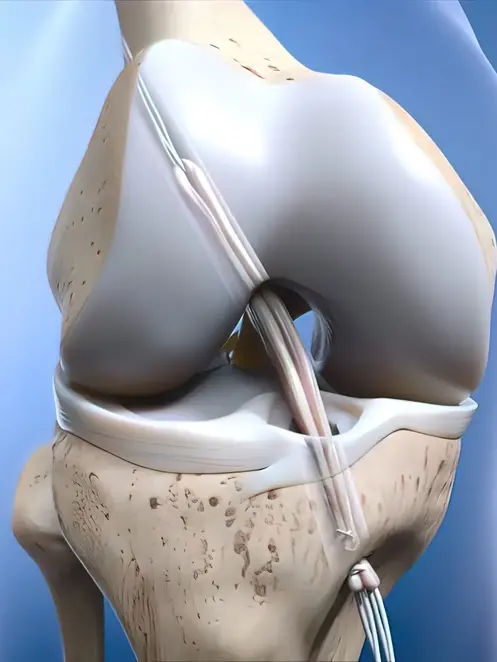
What is the PCL and where is it?
The PCL runs from the front-inner part of the femur to the back of the tibia, crossing the ACL in an X shape. It is wider and stronger than the ACL and is a key stabiliser when the knee is bent, for example going downstairs or squatting. Read more about the anterior cruciate ligament (ACL).
ACL vs PCL
| ACL | PCL | |
|---|---|---|
| Function | Stops the tibia sliding forward; controls rotation | Stops the tibia sliding backward |
| Strength | Thinner | Strongest knee ligament |
| Common cause of injury | Pivoting or awkward landing | Direct blow to a bent knee or falling onto it |
| Typical symptoms | Pop, fast swelling, knee gives way when turning | Pain at the back of the knee, milder swelling, instability on stairs |
| Usual treatment | Arthroscopic reconstruction for active people | Non-surgical for isolated tears; surgery for combined injuries |
What causes a PCL tear?
- Dashboard injury — the bent knee hits the dashboard in a car accident.
- Falling onto a bent knee with the foot pointed down.
- Sudden hyperflexion or hyperextension of the knee.
- High-energy injuries that damage several ligaments, such as knee dislocation.
Symptoms of a PCL tear
- Pain at the back or front of the knee, worse when kneeling.
- Mild to moderate swelling in the first hours or days.
- A feeling of looseness, especially going downstairs or downhill.
- Difficulty running or slowing down.
- Over time, pain at the front or inner side of the knee if instability is left untreated.
Diagnosis and grades
Diagnosis relies on the posterior drawer test and on seeing the tibia sag backward with the knee bent, followed by MRI; stress X-rays may measure how far the tibia shifts.
| Grade | Description | Usual treatment |
|---|---|---|
| Grade I | Small partial tear with limited backward shift | Non-surgical rehabilitation |
| Grade II | Larger partial tear with moderate shift | Usually non-surgical with a brace and follow-up |
| Grade III | Complete tear, sometimes with other ligament injuries | Non-surgical or surgical depending on associated injuries and symptoms |
Treatment
Without surgery
- A PCL brace that supports the back of the tibia in the first weeks.
- Rehabilitation focused on the quadriceps, which compensates for the PCL.
- Gradual return to activity guided by symptoms and strength.
When is surgery needed?
- PCL tear combined with other ligament injuries (ACL, collateral ligaments, posterolateral corner).
- The PCL pulled off with a fragment of bone, which can be fixed early arthroscopically.
- Ongoing instability or pain despite complete rehabilitation, especially in complete tears.
Reconstruction uses a tendon graft with principles similar to ACL reconstruction surgery, and rehabilitation usually takes longer.
Video: why is the knee so easily injured?
Frequently asked questions about the PCL
Can a PCL tear heal without surgery?
Yes. Unlike the ACL, the PCL has a better capacity to heal, and most isolated injuries improve with a brace and rehabilitation.
How do PCL and ACL tear symptoms differ?
ACL tears usually cause a pop, fast swelling and giving-way when turning; PCL tears cause milder swelling, pain at the back of the knee and instability on stairs.
How long does non-surgical PCL treatment take?
Most patients improve over weeks to a few months depending on the grade; return to sport depends on quadriceps strength and stability.
Can you walk with a torn PCL?
Usually yes, often almost normally, but stairs and running may be difficult, so the grade should be assessed.
Can an untreated PCL tear cause arthritis?
Chronic untreated instability can increase load on the front and inner knee over time, so PCL injuries are followed up even when treated without surgery.
To have your knee assessed, book a consultation, call +20 155 240 4488 or message us on WhatsApp at +20 155 554 7181.
Medically reviewed by Prof. Dr. Ibrahim Shaarawi, Professor of Orthopaedic Surgery. This article is general medical education and does not replace an examination or the plan your surgeon sets for you. See our medical disclaimer.
Related ACL guides
The PCL is part of our cruciate ligament guide; for surgery see ACL reconstruction surgery, and read:
- ACL reconstruction surgery
- The anterior cruciate ligament (ACL)
- ACL tear symptoms
- Partial ACL tear
- ACL treatment without surgery
References
- American Academy of Orthopaedic Surgeons (OrthoInfo). Posterior Cruciate Ligament Injuries.
- Gao S, et al. Management of posterior cruciate ligament injuries: an expert consensus from 17 countries. Int J Surg. 2025;111(6):4080-4085.
- Kiapour AM, Murray MM. Basic science of anterior cruciate ligament injury and repair. Bone Joint Res. 2014;3(2):20-31.