
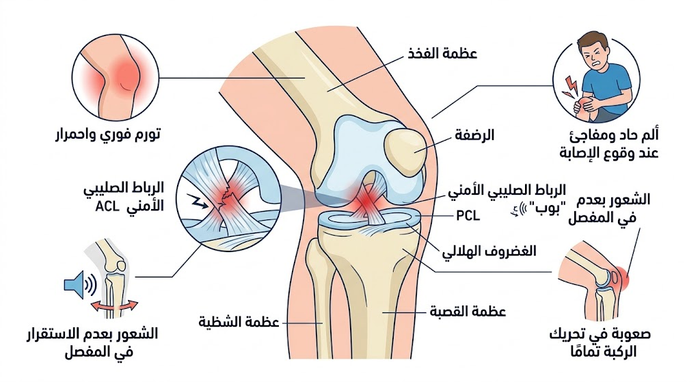
The Anterior Cruciate Ligament (ACL) is a strong structure composed of connective tissue located in the center of the knee. It plays a vital role in joint stability and helps control leg movement. The anterior and posterior cruciate ligaments are the most important, as they limit excessive movement and prevent the femur (thigh bone) from sliding over the tibia (shin bone). This ligament contributes significantly to maintaining balance and proper motor function.
A partial ACL tear means an incomplete rupture of the ligament, which partially affects the stability and function of the knee. It can be thought of as an intermediate state between mild injuries, such as an ACL sprain, and a complete ACL tear, which leads to a total loss of function. A partial tear differs from a complete tear in terms of injury severity and its impact on a person’s performance. A complete tear is usually accompanied by more severe symptoms, such as intense pain and the loss of the ability to bear weight.
There are several causes that can lead to a partial ACL tear, often depending on the type of physical activity the individual engages in. Violent or sudden movements, such as a quick turn or twist, are major contributing factors to this type of injury. Furthermore, previous injuries may play a role in increasing the risk of a cruciate ligament injury. Diagnosing this injury is highly precise and relies on clinical examination and imaging, enabling the best sports injuries doctor to differentiate it from other injuries that may present with similar symptoms.
Symptoms of a Partial ACL Tear
A partial tear in the cruciate ligament is a common injury affecting the knee, and several symptoms indicate its occurrence. One of the main symptoms is pain, which can range from moderate to severe, and may be constant or appear during physical activity. The pain is often centered around the knee area.
Swelling is another prominent symptom accompanying a partial ACL tear, resulting from fluid accumulation inside the joint. When swelling occurs, the injured person may notice that the knee looks larger than before, leading to difficulty in movement, and hindering the bending and straightening of the knee. Swelling may last for several days after the injury, impeding the ability to perform daily activities.
Additionally, the injured person may feel instability in the knee and face difficulty bearing weight or performing specific movements. This feeling of instability can be unsettling, as the person might feel as if their knee is not supporting them properly, increasing the risk of additional injuries. This symptom is very common among athletes, particularly noticed during activities requiring quick changes of direction or jumping.
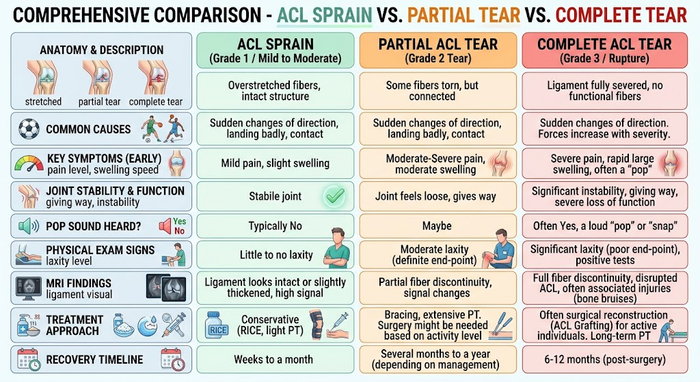
Comprehensive Comparison — Partial ACL Tear vs. Sprain vs. Complete Tear
| Comparison Criterion | ACL Sprain | Partial ACL Tear | Complete ACL Tear |
| Degree of Tear | Stretching without tearing (Grade I) | Partial tear (Grade II) | Complete tear (Grade III) |
| Pain Severity | Mild to moderate | Moderate to severe | Very severe — immediate |
| Swelling | Mild | Obvious — may last for days | Severe — blood inside the joint (hemarthrosis) |
| Stability | Preserved | Partially impaired | Complete loss of stability |
| Weight Bearing | Possible with slight pain | Difficult — requires support | Mostly impossible |
| Need for Surgery | Rarely | Depends on the case and activity | Mostly necessary for athletes |
| Approx. Recovery Time | 2–6 weeks | 6 weeks – 4 months | 6–12 months post-surgery |
| Most Accurate Diagnostic Tool | Clinical examination + X-ray | MRI — essential for accurate assessment | MRI + clinical examination |
Note: The above classification is indicative. An accurate diagnosis requires a direct clinical examination by a sports injuries specialist along with MRI interpretation. Symptoms alone are not relied upon to determine the degree of injury.
Diagnosis and Treatment Duration for a Partial ACL Tear
Diagnosing a partial ACL tear is a vital step in understanding the patient’s condition and determining the appropriate treatment plan. The first diagnostic step is consulting the best ACL doctor in Egypt to perform clinical examinations, which include a physical assessment of the knee. Doctors seek to determine the ligament’s stability and look for any signs indicating another knee injury. A common clinical test is the “Lachman test,” which evaluates the ligament’s response to stretching.
In addition to clinical examinations, medical imaging is a crucial step in the diagnostic process. X-rays are used first to confirm the absence of fractures in the bones surrounding the ligament. However, to obtain a more accurate assessment of the ACL’s condition, Magnetic Resonance Imaging (MRI) is utilized. This scan provides a precise depiction of the soft tissues, allowing the doctor to evaluate the degree of the ligament tear, its location, and its impact on surrounding tissues.
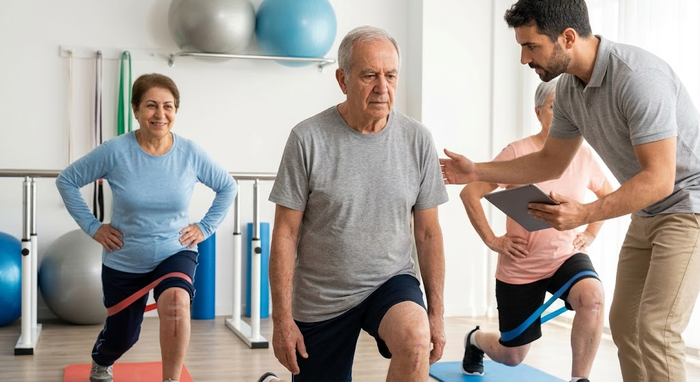
Regarding the treatment of a partial ACL tear, options range from conservative treatment to surgery. In mild cases, doctors opt for conservative treatment, which includes a period of rest, the application of ice, and physical therapy to improve the patient’s mobility and strengthen the muscles around the knee. In more severe cases, surgery may be necessary to repair the ligament. The duration of treatment depends on the severity of the injury, as the recovery period can take anywhere from a few weeks to several months. It is also important to note that the cruciate ligament does not regenerate naturally after a partial tear, highlighting the importance of taking appropriate measures to preserve knee health and function.
Can a Torn ACL be Treated Without Surgery?
Yes, it is possible. In the elderly and in cases of a simple partial tear, physical therapy and braces can be effectively used. (You can read this article for more information).
The Difference Between a Partial Tear and an ACL Sprain
Cruciate ligament injuries in the knee are common problems experienced by athletes and non-athletes alike. A partial ACL tear and an ACL sprain are often confused. Understanding the difference between these two injuries provides valuable information that aids in appropriate intervention and treatment.
When we speak of a partial ACL tear, we are referring to a condition where a portion of the ligament is torn, leading to weakness and instability in the knee. This type of injury is usually associated with severe pain and difficulty moving. It can occur due to sudden movements, such as changing direction or landing incorrectly. On the other hand, a sprain is considered a non-acute stretching of the ligament, often resulting from twisting movements or pressure on the knee.
Regarding symptoms, a partial ACL tear causes acute pain and obvious difficulty in movement, whereas the pain resulting from a sprain might be milder and is often accompanied by slight swelling. It is important to note that a sprain can be incidental and occur without a direct injury, while a partial tear is directly linked to an acute injury.
Treatment methods differ according to the type of injury. A partial tear may require surgical intervention, especially if the symptoms hinder the ability to perform daily activities. Conversely, some sprain cases may only require physical therapy and sports rehabilitation, where conservative treatments such as ice, rest, and knee support can help relieve pain and congestion.
By understanding the differences between a partial ACL tear, an ACL sprain, and a complete tear, the importance of obtaining an early, accurate diagnosis becomes clear. Consulting the most skilled orthopedic doctor in Egypt specializing in the cruciate ligament can greatly contribute to successful treatment and recovery. Therefore, it is advisable to consider the symptoms carefully and adhere to the recommended treatment schedule to achieve the best results.
Treatment of a Partial ACL Tear — Surgical vs. Conservative
| Criterion | Conservative Treatment (Non-Surgical) | Surgical Treatment (Reconstruction) |
| Suitable Cases | Simple partial tear — elderly — non-athletes | Athletes — large partial tear — chronic instability |
| Components | Rest + ice + brace + intensive physical therapy | Arthroscopic ligament reconstruction + rehabilitation protocol |
| Recovery Duration | 6 weeks – 4 months | 6–12 months |
| Return to Sports | Possible in light activities — limited in contact sports | Usually possible at the full competitive level |
| Risk of Future Deterioration | Higher — especially with sports and heavy loads | Lower — a strong new ligament |
| Natural Ligament Regeneration | Does not regenerate — heals with weaker scar tissue | Replaced with a stronger tendon graft |
| Total Cost | Lower immediately | Higher — but better in the long run for athletes |
Warning: The cruciate ligament does not regenerate with its original tissue after a partial tear. Making a treatment decision requires a careful individual assessment taking into account the patient’s age, activity level, and the degree of injury.
Who is the Best Knee Specialist Doctor in Egypt?
Cruciate ligament tears are at the core of the knee joint injuries specialty. Dr. Shaarawi is undisputedly considered one of the pioneers in this field in Egypt and the Arab world. This is based on his extensive experience in knee and cruciate ligament surgeries, patient testimonials, and numerous success stories of patients who were healed at his hands, thanks to God.

Frequently Asked Questions: Partial ACL Tears
An authoritative clinical guide covering anatomical bundle injuries, clinical stability tests, conservative rehabilitation, biologic augmentation, and surgical options.
What is a partial ACL tear?
A partial anterior cruciate ligament (ACL) tear is an injury where some collagen fibers of the ligament are disrupted while an anatomically intact, continuous portion remains anchored between the femur and tibia. The ACL comprises two functional components: the anteromedial (AM) bundle, which stabilizes the tibia against anterior displacement during flexion, and the posterolateral (PL) bundle, which controls rotatory laxity near full extension. A partial tear typically affects one of these bundles or involves an interstitial tear across a subset of ligament fibers.
What are the common symptoms of a partial ACL tear?
Key clinical signs include:
• Sudden knee pain during a pivoting, decelerating, or non-contact twisting mechanism.
• Moderate joint effusion or hemarthrosis developing over 12 to 24 hours (usually less explosive than the immediate swelling of a complete rupture).
• Terminal range-of-motion restriction due to intra-articular pressure.
• Absence of major instability during level walking, but apprehension or mild giving-way during rapid directional changes or stairs.
How does an orthopedic surgeon distinguish a partial from a complete ACL tear clinically?
Clinical evaluation focuses on manual laxity end-feel:
• Lachman Test: In a partial tear, there may be mild asymmetric anterior displacement (usually < 3–5 mm difference), but the examiner feels a firm, abrupt endpoint. In a complete tear, the endpoint is soft or empty.
• Pivot-Shift Test: Evaluates rotational subluxation. It is usually negative or grade 1 (a subtle glide) in stable partial tears, whereas high-grade ruptures yield a prominent clunk.
What is the accuracy of MRI in diagnosing partial ACL tears?
High-resolution MRI reliably detects intra-ligamentous edema, fiber discontinuity, and concomitant injuries such as meniscal tears and lateral compartment bone contusions. However, while MRI identifies structural disruption, it cannot assess the mechanical tension or functional stiffness of the remaining intact fibers. Therefore, imaging must always be interpreted alongside clinical physical exams to determine whether the residual ligament provides sufficient functional stability.
Can a partial ACL tear heal on its own without surgery?
Because the ACL is situated in an intra-articular environment bathed in synovial fluid (which dissolves early fibrin clots), torn collagen bundles rarely bridge back to their anatomical origin. However, the preserved intact bundle retains its blood supply and intact mechanoreceptors (proprioceptive nerve endings). Through dedicated neuromuscular rehabilitation, this intact portion undergoes biological remodeling and can successfully stabilize the knee for daily living and low-to-moderate sports.
What does non-operative (conservative) treatment involve?
Non-operative therapy is the first-line choice for low-grade partial tears with a firm endpoint:
• Phase 1 (Protection & Motion): Edema control with cryotherapy, brief bracing, and restoring extension and flexion.
• Phase 2 (Strengthening): Closed-kinetic-chain strengthening of the quadriceps, gluteals, and particularly the hamstrings, which act as dynamic ACL agonists by pulling the tibia posteriorly.
• Phase 3 (Neuromuscular Control): Proprioceptive and balance training on unstable surfaces to refine joint position sense and protect against re-injury.
Does Platelet-Rich Plasma (PRP) therapy help heal partial ACL tears?
Image-guided (ultrasound or fluoroscopy) intra-ligamentous injections of autologous leukocyte-poor PRP can provide biologic support for low-to-moderate partial tears. By delivering concentrated growth factors directly to the damaged fibers, PRP accelerates cellular proliferation, supports vascular ingrowth, reduces persistent synovitis, and can improve tissue tension within the recovering bundle alongside formal physical therapy.
When is surgical intervention necessary for a partial ACL tear?
Surgical treatment is indicated when:
1. More than 50% to 75% of ligament fibers are torn with pathological laxity on examination.
2. The patient experiences recurrent “giving-way” episodes or functional instability despite completing structured rehabilitation.
3. There is an associated meniscal tear requiring concomitant surgical repair to prevent joint degeneration.
4. The patient is a competitive athlete in high-demand pivoting sports (soccer, basketball, rugby) unable to tolerate subtle rotational laxity.
What is selective bundle ACL reconstruction (augmentation)?
Selective bundle reconstruction (augmentation) is an advanced arthroscopic technique performed when one bundle (typically the anteromedial) is ruptured while the other remains intact. Instead of resecting the whole ligament, the surgeon preserves the healthy bundle along with its blood supply and proprioceptive nerve endings. A single-bundle tendon graft is passed through isolated anatomical tunnels to replace only the torn bundle, optimizing joint biomechanics and promoting faster graft integration.
When can an athlete safely return to sports after a partial ACL tear?
Return to play depends on the chosen management pathway:
• Conservative Treatment: Non-pivoting conditioning can resume around 8 to 12 weeks, with return to full cutting sports permitted between 4 and 6 months once functional benchmarks are met.
• Selective Augmentation Surgery: Clearance generally takes 6 to 9 months to allow full graft ligamentization.
• Mandatory Criteria: Regardless of pathway, clearance requires a Limb Symmetry Index (LSI) of ≥ 90% in quadriceps and hamstring strength, ≥ 90% symmetry on single and triple-hop tests, and psychological readiness (ACL-RSI score).
References
- American Academy of Orthopaedic Surgeons (AAOS) — OrthoInfoAnterior Cruciate Ligament (ACL) Injuries — Diagnosis and Treatment — Last updated: 2022https://orthoinfo.aaos.org/en/diseases–conditions/anterior-cruciate-ligament-acl-injuries/
- Cleveland ClinicACL Injury: Causes, Symptoms, Diagnosis & Treatment — 2023https://my.clevelandclinic.org/health/diseases/15580-acl-injury
- Hospital for Special Surgery (HSS)ACL Tears: Partial vs. Complete — Diagnosis and Management — 2023https://www.hss.edu/condition-list_acl-tears.asp
- Mayo ClinicACL Injury — Diagnosis and Treatment — 2023https://www.mayoclinic.org/diseases-conditions/acl-injury/diagnosis-treatment/drc-20350430
- Medscape — Sports MedicineAnterior Cruciate Ligament Injury: Clinical Evaluation and Grading — 2022https://emedicine.medscape.com/article/89442-overview
- NICE (National Institute for Health and Care Excellence, UK)ACL reconstruction — Interventional procedures guidance [IPG586] — 2017 (In the context of available evidence)https://www.nice.org.uk/guidance/ipg586
- PubMed / NCBIDrogset JO et al. — Partial ACL tears: outcomes of conservative versus surgical management — Knee Surgery, Sports Traumatology, Arthroscopy 2006; 14(2):164–169https://pubmed.ncbi.nlm.nih.gov/16158248/
- British Journal of Sports Medicine (ScienceDirect)Filardo G et al. — Platelet-rich plasma for ACL reconstruction and partial tears: a systematic review — BJSM 2021; 55(1):25–33https://pubmed.ncbi.nlm.nih.gov/32152045/