
Knee osteoarthritis (OA) occurs when the articular surface of the knee joint wears down. It is a leading cause of knee pain, particularly in older adults, and can be effectively managed without surgery through several targeted interventions. In this article we will discuss Non-Surgical Treatment of Knee Osteoarthritis
Causes and Risk Factors
The main contributors to knee OA are: advancing age (cartilage weakens and erodes over time); excess body weight (the second most important risk factor) repetitive sports injuries; and underlying conditions such as septic arthritis or rheumatoid arthritis. Symptoms include pain on movement that worsens at certain times, a clicking or crunching sensation during walking, and limitations on daily activities such as stair climbing. OA can also contribute to anxiety and depression through its impact on quality of life.
Prevention
- Maintaining a healthy weight — excess weight accelerates cartilage breakdown.
- Moderate physical activity such as walking and swimming.
- Targeted exercises to strengthen periarticular muscles and improve flexibility.
- A knee brace in moderate-grade OA to prevent progression.
- Regular follow-up with a knee specialist to monitor joint health.
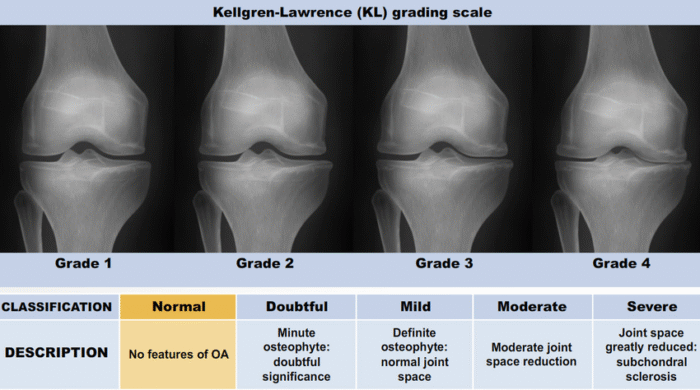
OA Grades and Non-Surgical Treatment of Knee Osteoarthritis
| Grade | Symptoms | Best Non-Surgical Options | Appropriate Injection | Radiofrequency? | Is Non-Surgical Sufficient? |
|---|---|---|---|---|---|
| Grade 1 | Mild pain — no disability | Exercise + weight loss + supplements | PRP (optional) | Not needed | Yes — very effective |
| Grade 2 | Regular pain + morning stiffness | Physiotherapy + medication + supplements | Hyaluronic acid or PRP | Optional | Yes — primary option |
| Grade 3 | Severe pain + swelling + limited ROM | Medication + physiotherapy + injections | Corticosteroid or hyaluronic acid | Suitable option | Partially — bridge to surgery |
| Grade 4 | Constant pain at rest | Analgesia for pain relief only | Hyaluronic acid (very temporary) | Temporary pain relief | No — joint replacement |
| * Based on OARSI 2019, EULAR 2023, and ACR/AF 2020. PRP evidence remains limited and is appropriate for early grades only. | |||||
Non-Surgical Options — Full Comparison
| Treatment Option | Suitable Grade | Pain Relief Rate | Duration of Effect | Frequency / Year | Treats OA? | Key Limitation |
|---|---|---|---|---|---|---|
| Physiotherapy + exercise | 1–3 | 60–80% with adherence | Ongoing if maintained | Daily | Slows progression | Requires strict daily commitment |
| Oral NSAIDs | 1–3 | Good symptom relief | While in use only | As needed | No | GI side effects — requires gastric protection |
| Topical gels / creams | 1–3 | Mild — low joint penetration | Hours | 2–3× daily | No | Least effective — supportive use only |
| Glucosamine + chondroitin | 1–2 | Variable — appears after 3–6 months | Ongoing with use | Daily | Partly — preserves cartilage | No clinical superiority between brands proven |
| PRP injection | 1–2 only | Variable — inconclusive evidence | 3–6 months | 2–4 sessions | Partly — tissue repair stimulation | Unproven in RCTs — expensive — early grades only |
| Hyaluronic acid injection | 2–3 | 60–75% | 6–12 months | 1–2 times | No — lubrication only | Less effective in Grade 4 |
| Corticosteroid injection | 2–3 | 70–90% | 6 months–1 year | 2–3 max | No — anti-inflammatory only | Max 3 per year — tendon weakening risk |
| Radiofrequency ablation | 2–4 | Good pain reduction | 6–18 months | As needed | No — nerve ablation only | Nerves regrow — pain can return |
| * Based on OARSI 2019, EULAR 2023, ACR/AF 2020, NICE NG226. No non-surgical option cures OA — the goals are pain relief, functional improvement, and slowing progression. | ||||||
When Is Total Knee Replacement Indicated?
Total knee replacement (TKR) is considered when non-surgical treatment fails to adequately control pain and restore function. Global success rates exceed 97%.
| Criterion | Non-Surgical Treatment Sufficient | Surgical Assessment Needed |
|---|---|---|
| Pain pattern | Improves with medication and physiotherapy | Constant even at rest — unresponsive to drugs |
| X-ray grade | Grade 1 or 2 | Grade 4 — bone on bone |
| Daily function | Limited but manageable walking | Unable to walk or climb stairs |
| Duration of conservative treatment | Under 6 months or responding well | Over 6–12 months with no meaningful response |
| Injection response | Responds to corticosteroid or hyaluronic acid | No effect even from intra-articular injections |
| TKR success rate (worldwide) | > 97% — substantial improvement in quality of life in appropriately selected patients | |
| * Based on AAOS, Mayo Clinic, and NICE NG226. Age and general health condition influence the decision — not every Grade 4 patient requires immediate surgery. | ||

Summary: Over 90% of knee OA patients improve with non-surgical treatment when started early and adhered to consistently. Surgery is an excellent option when conservative care fails, and with a global success rate exceeding 97%, TKR is one of the most successful surgical procedures in orthopaedics.
Frequently Asked Questions: Non-Surgical Treatment of Knee Osteoarthritis
An authoritative guide to non-operative joint preservation, physical rehabilitation, injectable biologics, pain ablation, and surgical escalation thresholds.
Can knee osteoarthritis be successfully managed without surgery?
Yes. The vast majority of patients with mild-to-moderate knee osteoarthritis (Kellgren-Lawrence grades 1 to 3) can achieve durable symptom control and functional restoration through non-operative strategies. While conservative measures do not regrow lost hyaline cartilage, a multimodal non-surgical protocol effectively reduces synovial inflammation, decelerates structural degradation, relieves mechanical joint pain, and delays or completely avoids surgical intervention.
What are the core pillars of conservative knee osteoarthritis management?
Evidence-based non-surgical protocols (endorsed by OARSI, AAOS, and ACR) rely on five synergistic pillars:
• Biomechanical Joint Unloading: Targeted weight reduction to diminish dynamic contact stress.
• Structured Exercise & Physical Therapy: Closed-chain kinetic strengthening of the quadriceps and peripatellar stabilizers.
• Targeted Pharmacotherapy: Prioritizing topical NSAIDs and selective anti-inflammatories over systemic opioids.
• Intra-Articular Injections: Viscosupplementation (hyaluronic acid), regenerative biologics (PRP), and judicious corticosteroids.
• Orthotic Realignment: Dynamic unloader knee braces and biomechanical shoe modifications.
How does weight loss contribute to joint preservation and pain reduction?
Biomechanically, each kilogram of body weight lost removes approximately four kilograms of compressive mechanical force across the tibiofemoral joint during ambulation. Additionally, adipose tissue functions as an endocrine organ that secretes systemic pro-inflammatory adipokines (such as leptin and resistin). Achieving a 5% to 10% weight loss blunts chronic inflammatory degradation and delivers clinically meaningful pain reduction.
What role does physical therapy play in protecting the arthritic knee?
Physical therapy functions as an internal shock absorber. Dedicated isometric and closed-chain strengthening of the quadriceps femoris, hamstrings, and hip abductors stabilizes the mechanical axis of the lower extremity, redistributes ground reaction forces away from denuded articular surfaces, and stimulates synovial fluid circulation to nourish remaining cartilage without high axial impact.
Which medications are prioritized for safe, long-term non-surgical pain management?
Topical NSAIDs (such as diclofenac gel) represent the first-line pharmacologic standard due to local joint penetration and minimal systemic bioavailability, which prevents gastrointestinal and renal adverse events. Oral NSAIDs or selective COX-2 inhibitors are reserved for acute inflammatory flares for limited intervals with gastric protection. Centrally acting modulators like duloxetine can be integrated for refractory or centralized chronic pain, whereas systemic opioids are strongly discouraged.
How do hyaluronic acid (viscosupplementation) injections work?
Hyaluronic acid (HA) acts as a viscoelastic supplement that restores the decreased molecular weight and concentration of native synovial fluid found in arthritic joints. It enhances boundary lubrication, restores elastoviscosity, absorbs mechanical shear stresses, and exerts mild local anti-inflammatory properties, often providing sustained functional improvement for 6 to 12 months in mild-to-moderate osteoarthritis.
What is the evidence regarding Platelet-Rich Plasma (PRP) therapy?
Autologous platelet-rich plasma (leukocyte-poor PRP) delivers concentrated bioactive growth factors (such as TGF-beta, PDGF, and IGF-1) and anti-inflammatory cytokines derived from the patient’s centrifuged blood. High-level comparative meta-analyses demonstrate that PRP can downregulate catabolic enzymes (MMP-13), modulate synovial inflammation, and provide superior, longer-lasting pain relief (spanning 9 to 12 months) compared with corticosteroids or hyaluronic acid in early-to-intermediate disease.
What is Genicular Nerve Radiofrequency Ablation (RFA)?
Genicular nerve radiofrequency ablation (RFA) is a minimally invasive, fluoroscopically or ultrasound-guided interventional procedure. By applying targeted thermal energy to disrupt the sensory genicular nerve branches (superior medial, superior lateral, and inferior medial) that transmit nociceptive signals from the knee capsule, RFA provides profound, long-term pain relief (lasting 6 to 24 months) without impairing motor function, making it ideal for non-surgical candidates or patients deferring replacement.
How do unloader knee braces help delay or prevent surgery?
Unloader knee braces utilize a three-point leverage system to apply a corrective mechanical moment across the knee joint. In isolated unicompartmental osteoarthritis (most commonly medial compartment disease with varus malalignment), an unloader brace mechanically widens the narrowed joint space during weight-bearing, transferring axial loads to the preserved compartment, improving gait biomechanics, and reducing daily pain.
At what point is non-surgical treatment considered to have failed?
Non-surgical therapy is deemed refractory when a patient experiences intractable pain and significant functional disability despite 3 to 6 months of comprehensive multi-modal conservative management. When advanced structural collapse (Kellgren-Lawrence grade 4, complete bone-on-bone contact) is coupled with rest pain, sleep disruption, and fixed angular or flexion contractures that impair daily independence, surgical consultation for joint replacement is indicated.
References
- NICE Guideline NG226. Osteoarthritis in over 16s: diagnosis and management. 2022. Available at: nice.org.uk
- AAOS OrthoInfo. Osteoarthritis of the Knee. 2023. Available at: orthoinfo.aaos.org
- Mayo Clinic Staff. Osteoarthritis – Symptoms and causes. 2024. Available at: mayoclinic.org
- Kolasinski SL, et al. 2019 ACR/AF Guideline for the Management of Osteoarthritis. Arthritis & Rheumatology. 2020;72(2):220–233. DOI: 10.1002/art.41142
- Bannuru RR, et al. OARSI guidelines for the non-surgical management of knee, hip, and polyarticular OA. Osteoarthritis and Cartilage. 2019;27(11):1578–1589. DOI: 10.1016/j.joca.2019.06.011
- Cleveland Clinic. Osteoarthritis of the Knee. 2023. Available at: my.clevelandclinic.org
- Rutjes AW, et al. Viscosupplementation for osteoarthritis of the knee. Annals of Internal Medicine. 2012;157(3):180–191. DOI: 10.7326/0003-4819-157-3-201208070-00473
- Hospital for Special Surgery (HSS). Knee Osteoarthritis Treatment. 2023. Available at: hss.edu