
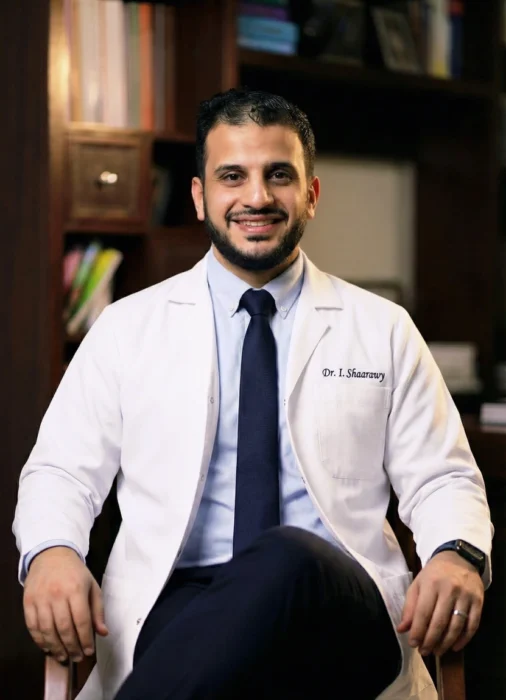
Dr. Ibrahim Shaarawi, Consultant of Surgical Oncology at Ain Shams University Hospitals and Visiting Professor of Orthopedic and Soft Tissue Oncology at Ohio State University Hospitals in the USA, is undisputedly considered the best surgical oncologist in Egypt. Dr. Ibrahim Shaarawi has an outstanding track record in treating peripheral tumors affecting the upper and lower extremities across all tissue types, whether they are muscular tumors, lipomas (fatty tumors), or bone tumors.
Below, we will detail all cancerous tumors, their treatment methods, and why Dr. Shaarawi is classified as the Best Orthopaedic Oncology Surgeon in Egypt.
Surgical oncology is a vital medical specialty focused on the excision of benign and malignant tumors, whether cancerous or non-cancerous, and surgery represents a crucial part of cancer treatment. In Egypt, surgical oncology plays a pivotal role in improving recovery rates for patients suffering from various types of cancer. Choosing the best surgical oncologist in Egypt directly impacts therapeutic outcomes and the patient’s health. This type of surgery is challenging and requires extensive experience, specialized skills, and comprehensive expertise in handling complex cases in various body parts.
A surgical oncologist is characterized by their training in advanced techniques to reach an accurate diagnosis before initiating surgical intervention. Cancer patients differ from others in their need for a surgeon capable of handling tumors safely and with high efficacy. However, patients face many challenges when choosing the right doctor. This may involve searching for a surgical oncologist with a stellar reputation, in addition to ensuring they hold the necessary certifications and adequate training.
The Best Surgical Oncologist in Egypt: Selection Criteria
When searching for the best surgical oncologist in Egypt, there is a set of important criteria to consider to ensure you choose a doctor who fits the patient’s needs. One of the most important of these criteria is experience. The field of surgical oncology requires deep knowledge and advanced techniques, so it is preferable to choose a doctor with many years of experience in this field. You should look for previous records of the surgeries they have performed, as the success rate of operations reflects the doctor’s experience in handling various cases.
Medical certifications and specialties also play a major role in choosing the best surgical oncologist. The doctor must hold recognized qualifications from official health authorities and be highly experienced in surgical oncology. If the doctor has undergone additional training or obtained specialized certifications in treating specific types of cancers, this reflects their commitment to providing effective and comprehensive treatment.
Doctor ratings and patient reviews also play a key role. It is highly recommended to look for the evaluations and experiences of previous patients with the doctor, as they can give you valuable insights into the level of care you can expect. These testimonials help form an idea of how close the doctor is to their patients and how they handle fears and challenges during treatment.
Ultimately, when choosing a surgical oncologist, all these criteria should be balanced carefully, which will ensure the provision of appropriate and effective healthcare simultaneously. Choosing the right doctor can make a massive difference in treatment outcomes and the overall patient experience.
Types of Tumors Treated by the Best Surgical Oncologist in Egypt
Tumors are considered a significant medical challenge that requires high expertise in the field of peripheral soft tissue and bone oncology surgery. When searching for the best orthopedic oncology surgeon in Egypt, it is important to know the different types of tumors they specialize in treating. Tumors are generally divided into two main types: cancerous (malignant) tumors and non-cancerous (benign) tumors.
Cancerous tumors, also known as malignant tumors, arise due to the uncontrolled division of cells. These tumors tend to spread to adjacent tissues and other body organs, making them more dangerous. For example, cancerous tumors can affect any tissue or organ in the body and require immediate surgical intervention by an experienced surgical oncologist.
Dr. Shaarawi specializes in treating all peripheral tumors, meaning those affecting all tissues of the upper extremities from the shoulder to the hand, or the lower extremities from the pelvis to the foot. Among the most common tumors treated by the surgical oncologist are:
- Lipomas (fatty tumors)
- Malignant muscle tumors
- Peripheral nerve tumors
- Malignant bone tumors
- Joint tumors
- Benign and malignant synovial tumors
- Bone metastases from breast or prostate cancer
Non-cancerous tumors, or benign tumors, are usually not dangerous because they do not spread to surrounding tissues. These tumors may include sebaceous cysts, muscle tumors, and various soft tissue tumors. Although these types of tumors are non-cancerous, they may require surgical removal if they cause pain or exert pressure on other organs.
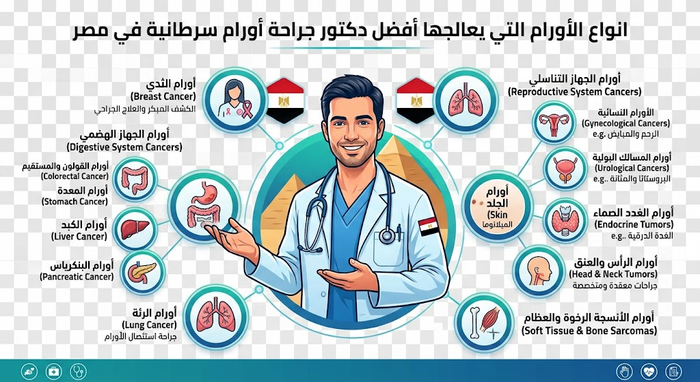
Types of Peripheral Tumors Treated by Dr. Shaarawi — Benign and Malignant
| Tumor Type | Affected Tissue | Nature | Common Locations | Urgency | Treatment Approach |
| Lipoma | Fatty tissue | Benign | Shoulder, back, upper and lower extremities | Non-urgent — Observation or excision | Elective surgical excision or when symptomatic |
| Liposarcoma | Fatty tissue | Malignant | Thigh, retroperitoneum | Urgent | Wide-margin excision + radiotherapy |
| Malignant Muscle Tumor (Rhabdomyosarcoma / Leiomyosarcoma) | Muscle tissue | Malignant | Upper and lower extremities | Very urgent | Excision + chemotherapy + radiotherapy |
| Peripheral Nerve Tumors | Nerve sheath | Benign or malignant (MPNST) | Arm and leg nerves | Urgent evaluation | Precise excision while preserving nerve function |
| Malignant Bone Tumors (Osteosarcoma / Ewing) | Extremity bones | Malignant | Around the knee, shoulder, pelvis | Very urgent | Preoperative chemotherapy + excision + reconstruction |
| Joint Tumors (GCTTS) | Tendon sheath or synovium | Benign — rarely malignant | Hand, knee, ankle | Evaluation within a week | Excision alongside the tendon sheath |
| Malignant Synovial Tumors (Synovial Sarcoma) | Synovium | Malignant | Near large joints | Very urgent | Wide excision + radiotherapy |
| Bone Metastases | Extremity bones (from breast or prostate) | Malignant (Secondary) | Femur, humerus, spine | Urgent — Risk of pathological fracture | Prophylactic surgical fixation + treatment of the primary tumor |
Booking Steps with the Best Surgical Oncologist in Cairo
Dr. Ibrahim Shaarawi’s surgical oncology clinics cover most areas of Cairo. There is a surgical oncology clinic in Nasr City, a surgical oncology clinic in the Fifth Settlement, and an oncology clinic in Mohandeseen.
You can book an appointment at any of the branches by calling 00201555547181.
[Book an Appointment] [Call]
What is the Difference Between Malignant and Non-Malignant Tumors?
Cancerous tumors are called malignant tumors due to their rapid division and their ability to invade surrounding tissues and spread throughout the body. In contrast, benign tumors behave less aggressively; they increase in size but slowly, do not spread to other body parts, and primarily cause issues by putting pressure on surrounding tissues. (You can read this article to learn more about what a cancerous tumor looks like).
It is crucial to understand the difference between malignant and non-malignant tumors. Malignant, or cancerous, tumors are those that contain cancer cells capable of spreading to other parts of the body. This requires more complex treatment plans, including surgery, chemotherapy, and radiation therapy. In contrast, non-malignant tumors do not spread and tend to be less dangerous. However, some non-malignant tumors may need monitoring or removal if they exert pressure on adjacent tissues or cause bothersome symptoms.
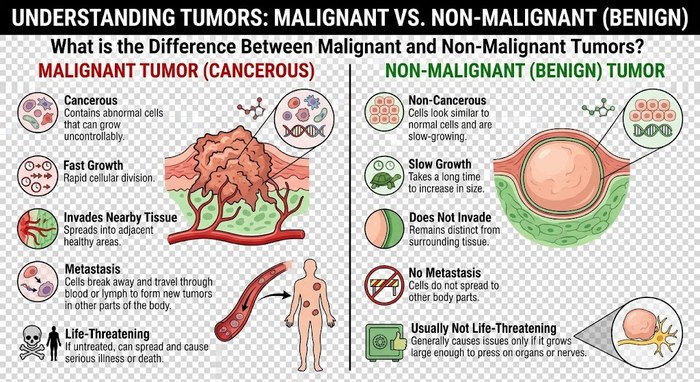
Difference Between Benign and Malignant Tumors — Quick Comparison Table
| Characteristic | Benign Tumor | Malignant (Cancerous) Tumor |
| Growth Rate | Slow — months to years | Fast — weeks to months |
| Invasion of Adjacent Tissues | No — limited by clear borders | Yes — invades tissues |
| Spread (Metastasis) | Does not spread | Spreads via blood or lymph |
| Consistency on Examination | Soft, elastic — movable | Hard — usually immobile |
| Borders on MRI | Clear and well-defined | Unclear — extending into tissues |
| Life Threat | Low — rarely life-threatening | High — requires urgent intervention |
| Final Diagnosis | MRI + Ultrasound are often sufficient | Biopsy is mandatory before any surgery |
| Excision Approach | Simple excision with a limited margin | Wide-margin excision — may include reconstruction |
To ensure receiving appropriate healthcare, one must know the steps for booking with the best surgical oncologist in Egypt. You can start by searching for specialized doctors in surgical oncology and consulting their reviews and previous experiences. After that, contact the clinic to schedule an appointment. Often, the booking process also involves an initial consultation where the patient can ask questions and determine the exact nature of the tumor they have.
The initial consultation includes clinical examinations and may involve advanced imaging techniques like X-rays and MRI scans. It is important that appointments are timely, given the importance of early examination in determining the tumor type. Additionally, the patient should bring the results of previous tests and X-rays because this information can help the doctor make more accurate treatment decisions.
When discussing treatment options, it is essential to collaborate with the surgical oncologist to understand the consequences of each tumor type and how it might affect treatment planning. It is worth noting that making sound decisions after an accurate diagnosis is the foundation of successful treatment and recovery.
The Patient Journey: From the First Appearance of a Mass to Surgery
| Step | What Happens | Goal | Duration |
| 1 | Initial Consultation — Clinical Examination: | Assessing the mass’s size, consistency, location, and danger signs | First visit |
| 2 | MRI Scan: | Determining the tumor’s borders, depth, and its relationship to blood vessels and nerves | Within a week |
| 3 | Ultrasound or Endoscopy-Guided Biopsy: | Final histological diagnosis — benign or malignant? | After the MRI |
| 4 | Multidisciplinary Team (MDT) Discussion: | Coordinating with medical and radiation oncologists in case of malignancy | One week |
| 5 | Surgical Planning: | Determining the excision margin and the need for reconstruction | Before surgery |
| 6 | Surgical Excision: | Removing the tumor with an adequate margin while preserving function as much as possible | Day of surgery |
| 7 | Routine Follow-Up: | Detecting any early recurrence + periodic MRI | Every 3–6 months |
Frequently Asked Questions: Best Orthopaedic Oncology Surgeon in Egypt
Authoritative guidance on primary bone sarcomas, soft tissue tumors, limb-salvage reconstructions, biopsy safety, and multidisciplinary care.
What credentials define the best orthopaedic oncology surgeon in Egypt?
The leading orthopaedic oncology surgeons in Egypt are recognized by:
• Academic Rank & Training: University Professorships or Consultant appointments at top academic faculties (such as Ain Shams University or Cairo University) and specialized cancer institutes, supported by doctoral degrees (MD/PhD) and international fellowship training.
• Subspecialized Case Volume: High annual surgical volumes in musculoskeletal tumor resections, complex pelvic reconstructions, and custom megaprosthetic joint replacements.
• Tumor Board Integration: Active participation in Multidisciplinary Tumor Boards (MDTs) to coordinate systemic therapy with surgical intervention.
• Tertiary Hospital Access: Operating within fully equipped tertiary hospitals with advanced ICUs, dedicated blood banks, and intraoperative frozen section pathology services.
What conditions are treated by an orthopaedic oncologist?
Orthopaedic oncologists treat benign, aggressive, and malignant musculoskeletal lesions, including:
• Primary Malignant Bone Tumors: Osteosarcoma, Ewing sarcoma, Chondrosarcoma, and Chordoma.
• Soft Tissue Sarcomas: Liposarcoma, Synovial sarcoma, Leiomyosarcoma, and Undifferentiated Pleomorphic Sarcoma (UPS).
• Locally Aggressive Benign Lesions: Giant Cell Tumor (GCT) of bone, Aneurysmal Bone Cysts (ABC), and Desmoid tumors.
• Skeletal Metastases: Pathological and impending fractures secondary to carcinomas (breast, lung, renal, thyroid, prostate).
What is limb-salvage (limb-sparing) surgery, and is it widely available in Egypt?
Limb-salvage surgery involves resecting the musculoskeletal tumor with clear surgical margins while preserving the extremity, avoiding amputation in over 90% to 95% of cases. In Egypt, specialized centers perform advanced reconstructions utilizing modular tumor megaprostheses, 3D-printed patient-specific titanium implants, massive allografts, or vascularized biological transfers (such as free vascularized fibula autografts), restoring mobility and anatomical integrity.
Why must a suspected bone tumor biopsy be planned by an orthopaedic oncologist?
The biopsy tract must be completely excised en bloc with the surgical specimen during definitive oncological surgery. An improperly oriented or transverse biopsy performed by inexperienced hands can violate multiple compartments, cross tissue planes, or contaminate neurovascular bundles. This can lead to local recurrence and convert a limb-salvage candidate into a patient requiring amputation. Biopsies should always be performed or planned by the operating orthopaedic oncologist.
What role does a Multidisciplinary Tumor Board (MDT) play in musculoskeletal cancer care?
The MDT is essential for comprehensive sarcoma management. Comprising the orthopaedic oncology surgeon, medical oncologist, radiation oncologist, specialized musculoskeletal pathologist, and diagnostic radiologist, the board reviews all clinical and molecular data together. This ensures optimal timing for neoadjuvant chemotherapy (to induce tumor necrosis prior to resection), precision radiation therapy, and coordinated reconstructive surgery.
How is a modular tumor megaprosthesis used after bone tumor resection?
Resection of aggressive or malignant tumors around major joints (such as the distal femur, proximal tibia, or proximal humerus) leaves substantial skeletal and articular defects. Modular tumor endoprostheses (megaprostheses) are modular prosthetic systems made of titanium and cobalt-chromium alloys that replace both the resected bone segment and the joint. They provide immediate structural stability, facilitate soft tissue attachment, and allow early post-operative mobilization.
How are metastatic bone lesions and impending pathological fractures managed?
For secondary bone metastases, the orthopaedic oncologist evaluates fracture risk using validated clinical tools (such as Mirels’ Criteria). High-risk or completed pathological fractures are treated with prophylactic intramedullary rodding, anatomical plating with polymethylmethacrylate (PMMA) bone cement augmentation, or joint arthroplasty. The objective is to restore skeletal stability, eliminate pain, and maintain independent functional mobility.
What diagnostic imaging workup is required before tumor surgery?
A complete diagnostic workup includes:
• Biplanar Digital Radiographs: Standard X-rays to assess bone destruction pattern, periosteal reaction, and matrix mineralization.
• Contrast-Enhanced High-Field MRI: Essential for determining intramedullary spread, “skip lesions,” fascial involvement, and proximity to major neurovascular bundles.
• Systemic Staging Studies: High-resolution chest CT (as the lungs are the primary metastatic site for sarcomas) and whole-body PET-CT or bone scintigraphy to evaluate systemic dissemination.
Why is achieving clear surgical margins (R0 resection) critical in sarcoma surgery?
An R0 resection confirms that the excised specimen is enveloped by a continuous envelope of uninvolved, healthy tissue, leaving microscopic margins free of malignant cells. In primary sarcomas, achieving wide, clear negative margins remains the single most important surgeon-controlled prognostic factor to minimize local recurrence, safeguard limb function, and improve long-term disease-specific survival.
What is the expected rehabilitation and surveillance protocol following orthopaedic oncology surgery?
Post-operative care involves two parallel pathways:
• Functional Rehabilitation: Tailored physical therapy focusing on weight-bearing progression, gait retraining, muscle transposition conditioning, and range-of-motion optimization.
• Oncological Surveillance: Clinical assessments, local extremity imaging (MRI/radiographs), and chest imaging (CT scans) every 3 months for the first 2 years, every 6 months through year 5, and annually up to 10 years to monitor implant durability and detect early recurrence.
References
WHO Classification of Tumours Editorial Board. WHO Classification of Soft Tissue and Bone Tumours. 5th edition. International Agency for Research on Cancer (IARC). 2020. متاح على: iarc.who.int- ESMO Clinical Practice Guidelines. Soft tissue and visceral sarcomas: ESMO–EURACAN–GENTURIS Clinical Practice Guidelines. Annals of Oncology. 2021;32(11):1348–1365. DOI: 10.1016/j.annonc.2021.07.006
- NCCN Clinical Practice Guidelines in Oncology. Bone Cancer. Version 2.2024. National Comprehensive Cancer Network. 2024. متاح على: nccn.org
- AAOS OrthoInfo. Soft Tissue Tumors. American Academy of Orthopaedic Surgeons. 2023. متاح على: orthoinfo.aaos.org
- Hospital for Special Surgery (HSS). Sarcoma Treatment. 2023. متاح على: hss.edu
- Mayo Clinic Staff. Soft tissue sarcoma – Symptoms and causes. Mayo Clinic. 2023. متاح على: mayoclinic.org
- Enneking WF, et al. A system for the surgical staging of musculoskeletal sarcoma. Clinical Orthopaedics and Related Research. 1980;153:106–120. DOI: 10.1097/00003086-198011000-00013
- Medscape. Soft Tissue Sarcoma Treatment & Management. 2024. متاح على: emedicine.medscape.com