
Arthroscopic meniscus repair means stitching a torn meniscus back together through small keyhole incisions instead of trimming it away. The goal is to keep the knee’s shock absorber, which protects the joint from osteoarthritis in the long run. Not every tear can be repaired: the tear’s location and pattern, and the patient’s age, decide it. Prof. Dr. Ibrahim Shaarawi, Professor of Orthopaedic Surgery in Cairo, explains when repair saves the meniscus, how it is done, and how recovery differs from a meniscectomy.
Key takeaways
- Repair keeps the meniscus; partial meniscectomy removes part of it. Long-term studies link preserving the meniscus to less knee osteoarthritis years later.
- The best candidates are recent longitudinal tears in the outer third (the red zone), especially in younger patients and when combined with ACL reconstruction.
- Recovery is slower than after trimming: crutches and a brace for several weeks, and return to sport usually at 4 to 6 months.
- Roughly one in four to five repairs fails and needs another procedure within five years, so the result depends on choosing the right tear and on disciplined rehabilitation.
What is meniscus repair?
Each knee has two C-shaped fibrocartilage menisci: medial (inner) and lateral (outer). They sit between the thigh bone and the shin bone. They spread load, absorb shock and help stabilise the knee. When one tears, the surgeon has two main options during knee arthroscopy:
- Partial meniscectomy (trimming): removing the torn, non-healing part and smoothing the rim.
- Meniscus repair (suturing): bringing the torn edges together with special stitches so the meniscus heals in place.
Repair is the tissue-preserving option, but it only works if the tear is in a place that can heal.
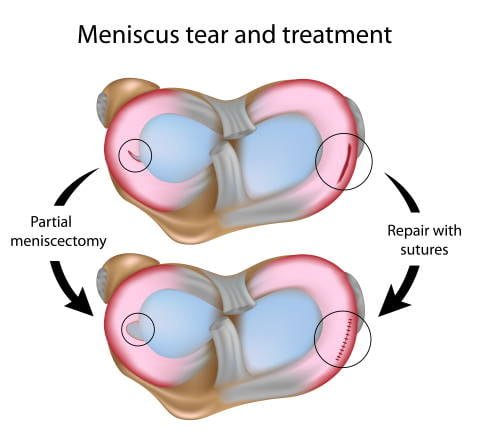
Why try to save the meniscus?
Every piece of meniscus that is removed reduces the area that carries load inside the knee. That raises the pressure on the articular cartilage and, over years, raises the risk of knee osteoarthritis. The European meniscus consensus (ESSKA) is clear: save the meniscus whenever possible.
A systematic review comparing repair with partial meniscectomy found better long-term function after repair, although repeat surgery is more likely. In a long-term follow-up of athletes, repair was linked to better return to activity and fewer arthritic changes on X-ray.
When is a meniscus tear repairable?
The surgeon judges this from the MRI and confirms it by looking directly at the tear during arthroscopy:
| Factor | Favours repair | Favours partial meniscectomy |
|---|---|---|
| Location | Outer third (red zone), close to the blood supply | Inner third (white zone), no blood supply |
| Pattern | Longitudinal, bucket-handle, root tear | Complex, frayed, or degenerative horizontal tear |
| Age of the tear | Recent (weeks to a few months) | Old, with worn edges |
| Tissue quality | Healthy tissue that holds stitches | Degenerate tissue |
| ACL | Repaired at the same operation as the ACL | Unstable knee left untreated |
| Patient | Young, active, able to follow rehab restrictions | Unable to protect the knee after surgery |
Degenerative tears in people over forty often need no surgery at all and improve with non-surgical treatment and physiotherapy. Large randomised trials have shown that arthroscopy adds little over structured physiotherapy for these tears.
Tears that are commonly repaired
Longitudinal tear in the red zone
The ideal tear to repair: blood reaches both edges, so it can heal. It is common after sports twisting injuries.
Bucket-handle tear
A large longitudinal tear whose inner fragment flips into the middle of the knee, locking it so it cannot straighten. It needs prompt surgery, and the fragment is reduced and repaired whenever the tissue allows.
Meniscal root tear
The end of the meniscus detaches from its anchor on the bone. Functionally it is as if the meniscus were missing, and arthritis speeds up if it is left. It is reattached through a small tunnel in the shin bone.
Tear with an ACL rupture
When the meniscus is repaired during ACL reconstruction, healing rates are clearly higher. Bleeding from the bone tunnels feeds the repair site.
How is arthroscopic meniscus repair done?
- Anaesthesia: usually spinal or general, depending on the patient.
- Portals: two small incisions at the front of the knee for the camera and instruments, with saline to open up the joint.
- Assessment: the surgeon checks the tear’s position, length and tissue quality. This is where the final repair-or-trim decision is made.
- Preparing the edges: the tear edges are gently freshened to stimulate bleeding and healing.
- Passing the sutures: with one of three techniques chosen by tear location (see below).
- Closure: one or two skin stitches, a dressing and a knee brace.
Suture techniques:
- All-inside: small anchoring devices placed entirely through the arthroscope; the most common choice for posterior tears.
- Inside-out: sutures tied through a small extra incision; used for long tears.
- Outside-in: suited to anterior tears.
Repair usually takes one to one and a half hours depending on the number of sutures, and longer when combined with an ACL reconstruction. Most patients go home the same day or the next day.
Recovery after meniscus repair
This is the biggest difference from trimming. A repaired meniscus needs time to heal, so the knee is protected at first:
| Phase | What usually happens |
|---|---|
| Weeks 0 to 4 | Crutches with partial weight-bearing (depending on tear type), brace, knee bend usually limited to 90° |
| Weeks 4 to 6 | Gradual increase to full weight-bearing, more range of motion |
| Months 2 to 3 | Thigh strengthening and balance; no deep squats or twisting under load |
| Months 3 to 4 | Light jogging on flat ground if the surgeon agrees |
| Months 4 to 6 | Gradual return to sport after strength and stability testing |
Root repairs and large bucket-handle repairs may need a longer period without weight-bearing. The week-by-week plan is in our guide to exercises after meniscus surgery.
How successful is meniscus repair?
In a systematic review of repairs followed for more than five years, about 23% failed and needed another procedure. In other words, around three out of four patients keep their repaired meniscus. Success is more likely with:
- longitudinal tears in the red zone
- recent injuries
- repair combined with ACL reconstruction
- strict adherence to the early weight-bearing and bending limits
Even when a repair fails, it is usually managed with a simple second arthroscopy to trim the part that did not heal.
Possible risks
In specialised hands this is a safe operation, but you should know its risks:
- the meniscus not healing, or tearing again
- stiffness if rehabilitation is neglected
- mild irritation at the suture sites
- rarely, irritation of a small skin nerve near medial sutures, causing temporary numbness
- rarely, infection or a blood clot
Full details are on our arthroscopic meniscus surgery page.
Frequently asked questions
Can the medial meniscus be repaired?
Yes. The medial meniscus is the one injured most often. Longitudinal tears in its outer third and posterior root tears are repaired successfully. What matters is where the tear is, not which meniscus it is in.
When can I walk after meniscus repair?
Most patients walk on crutches from day one with partial weight and a brace. Normal walking without crutches usually returns between weeks four and six, depending on the tear and your surgeon’s protocol.
Is repair always better than removal?
No. Repair is better when the tear can heal. A tear in the white zone or in frayed tissue will not heal after stitching, and a limited trim is the right treatment.
How much does meniscus repair cost in Egypt?
Repair costs more than trimming because of the fixation devices used. See our knee arthroscopy cost guide for prices by procedure.
Is your tear repairable?
The choice between repair and trimming is made after examining the knee and reviewing the MRI, and it is confirmed during the arthroscopy itself. Prof. Dr. Ibrahim Shaarawi assesses each case individually and favours saving the meniscus whenever the tear allows. Book a consultation, message us on WhatsApp at +20 155 554 7181, or call +20 155 240 4488.
Medically reviewed by Prof. Dr. Ibrahim Shaarawi, Professor of Orthopaedic Surgery. This article is general medical education and does not replace a personal consultation. See our medical disclaimer.
References
- Nepple JJ, Dunn WR, Wright RW. Meniscal repair outcomes at greater than five years: a systematic literature review and meta-analysis. J Bone Joint Surg Am. 2012;94(24):2222-2227.
- Paxton ES, Stock MV, Brophy RH. Meniscal repair versus partial meniscectomy: a systematic review comparing reoperation rates and clinical outcomes. Arthroscopy. 2011;27(9):1275-1288.
- Stein T, et al. Long-term outcome after arthroscopic meniscal repair versus arthroscopic partial meniscectomy for traumatic meniscal tears. Am J Sports Med. 2010;38(8):1542-1548.
- Kopf S, et al. Management of traumatic meniscus tears: the 2019 ESSKA meniscus consensus. Knee Surg Sports Traumatol Arthrosc. 2020;28(4):1177-1194.
- Cannon WD Jr, Vittori JM. The incidence of healing in arthroscopic meniscal repairs in anterior cruciate ligament-reconstructed knees versus stable knees. Am J Sports Med. 1992;20(2):176-181.