
Quick answer
Knee replacement surgery usually takes about 1.5–2 hours under spinal anaesthesia (sometimes general). The surgeon removes the worn surfaces, shapes the bone, tests trial components, fixes the final implant and closes the wound. Most patients stand on the first day and go home after 2–3 days.
✅ Last medically reviewed by Prof. Dr. Ibrahim Shaarawi, Professor of Orthopaedic Surgery, on 12 October 2026
Knowing what happens before, during and after the operation takes away much of the fear. Here are the steps as they happen with our patients, part of our guide to total knee replacement surgery.
Before surgery: assessment and preparation
- Examination and standing X-rays to plan the implant size and alignment.
- Blood tests, ECG and an anaesthetic review; heart or chest assessment when needed.
- Optimising diabetes, blood pressure and anaemia.
- Treating any infection (teeth, urine, skin) before surgery.
- Learning the first exercises and preparing the home.
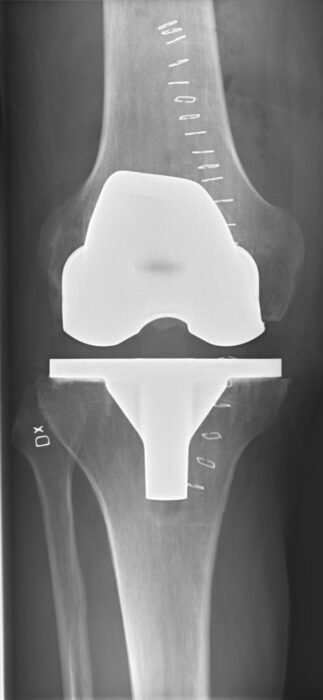
Anaesthesia
Most knee replacements are done under spinal anaesthesia, which numbs the legs while you breathe on your own, often with light sedation. General anaesthesia is used when spinal is not suitable. A nerve block or local anaesthetic around the knee helps control pain after surgery.
Video: When does walking start after knee replacement?
The operation step by step
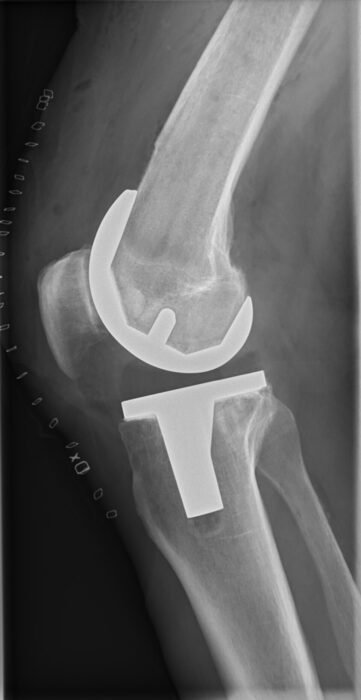
- An incision over the front of the knee.
- Precise cuts to remove the worn surfaces of the thigh and shin bones, guided by alignment instruments.
- Balancing the ligaments so the knee is stable bending and straight.
- Testing trial components for size, movement and stability.
- Fixing the final implant, usually with bone cement, and inserting the plastic liner.
- Closing the wound in layers and applying a dressing.
The operation usually takes about 1.5–2 hours; replacing both knees in one session takes longer.
Key numbers to know
- National registry data show that 82% of total knee replacements last 25 years, compared with 70% of partial knee replacements (Evans et al., The Lancet 2019).
- Across 18 randomised trials (1,739 patients), physiotherapy improved function and pain at 3–4 months after knee replacement, and home exercise worked as well as clinic sessions (Artz et al., 2015).
| Treatment | When we use it | What to expect |
|---|---|---|
| Conservative care: exercise, weight loss, topical pain relief | Grade 1–3 arthritis | Better pain and movement; many patients delay surgery |
| Joint injections (steroid, hyaluronic acid or PRP) | Persistent pain despite conservative care | Temporary relief that varies between patients |
| High tibial osteotomy (HTO) | Active patients under 60 with bow legs and arthritis on the inner side only | Realigns the leg and keeps the natural knee |
| Partial knee replacement | Arthritis limited to one compartment with healthy ligaments | Faster recovery and a more natural-feeling knee |
| Total knee replacement | Severe (grade 4) arthritis with pain limiting daily life | Pain usually resolves; walking on day 1–2 |
| Revision knee replacement | Loosening, infection or instability of a previous knee replacement | Bigger surgery with special components to restore stability |
At Prof. Dr. Ibrahim Shaarawi’s clinics in Nasr City, Mohandeseen and New Cairo (5th Settlement) we examine the knee and review standing X-rays at the same visit, then decide on conservative care, osteotomy, or a partial or total knee replacement according to the arthritis grade, your age and activity.
In hospital after surgery
You will stand and take your first steps with a frame on day one, start bending exercises, and receive blood-clot prevention. Most patients go home after 2–3 days. For the full timeline see knee replacement recovery time and walking after knee replacement.
Cost and choosing the surgeon
A total knee replacement usually costs EGP 120,000–200,000 — see the knee replacement cost in Egypt. For how to choose your surgeon see choosing a knee replacement surgeon in Egypt.
Looking for an experienced knee surgeon? Read our guides to the best knee specialist in Egypt and the best orthopaedic surgeon in Egypt to see how to choose.
Frequently asked questions about knee replacement surgery steps
How long does knee replacement surgery take?
Usually about 1.5–2 hours for one knee, longer when both knees are replaced together.
Will I be asleep during the operation?
Most patients have spinal anaesthesia with light sedation; general anaesthesia is used when spinal is not suitable.
Is the operation painful?
You feel no pain during surgery; afterwards we combine nerve blocks and several painkillers to keep pain manageable.
How long will I stay in hospital?
Usually 2–3 days, once you can walk safely with a frame and pain is controlled.
When do I start walking?
Usually on the first day after surgery, with a frame and a physiotherapist.
To have your knee assessed and your X-rays reviewed, book a consultation, call +20 155 240 4488 or message us on WhatsApp at +20 155 554 7181.
Medically reviewed by Prof. Dr. Ibrahim Shaarawi, Professor of Orthopaedic Surgery. This article is general medical education and does not replace an examination or the treatment plan your surgeon sets for you. See our medical disclaimer.
Related knee replacement guides
Guides for before and after the operation:
- Total knee replacement surgery
- Knee replacement cost in Egypt
- Artificial knee types and prices
- Choosing a knee replacement surgeon in Egypt
- When you need a knee replacement
- Knee replacement success rate
- Knee replacement recovery time
References
- Evans JT, et al. How long does a knee replacement last? A systematic review and meta-analysis of case series and national registry reports with more than 15 years of follow-up. Lancet. 2019;393(10172):655-663.
- Artz N, et al. Effectiveness of physiotherapy exercise following total knee replacement: systematic review and meta-analysis. BMC Musculoskelet Disord. 2015;16:15.
- American Academy of Orthopaedic Surgeons (OrthoInfo). Total Knee Replacement.
- National Institute for Health and Care Excellence (NICE). Joint replacement (primary): hip, knee and shoulder. NICE guideline NG157. 2020.