
In short: hip replacement is one of the most successful and safest operations, and most patients have no serious complications. The main possible complications of hip replacement are blood clots, infection, dislocation, a difference in leg length, fracture around the implant, nerve injury and loosening after many years. Most are uncommon and their risk is reduced by good preparation, the right implant and following the instructions after surgery.
What is hip replacement?
Hip replacement (hip arthroplasty) replaces a worn or damaged hip with an artificial joint to relieve severe pain and restore movement. The most common reasons are osteoarthritis, femoral neck fracture, avascular necrosis of the femoral head and developmental hip deformities. There are two basic types — total hip and hemiarthroplasty — with further choices of cup, bearing and fixation; see types of hip replacement.
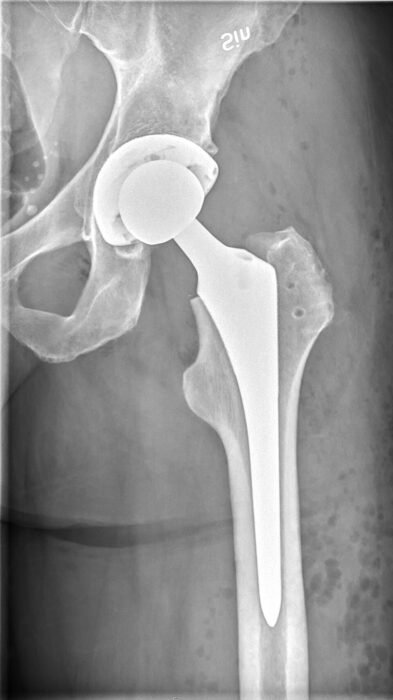
Table of hip replacement complications and how we reduce them
| Complication | What it is | Warning signs | Prevention and treatment |
|---|---|---|---|
| Blood clots | A clot in the leg veins that can travel to the lungs | Calf pain and swelling, breathlessness | Blood thinners, early walking, ankle exercises |
| Infection | Infection around the implant — uncommon but serious | Fever, redness, discharge, increasing pain | Preventive antibiotics, sterile technique, diabetes control; may need a washout |
| Dislocation | The ball comes out of the cup, mostly in the first months | Sudden pain, a short or rotated leg | Safe positions, precise positioning, dual mobility for high-risk patients |
| Leg-length difference | A feeling that one leg is longer or shorter | Imbalance when walking | Pre-operative planning; the feeling usually settles with rehab |
| Periprosthetic fracture | During surgery or after a fall | Sudden pain and inability to walk | Cemented fixation in fragile bone, fall prevention |
| Nerve injury | Sciatic nerve irritation — rare | Numbness or weakness in the foot | Surgical care; usually improves gradually |
| Loosening or wear | After years of use | Increasing groin or thigh pain | X-ray follow-up and revision if needed |
Risks related to the patient
- Smoking increases wound problems and infection.
- Obesity slows wound healing and raises infection risk.
- Heart disease raises the risk of general complications.
- Diabetes raises infection risk, especially if poorly controlled.
Dislocation
Dislocation usually happens in the early weeks with deep hip bending or turning the leg inwards. It is normally put back under anaesthesia without an operation; recurrent dislocation is treated by adjusting the components or converting to a dual mobility (tripolar) hip replacement. Following the positions in sleeping and sitting after hip replacement lowers the risk.
Blood clots and leg swelling
Leg swelling after surgery is common and usually normal, but swelling with calf pain may mean a clot and needs urgent assessment. Read leg swelling after hip replacement.
Video: is hip replacement surgery dangerous?
Is hip replacement dangerous?
The Lancet called total hip replacement “the operation of the century” for its success in relieving pain and restoring movement. Like any major operation it carries risks, but serious complications are uncommon and become rarer with good pre-operative assessment, control of chronic conditions, surgery in a well-equipped hospital and early mobilisation. Most artificial hips work for more than 15–20 years.
Complications specific to each implant
- Hemiarthroplasty: wear of the socket cartilage over time and groin pain — bipolar hip hemiarthroplasty.
- Dual mobility: dissociation of the head inside the liner (rare) — dual mobility (tripolar) hip replacement.
- Ceramic: squeaking or ceramic fracture (very rare) — ceramic hip replacement.
- Cemented: bone cement implantation syndrome in frail patients (rare) — cemented hip replacement.
- Cementless: thigh pain or a crack while impacting the stem — cementless hip replacement.
- Long stem: higher complication rates because these are revision operations — long-stem hip replacement.
How to reduce your risk
- Stop smoking before surgery.
- Lose weight if you are overweight.
- Get heart disease and diabetes well controlled.
- Follow your surgeon’s instructions before and after surgery.
When to call your doctor immediately
- Fever or shivering, or redness and discharge from the wound.
- Calf pain and swelling, breathlessness or chest pain.
- Sudden severe pain with a change in leg length or direction.
- Inability to bear weight after a fall.
- Pain that increases rather than eases over the days.
Cost of hip replacement
The cost depends on the implant: a conventional total hip costs 100,000–120,000 EGP, a bipolar hemiarthroplasty 80,000–90,000 EGP, a dual mobility (tripolar) hip 150,000–180,000 EGP and a ceramic hip 195,000–240,000 EGP, while revision and long-stem surgery is priced after assessment. Details in hip replacement cost in Egypt.
Frequently asked questions about hip replacement complications
What are the complications of hip replacement?
Blood clots, infection, dislocation, leg-length difference, fracture around the implant, nerve injury and loosening after years — most are uncommon.
Is hip replacement dangerous?
It is major surgery but one of the most successful and safest; serious complications are uncommon and fall with good preparation and early walking.
How do I know my hip has dislocated?
Sudden severe pain, inability to walk and a change in leg length or rotation — go to the emergency department immediately.
Is hip replacement safe for older adults?
Usually yes with a good medical assessment, choosing the implant and fixation that reduce risk.
How long does a hip replacement last?
About three quarters still work after 15–20 years and about 58% after 25 years, according to worldwide registry data.
To have your hip assessed, book a consultation, call +20 155 240 4488 or message us on WhatsApp at +20 155 554 7181.
Medically reviewed by Prof. Dr. Ibrahim Shaarawi, Professor of Orthopaedic Surgery. This article is general medical education and does not replace an examination or the plan your surgeon sets for you. See our medical disclaimer.
Related hip replacement guides
Complications are part of the decision about hip replacement surgery. Read also:
- Hip replacement surgery
- Hip replacement cost in Egypt
- The best hip orthopaedic surgeons in Egypt
- Hip replacement recovery time
- Leg swelling after hip replacement
References
- Learmonth ID, et al. The operation of the century: total hip replacement. Lancet. 2007;370(9597):1508-19.
- Evans JT, et al. How long does a hip replacement last? A systematic review and meta-analysis of case series and national registry reports with more than 15 years of follow-up. Lancet. 2019;393(10172):647-54.
- American Academy of Orthopaedic Surgeons (OrthoInfo). Total Hip Replacement.
- National Institute for Health and Care Excellence (NICE). Joint replacement (primary): hip, knee and shoulder. NICE guideline NG157. 2020.
- National Institute for Health and Care Excellence (NICE). Venous thromboembolism in over 16s: reducing the risk of hospital-acquired deep vein thrombosis or pulmonary embolism. NICE guideline NG89. 2018.
- Darrith B, et al. Outcomes of dual mobility components in total hip arthroplasty: a systematic review of the literature. Bone Joint J. 2018;100-B(1):11-9.
- Fernandez MA, et al. Cemented or uncemented hemiarthroplasty for intracapsular hip fracture. N Engl J Med. 2022;386(6):521-30.