
A cementless hip replacement is press-fitted into precisely prepared bone, with a rough porous or hydroxyapatite-coated surface that lets bone grow into it over the following weeks, so the implant becomes part of the bone. It usually suits younger people with good bone. Fixation is applied to the implant that suits you: total hip 100,000–120,000 EGP, bipolar hemiarthroplasty 80,000–90,000 EGP, confirmed after assessment.
To compare all implant types in one place, read types of hip replacement.
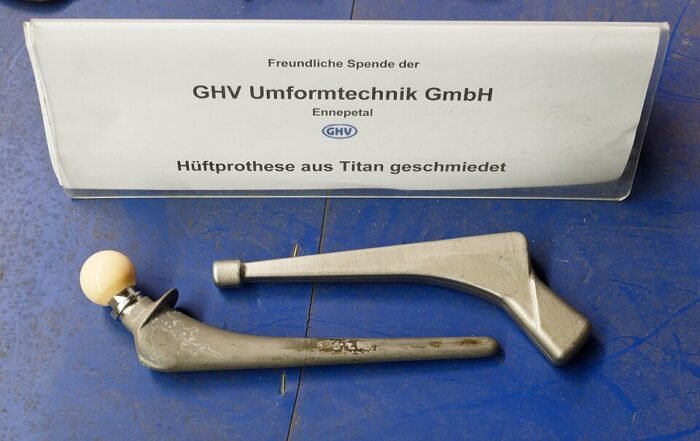
What the implant looks like
- A titanium or titanium-alloy stem and cup with a rough, porous outer surface.
- Many stems are coated with hydroxyapatite, a bone-like mineral that encourages growth.
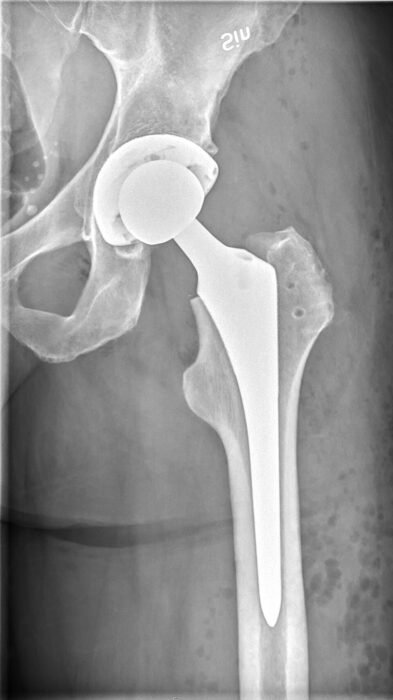
- The component is impacted into a slightly smaller space (press-fit) for initial friction stability.
- Over 6–12 weeks bone grows onto the surface, making fixation biological and permanent.
- The cup may be supplemented with screws into the pelvis when needed.
Indications: who is it for?
- Younger patients (often under about 65–70).
- Good bone quality and a narrow or medium femoral canal.
- High physical activity.
- Avascular necrosis of the femoral head in young adults.
- A cementless cup is also common in many older adults as part of a hybrid hip.
- Some revision operations with special stems.
How does the surgeon choose the right implant for you?
- Age and expected activity: a young active person needs an implant that lasts longer; an older person needs a safer, shorter operation.
- Bone quality: osteoporosis favours cemented fixation; good bone allows cementless fixation.
- The socket: healthy cartilage allows a hemiarthroplasty for fractures; a worn socket needs a total hip.
- Dislocation risk: neurological disease, weak muscles and revisions favour dual mobility.
- A previous implant or bone loss: may require a long stem and special planning.
- General health: heart disease, diabetes and kidney disease affect the right length of operation and type of anaesthesia.
cementless hip replacement vs a cemented hip
| Cementless | Cemented | |
|---|---|---|
| How it becomes stable | Press-fit, then bone ingrowth | Immediately as the cement sets |
| Usually suits | Younger people with good bone | Older adults and osteoporosis |
| Fracture during surgery | Slightly higher in fragile bone | Less |
| Specific complication | Thigh pain or failed ingrowth (uncommon) | Bone cement implantation syndrome (rare) |
| Future revision | Relatively easier | Removing cement makes it harder |
| Cost | By implant type: total hip 100,000–120,000 EGP, bipolar hemiarthroplasty 80,000–90,000 EGP | By implant type |
Biological fixation is an advantage for younger patients who may need revision decades later, since revision is easier without cement to remove. In fragile bone, however, the risk of fracturing the femur while impacting the stem rises, so cement is preferred for older adults. Reviews of randomised trials found no major overall difference between the methods; the combination is chosen for the patient and bone quality.
Video: What a hip implant looks like (Arabic)
Surgical steps
- Assessment of bone quality and canal shape on X-ray, and templating of implant sizes.
- Spinal or general anaesthesia with a nerve block.
- Approach to the joint and removal of the damaged head.
- Gradual reaming of the socket to the planned size, then firm impaction of the cup (with screws if needed).
- Preparation of the femoral canal with graduated instruments until the trial stem is firmly seated.
- Impaction of the final stem and fitting of the liner and head.
- Testing stability and leg length, closure, and usually walking from day one.
Cost in Egypt
| Implant | Approximate price |
|---|---|
| Total hip (conventional) | 100,000–120,000 EGP |
| Bipolar hemiarthroplasty | 80,000–90,000 EGP |
| Dual mobility (tripolar) hip | 150,000–180,000 EGP |
| Ceramic hip | 195,000–240,000 EGP |
| Revision surgery / long stem | Confirmed after assessment |
The price usually covers the implant, the operation and a short hospital stay, and varies with the implant, the hospital and your general health; the final price is confirmed after examination and X-rays. An implant should not be chosen on price alone — the right one is what suits your age, activity and bone quality. See also: hip replacement cost in Egypt.
Complications and how we reduce them
| Complication | What it is | How we reduce it |
|---|---|---|
| Fracture during surgery | A small crack while impacting the stem, usually treated with a wire at the same operation | Careful planning and choosing cement for fragile bone |
| Thigh pain | Mid-thigh pain sometimes in the first months | Follow-up; usually settles as fixation completes |
| Subsidence or instability | If bone does not grow onto the surface | Following weight-bearing advice and X-ray follow-up |
| Dislocation | As with any hip | Safe positions |
| Infection and clots | As with any joint surgery | Preventive antibiotics and blood thinners |
For all complications of the operation in detail, read hip replacement complications.
Instructions after surgery
- Usually walking with a frame from day one, bearing weight as your surgeon advises.
- Avoid heavy loads and impacts in the early weeks while bone grows onto the implant.
- Safe positions and a high chair in the early weeks.
- Prescribed blood thinners.
- Graded hip-strengthening exercises.
- Tell your surgeon about any increasing thigh pain.
- X-ray follow-up to confirm fixation.
Details on sleeping, sitting and using the bathroom are in sleeping and sitting after hip replacement, and the recovery stages in hip replacement recovery time.
How long does the implant last?
A large Lancet analysis of worldwide joint registries found that about three quarters of hip replacements are still working after 15–20 years and about 58% after 25 years. Implant survival depends on the patient’s age, activity and weight, the bearing surfaces and fixation, and the precision of component positioning. Keeping a healthy weight, avoiding high-impact sport, treating any infection in the body promptly and attending regular X-ray follow-up all help the implant last as long as possible, and pick up loosening early, before it causes bone loss.
Frequently asked questions about cementless hip replacement
How does a cementless hip become fixed?
It is press-fitted into precisely prepared bone, then bone grows onto its porous or hydroxyapatite-coated surface over weeks, making it biologically stable.
Who is a cementless hip suitable for?
Usually younger people with good bone, and some older adults as part of a hybrid hip.
How much does a cementless hip replacement cost?
Fixation is applied to the implant that suits you: total hip 100,000–120,000 EGP, bipolar hemiarthroplasty 80,000–90,000 EGP, confirmed after assessment.
Can I walk straight after a cementless hip?
Usually yes, with a frame from day one, following weight-bearing advice until bone grows onto the implant.
Does a cementless hip last longer?
Reviews show no major overall difference in implant survival, but future revision is easier because there is no cement to remove.
To have your hip assessed, book a consultation, call +20 155 240 4488 or message us on WhatsApp at +20 155 554 7181.
Medically reviewed by Prof. Dr. Ibrahim Shaarawi, Professor of Orthopaedic Surgery. This article is general medical education and does not replace an examination or the plan your surgeon sets for you. See our medical disclaimer.
Related hip replacement guides
Cementless hip replacement is one of the types of hip replacement. Read also:
- Hip replacement surgery
- Types of hip replacement
- Bipolar hip hemiarthroplasty
- Dual mobility (tripolar) hip replacement
- Ceramic hip replacement
- Long-stem hip replacement
- Cemented hip replacement
- Hip replacement complications
- Hip replacement cost in Egypt
References
- Abdulkarim A, et al. Cemented versus uncemented fixation in total hip replacement: a systematic review and meta-analysis of randomized controlled trials. Orthop Rev (Pavia). 2013;5(1):e8.
- López-López JA, et al. Choice of implant combinations in total hip replacement: systematic review and network meta-analysis. BMJ. 2017;359:j4651.
- Evans JT, et al. How long does a hip replacement last? A systematic review and meta-analysis of case series and national registry reports with more than 15 years of follow-up. Lancet. 2019;393(10172):647-54.
- American Academy of Orthopaedic Surgeons (OrthoInfo). Total Hip Replacement.