
This article covers hip arthritis treatment: without surgery (activity changes, weight loss, physiotherapy, medicines, injections) and with surgery (hip replacement). Symptoms, grades and diagnosis are in hip arthritis symptoms and grades.
What is arthritis and what are the parts of a joint?
Arthritis affects joints — where bones meet and move. Osteoarthritis wears the joint surfaces so movement is no longer smooth and becomes painful. Joints are cushioned by articular cartilage, a smooth tissue that lets bones glide without friction, and many have a synovial lining that lubricates them, supported by tendons and ligaments.
Causes and risk factors
Hip arthritis is common in older adults because the main cause is long-term use; early arthritis can follow an injury. Risk factors include age, lifestyle (smoking, lack of exercise), sex (more common in women) and weight.
Treatment options by grade
| Grade | Treatment usually suitable |
|---|---|
| Mild (1–2) | Weight loss, strengthening and flexibility exercises, painkillers when needed, activity changes |
| Moderate (2–3) | Regular physiotherapy, anti-inflammatories for limited periods, injections in selected cases, a stick in the opposite hand |
| Severe (3–4) with pain disturbing sleep and walking | Hip replacement |
International guidance recommends exercise and weight loss as the foundation of treatment at every grade, and considering joint replacement when pain and stiffness affect quality of life despite conservative care. Choosing the right implant is covered in types of hip replacement.
Video: what a hip implant looks like
Treating hip arthritis without surgery
- Medicines: painkillers and anti-inflammatories relieve symptoms; biologic drugs are used for rheumatoid or psoriatic arthritis.
- Physiotherapy: improves strength, range of motion and mobility.
- Weight loss and activity changes reduce load on the hip.
- Injections: may relieve pain temporarily in selected cases but do not stop cartilage wear.
- Early avascular necrosis of the femoral head may respond to core decompression before the joint surface collapses — see core decompression of the femoral head.
Hip replacement: the definitive treatment
In advanced arthritis, total hip replacement is the definitive treatment with a high success rate; the Lancet called it “the operation of the century”. The damaged joint is replaced by an implant, and you start moving straight after surgery. The operation takes about one to two hours depending on the details and implant. Cost: a conventional total hip costs 100,000–120,000 EGP, a bipolar hemiarthroplasty 80,000–90,000 EGP, a dual mobility (tripolar) hip 150,000–180,000 EGP and a ceramic hip 195,000–240,000 EGP, while revision and long-stem surgery is priced after assessment — see hip replacement cost in Egypt.
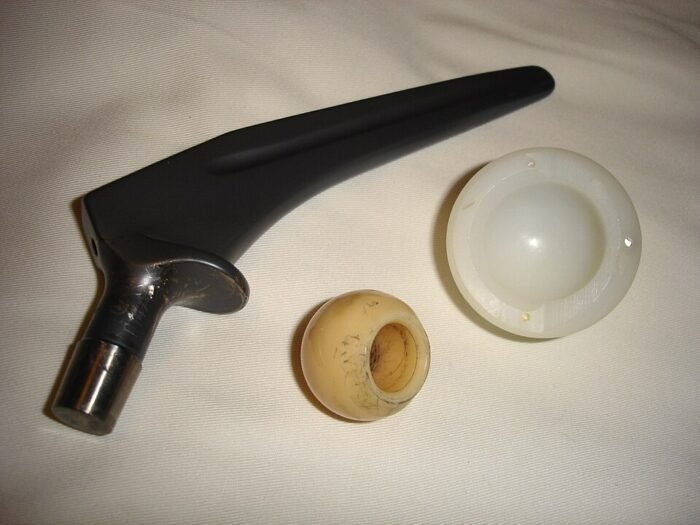
After hip replacement
- Sleeping: on your back with a pillow between the legs for 6–12 weeks depending on your recovery — see sleeping and sitting after hip replacement.
- Recovery: early recovery takes about two weeks; full recovery of the muscles around the joint 4–6 months — see hip replacement recovery time.
- Walking: from the morning after surgery, with frequent short walks — see walking after hip replacement.
- Risks: most patients have no serious complications — see hip replacement complications.
- How long it lasts: most hip replacements last well beyond 13 years; about 58% still work after 25 years.
Frequently asked questions about hip arthritis treatment
Can hip arthritis be treated without surgery?
In mild and moderate grades, usually yes: weight loss, exercise, physiotherapy, and medicines or injections in selected cases.
What is the definitive treatment for hip arthritis?
Hip replacement in advanced arthritis — one of the most successful operations for relieving pain and restoring movement.
Do injections help hip arthritis?
They may relieve pain temporarily in selected cases, but they do not stop cartilage wear.
What are the best exercises for hip arthritis?
Strengthening and flexibility exercises for the hip and thigh, walking, swimming and cycling, supervised by a specialist.
When do I need a hip replacement?
When pain stops you sleeping, walking and doing daily activities despite conservative treatment, with advanced arthritis on X-ray.
To have your hip assessed, book a consultation, call +20 155 240 4488 or message us on WhatsApp at +20 155 554 7181.
Medically reviewed by Prof. Dr. Ibrahim Shaarawi, Professor of Orthopaedic Surgery. This article is general medical education and does not replace an examination or the plan your surgeon sets for you. See our medical disclaimer.
Related hip replacement guides
Advanced arthritis is treated with hip replacement surgery. Read also:
- Hip replacement surgery
- Hip arthritis symptoms and grades
- Core decompression of the femoral head
- Femoral neck fracture in older adults
- Preventing falls and fractures in older adults
- Types of hip replacement
References
- American Academy of Orthopaedic Surgeons (OrthoInfo). Osteoarthritis of the Hip.
- National Institute for Health and Care Excellence (NICE). Joint replacement (primary): hip, knee and shoulder. NICE guideline NG157. 2020.
- Learmonth ID, et al. The operation of the century: total hip replacement. Lancet. 2007;370(9597):1508-19.
- Evans JT, et al. How long does a hip replacement last? A systematic review and meta-analysis of case series and national registry reports with more than 15 years of follow-up. Lancet. 2019;393(10172):647-54.