
A long-stem hip replacement uses a femoral stem that extends further down the thigh bone than a standard stem, bypassing weak, broken or missing bone to fix in healthy bone below. It is used mainly in revision hip surgery, fractures around a previous hip replacement and significant bone loss. Its price is confirmed after assessment because it depends on the stem and the case.
To compare all implant types in one place, read types of hip replacement.
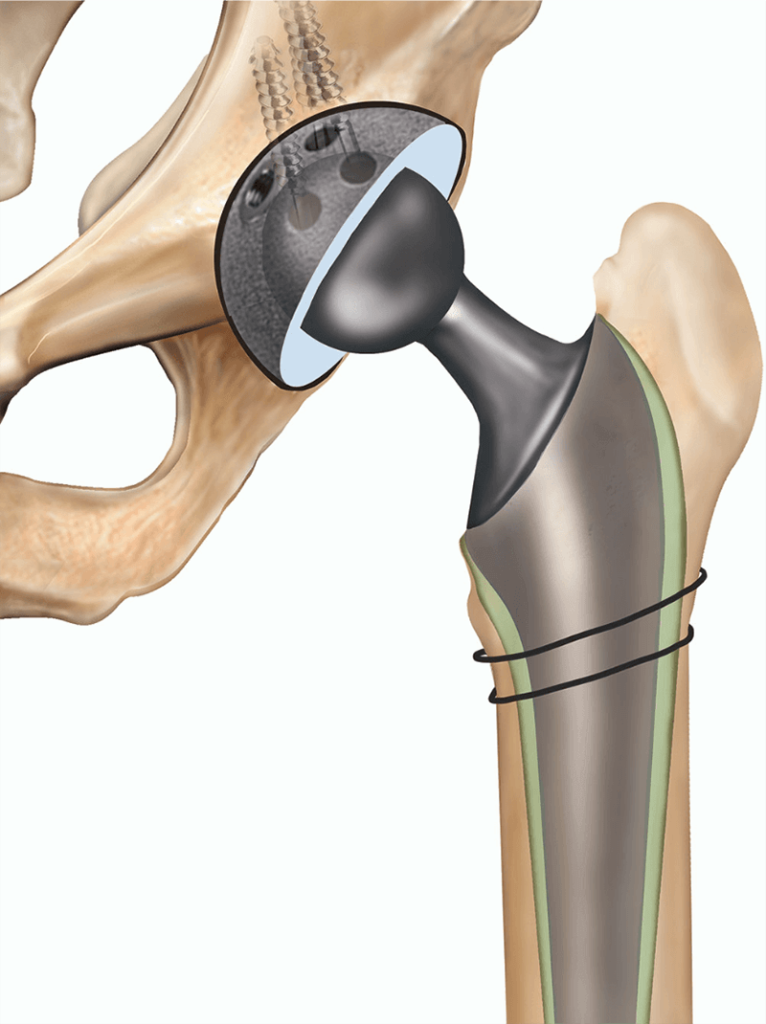
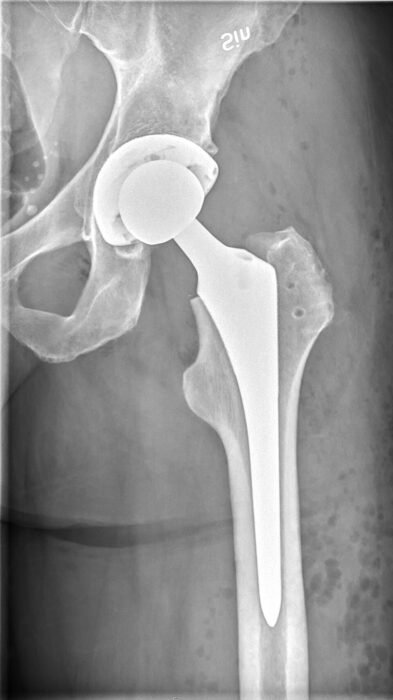
What the implant looks like
- A long stem, either one piece or two connected parts (modular) to fine-tune length and rotation.
- Many modern long stems are tapered and fluted to grip the femur and resist rotation and subsidence.
- Usually cementless in healthy bone below the weak area; cement is used in selected cases.
- Cerclage wires or plates may be added around the femur to fix fractures or cracks.
- It carries a head and cup like any total hip; a dual mobility cup may be used to reduce dislocation in revisions.
Indications: who is it for?
- Loosening or failure of a previous hip replacement with bone loss in the upper femur.
- A femoral fracture around a previous hip replacement with a loose stem.
- Major upper-femur bone loss from previous infection or tumours.
- Some complex upper-femur fractures in older adults where a standard stem is not enough.
- Failed previous plate or nail fixation of upper-femur fractures.
- Femoral deformities that prevent standard stem fixation.
How does the surgeon choose the right implant for you?
- Age and expected activity: a young active person needs an implant that lasts longer; an older person needs a safer, shorter operation.
- Bone quality: osteoporosis favours cemented fixation; good bone allows cementless fixation.
- The socket: healthy cartilage allows a hemiarthroplasty for fractures; a worn socket needs a total hip.
- Dislocation risk: neurological disease, weak muscles and revisions favour dual mobility.
- A previous implant or bone loss: may require a long stem and special planning.
- General health: heart disease, diabetes and kidney disease affect the right length of operation and type of anaesthesia.
long-stem hip replacement vs a standard stem
| Long stem | Standard (and short) stem | |
|---|---|---|
| Where it fixes | Below the weak area of the femur | Upper femur (short stems even higher) |
| Usually used in | Revisions, periprosthetic fractures, bone loss | Primary (first-time) surgery |
| Operating time and blood loss | Longer, more | Shorter, less |
| Bone preservation | Uses more bone | Standard preserves well; short preserves more in young patients |
| Recovery | Slower; early weight-bearing may be limited | Usually faster |
| Cost | Confirmed after assessment | total hip 100,000–120,000 EGP, bipolar hemiarthroplasty 80,000–90,000 EGP |
A standard stem is the natural choice for most first-time operations, and short stems are sometimes used in younger patients to preserve bone. A long stem is a salvage tool when the upper femur cannot hold an implant. Systematic reviews of tapered revision stems show good functional results and satisfactory survival, with success depending on surgical experience and remaining bone quality.
Video: How a hip replacement is performed (Arabic)
Surgical steps
- Careful assessment: X-rays, CT and tests to rule out infection before any revision.
- Spinal or general anaesthesia with blood available if needed.
- Removal of the old implant or fixation of the fracture and cleaning of the area.
- Preparation of the femoral canal over a longer distance with special instruments.
- Fixing the long stem in healthy bone, adding wires or plates as needed.
- Fitting the right head and cup (possibly dual mobility to reduce dislocation).
- Testing stability and leg length, closure, and mobilisation according to fixation strength.
Cost in Egypt
| Implant | Approximate price |
|---|---|
| Total hip (conventional) | 100,000–120,000 EGP |
| Bipolar hemiarthroplasty | 80,000–90,000 EGP |
| Dual mobility (tripolar) hip | 150,000–180,000 EGP |
| Ceramic hip | 195,000–240,000 EGP |
| Revision surgery / long stem | Confirmed after assessment |
The price usually covers the implant, the operation and a short hospital stay, and varies with the implant, the hospital and your general health; the final price is confirmed after examination and X-rays. An implant should not be chosen on price alone — the right one is what suits your age, activity and bone quality. See also: hip replacement cost in Egypt.
Complications and how we reduce them
| Complication | What it is | How we reduce it |
|---|---|---|
| Fracture during surgery | Because of weak bone | Careful planning and prophylactic wires |
| Stem subsidence | The stem settles slightly in the bone | Choosing the right tapered stem and graded weight-bearing |
| Dislocation | Higher in revisions | Dual mobility cup and safe positions |
| Infection | Relatively higher in revisions | Ruling out infection beforehand and antibiotics |
| Thigh pain | Mid-thigh pain in some cases | Follow-up and physiotherapy |
| More bleeding | Longer operation | Blood available and bleeding-reducing medicines |
For all complications of the operation in detail, read hip replacement complications.
Instructions after surgery
- Weight-bearing as your surgeon advises; it may be partial in the early weeks.
- A frame then a stick for longer than after primary surgery.
- Strict safe positions, as dislocation risk is higher in revisions.
- Blood thinners and antibiotics as prescribed.
- Graded physiotherapy to strengthen the hip muscles.
- X-ray follow-up to check stem stability and bone healing.
- Fall prevention and osteoporosis treatment.
Details on sleeping, sitting and using the bathroom are in sleeping and sitting after hip replacement, and the recovery stages in hip replacement recovery time.
How long does the implant last?
A large Lancet analysis of worldwide joint registries found that about three quarters of hip replacements are still working after 15–20 years and about 58% after 25 years. Implant survival depends on the patient’s age, activity and weight, the bearing surfaces and fixation, and the precision of component positioning. Keeping a healthy weight, avoiding high-impact sport, treating any infection in the body promptly and attending regular X-ray follow-up all help the implant last as long as possible, and pick up loosening early, before it causes bone loss.
Frequently asked questions about long-stem hip replacement
When is a long-stem hip replacement needed?
In revision surgery, fractures around a previous hip replacement, major bone loss in the upper femur and some complex fractures.
How much does a long-stem hip replacement cost?
It is confirmed after assessment because it depends on the stem and the size of the operation; for comparison: total hip 100,000–120,000 EGP, bipolar hemiarthroplasty 80,000–90,000 EGP.
What is the difference between a long and a standard stem?
A standard stem fixes in the upper femur for first-time surgery; a long stem bypasses weak bone and fixes below it, mostly in revisions and fractures.
Is recovery longer with a long stem?
Usually yes, because the operation is bigger and early weight-bearing may be limited depending on fixation.
Can a hip replacement be redone?
Yes — this is revision surgery, which often needs a long stem, specialist experience and careful assessment to rule out infection.
To have your hip assessed, book a consultation, call +20 155 240 4488 or message us on WhatsApp at +20 155 554 7181.
Medically reviewed by Prof. Dr. Ibrahim Shaarawi, Professor of Orthopaedic Surgery. This article is general medical education and does not replace an examination or the plan your surgeon sets for you. See our medical disclaimer.
Related hip replacement guides
Long-stem hip replacement is one of the types of hip replacement. Read also:
- Hip replacement surgery
- Types of hip replacement
- Bipolar hip hemiarthroplasty
- Dual mobility (tripolar) hip replacement
- Ceramic hip replacement
- Cemented hip replacement
- Cementless hip replacement
- Hip replacement complications
- Hip replacement cost in Egypt
References
- Koutalos AA, et al. Clinical, functional and radiographic outcomes after revision total hip arthroplasty with tapered fluted modular or non-modular stems: a systematic review. Hip Int. 2022;32(4):475-87.
- Evans JT, et al. How long does a hip replacement last? A systematic review and meta-analysis of case series and national registry reports with more than 15 years of follow-up. Lancet. 2019;393(10172):647-54.
- American Academy of Orthopaedic Surgeons (OrthoInfo). Total Hip Replacement.
- National Institute for Health and Care Excellence (NICE). Joint replacement (primary): hip, knee and shoulder. NICE guideline NG157. 2020.