
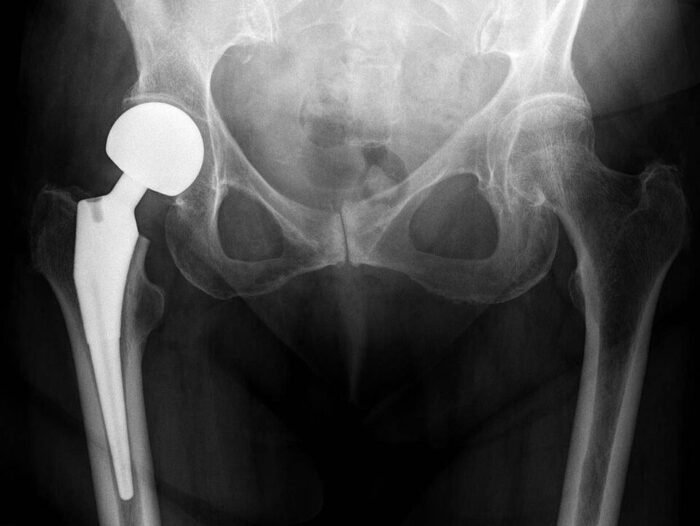
A bipolar hip hemiarthroplasty replaces only the head and neck of the thigh bone and leaves the natural hip socket in place. It is mainly used for femoral neck fractures in older adults who had limited activity before the fracture and whose socket cartilage is healthy. It costs 80,000–90,000 EGP in Egypt, and most patients stand and walk with a frame within a day or two.
To compare all implant types in one place, read types of hip replacement.
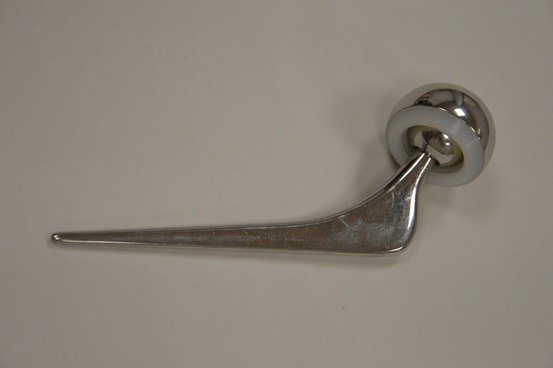
What the implant looks like
- A metal stem is fixed inside the thigh-bone canal (usually with cement in older patients), carrying a small head.
- The small head turns inside a large outer head lined with polyethylene, and it is this large head that moves in the natural socket.
- Two nested bearings (hence “bipolar”) share the movement, aiming to reduce wear of the socket cartilage.
- The socket is not replaced, so the operation is shorter with less blood loss than a total hip.
Indications: who is it for?
- Displaced femoral neck fracture in older adults — the most common use.
- Patients with limited mobility before the fracture, or who used a stick or frame.
- Medical conditions that make a shorter, lower-blood-loss operation the safer choice.
- Healthy socket cartilage without obvious arthritis on X-ray.
- Some pathological femoral neck fractures, depending on assessment.
- Failed screw fixation of a femoral neck fracture in an older patient.
How does the surgeon choose the right implant for you?
- Age and expected activity: a young active person needs an implant that lasts longer; an older person needs a safer, shorter operation.
- Bone quality: osteoporosis favours cemented fixation; good bone allows cementless fixation.
- The socket: healthy cartilage allows a hemiarthroplasty for fractures; a worn socket needs a total hip.
- Dislocation risk: neurological disease, weak muscles and revisions favour dual mobility.
- A previous implant or bone loss: may require a long stem and special planning.
- General health: heart disease, diabetes and kidney disease affect the right length of operation and type of anaesthesia.
bipolar hip hemiarthroplasty vs total hip replacement
| Bipolar hemiarthroplasty | Total hip replacement | |
|---|---|---|
| What is replaced | Femoral head and neck only | Femoral head and socket |
| Usually suits | Femoral neck fracture in older, less active adults | Arthritis, and fractures in active independent people |
| Operating time and blood loss | Shorter, less | Relatively longer |
| Dislocation risk | Usually lower | Slightly higher (reduced with dual mobility) |
| Long-term groin pain | Possible if socket cartilage wears | Less, as the socket is replaced |
| Approximate cost | 80,000–90,000 EGP | 100,000–120,000 EGP |
In a large international trial of femoral neck fractures in older adults, there was no major difference in the need for further surgery between total hip replacement and hemiarthroplasty at two years, with slightly better function after total hip and fewer dislocations after hemiarthroplasty. A hemiarthroplasty is therefore chosen for older, less active patients, and a total hip for active independent ones. A Cochrane review also found little difference between unipolar and bipolar designs.
Video: Hip fracture in older adults: can surgery be avoided? (Arabic)
Surgical steps
- Urgent assessment: X-rays, blood tests and optimising medical conditions; surgery is ideally within 24–48 hours of the fracture.
- Usually spinal anaesthesia, with a nerve block to reduce pain.
- Approach to the hip through a lateral or posterior incision.
- Removal of the broken femoral head and careful measurement to choose the right head size.
- Preparation of the femoral canal and fixation of the stem (cemented in most older patients).
- Fitting the bipolar head, reducing the joint and testing stability and leg length.
- Layered closure, then sitting and standing with a frame within one to two days.
Cost in Egypt
| Implant | Approximate price |
|---|---|
| Total hip (conventional) | 100,000–120,000 EGP |
| Bipolar hemiarthroplasty | 80,000–90,000 EGP |
| Dual mobility (tripolar) hip | 150,000–180,000 EGP |
| Ceramic hip | 195,000–240,000 EGP |
| Revision surgery / long stem | Confirmed after assessment |
The price usually covers the implant, the operation and a short hospital stay, and varies with the implant, the hospital and your general health; the final price is confirmed after examination and X-rays. An implant should not be chosen on price alone — the right one is what suits your age, activity and bone quality. See also: hip replacement cost in Egypt.
Complications and how we reduce them
| Complication | What it is | How we reduce it |
|---|---|---|
| Dislocation | The head comes out of the socket, mostly in the first weeks | Safe positions and a high chair |
| Socket cartilage wear | Groin pain after years | Careful patient selection; conversion to total hip if needed |
| Fracture around the stem | During surgery or after a fall | Cement fixation in fragile bone and fall prevention |
| Infection | Heat and wound discharge (uncommon) | Preventive antibiotics and wound care |
| Blood clots | Calf swelling and pain | Blood thinners and early movement |
| Leg length difference | The leg feels shorter or longer | Careful measurement during surgery |
For all complications of the operation in detail, read hip replacement complications.
Instructions after surgery
- Walking with a frame from day one or two, bearing weight as your surgeon advises.
- Sitting in a high chair with arms; avoid low chairs and sofas.
- Avoid bending the hip beyond 90 degrees and crossing the legs in the early weeks (depending on the approach).
- Sleep on your back with a pillow between the knees.
- Continue prescribed blood thinners to prevent clots.
- Make the home fall-safe: remove rugs, add night lights and a raised toilet seat.
- Treat osteoporosis after the fracture to reduce the risk of another.
Details on sleeping, sitting and using the bathroom are in sleeping and sitting after hip replacement, and the recovery stages in hip replacement recovery time.
How long does the implant last?
A large Lancet analysis of worldwide joint registries found that about three quarters of hip replacements are still working after 15–20 years and about 58% after 25 years. Implant survival depends on the patient’s age, activity and weight, the bearing surfaces and fixation, and the precision of component positioning. Keeping a healthy weight, avoiding high-impact sport, treating any infection in the body promptly and attending regular X-ray follow-up all help the implant last as long as possible, and pick up loosening early, before it causes bone loss.
Frequently asked questions about bipolar hip hemiarthroplasty
What is a bipolar hip hemiarthroplasty?
An implant that replaces only the femoral head and neck, with a large outer head containing a smaller inner head, used mainly for femoral neck fractures in older adults.
How much does a hip hemiarthroplasty cost in Egypt?
A bipolar hemiarthroplasty costs 80,000–90,000 EGP; the final price is confirmed after assessment.
What is the difference between a hemiarthroplasty and a total hip?
A hemiarthroplasty replaces only the femoral head and keeps the socket; a total hip replaces both. The hemi is shorter with fewer dislocations; the total suits active people and arthritis.
When can I walk after a hemiarthroplasty?
Usually within one to two days with a frame, gradually increasing distance with physiotherapy.
Is hemiarthroplasty dangerous for older adults?
It is major surgery but safer than leaving the fracture untreated, because prolonged bed rest causes clots, pneumonia and pressure sores; patients are carefully assessed beforehand.
To have your hip assessed, book a consultation, call +20 155 240 4488 or message us on WhatsApp at +20 155 554 7181.
Medically reviewed by Prof. Dr. Ibrahim Shaarawi, Professor of Orthopaedic Surgery. This article is general medical education and does not replace an examination or the plan your surgeon sets for you. See our medical disclaimer.
Related hip replacement guides
Bipolar hip hemiarthroplasty is one of the types of hip replacement. Read also:
- Hip replacement surgery
- Types of hip replacement
- Dual mobility (tripolar) hip replacement
- Ceramic hip replacement
- Long-stem hip replacement
- Cemented hip replacement
- Cementless hip replacement
- Hip replacement complications
- Hip replacement cost in Egypt
References
- HEALTH Investigators. Total hip arthroplasty or hemiarthroplasty for hip fracture. N Engl J Med. 2019;381(23):2199-208.
- Lewis SR, et al. Arthroplasties for hip fracture in adults. Cochrane Database Syst Rev. 2022;2(2):CD013410.
- Fernandez MA, et al. Cemented or uncemented hemiarthroplasty for intracapsular hip fracture. N Engl J Med. 2022;386(6):521-30.
- American Academy of Orthopaedic Surgeons (OrthoInfo). Hip Fractures.
- Evans JT, et al. How long does a hip replacement last? A systematic review and meta-analysis of case series and national registry reports with more than 15 years of follow-up. Lancet. 2019;393(10172):647-54.