
The key difference: an arthroscopic Bankart repair reattaches the soft tissues — the labrum and capsule — to the socket rim, and suits most recurrent dislocations without major bone loss. A Latarjet transfers a piece of the coracoid bone to the front of the socket to replace lost bone, and is preferred for significant bone loss or failed previous surgery. Between them, Bankart with remplissage is used when the Hill-Sachs defect is large.
Arthroscopic Bankart repair
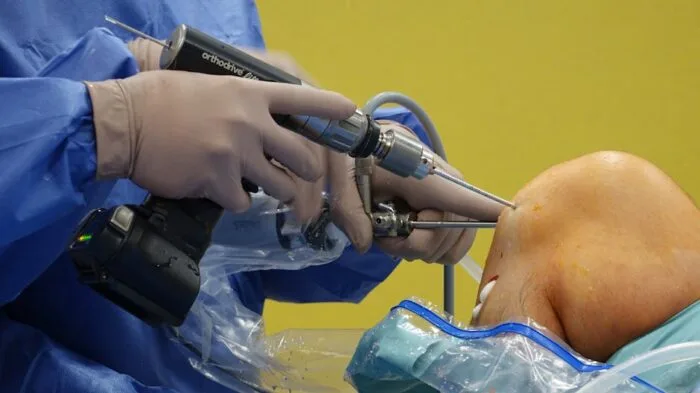
Performed through 2 to 3 small portals, the torn labrum is freed and reattached, with capsular tightening, to the socket rim using small anchors loaded with sutures — restoring the front bumper that stops the shoulder slipping out. Advantages: small incisions, less pain, preserved natural anatomy, and same-day or next-day discharge.
Bankart with remplissage
A Hill-Sachs defect is a dent in the back of the humeral head. If it is large, it can “engage” on the socket rim when the arm is raised and turned back, causing dislocation even after a Bankart repair. Remplissage fills the defect arthroscopically with the infraspinatus tendon and posterior capsule in the same operation so it no longer catches on the rim. Systematic reviews show it reduces recurrence in these cases.
Open Latarjet
A piece of the coracoid process with its attached tendons is moved to the front rim of the socket and fixed with screws. The bone block replaces lost bone, and the tendons act as a sling supporting the front of the shoulder when the arm is raised. It is done through a small incision at the front of the shoulder and is the strongest option for significant bone loss.
The three procedures compared
| Arthroscopic Bankart | Bankart with remplissage | Open Latarjet | |
|---|---|---|---|
| What it fixes | Labrum and capsule | Bankart + filling the Hill-Sachs defect | Rebuilds the rim with a bone block |
| Best for | Recurrence without major bone loss | Large Hill-Sachs with limited bone loss | Major bone loss, failed surgery, high-risk contact sport |
| Technique | Arthroscopy, 2–3 portals | Arthroscopy | Small open incision and screws |
| Notes | Preserves natural anatomy | May slightly limit external rotation | Specific risks from screws and the bone block |
| Approximate cost | 60,000 EGP | Confirmed after assessment | 80,000 EGP |
How does the surgeon choose?
- The amount of glenoid bone loss on CT — the key factor; major bone loss raises the failure rate of a Bankart repair alone.
- The size of the Hill-Sachs defect and whether it engages with movement.
- Age and sport: young contact athletes carry the highest risk.
- Ligament laxity and number of dislocations.
- Failed previous operations.
Scoring tools such as the Instability Severity Index combine age, sport, laxity and X-ray bone appearance; a higher score favours a bone procedure. Comparative studies in athletes suggest the Latarjet lowers recurrence in high-risk cases, while the Bankart repair remains excellent for the right patient.
How is bone loss measured?
Plain X-rays give a first impression, but 3D CT is the most accurate way to measure how much of the socket rim is missing and to size the Hill-Sachs defect. Relating the two shows whether the defect will engage after repair, which decides on adding remplissage or moving to a Latarjet. A classic study described how major front bone loss — giving the socket an “inverted pear” shape — leads to failure of a Bankart repair alone.
Recovery after each procedure
After a Bankart repair (with or without remplissage) a sling is usually worn for 3 to 6 weeks while the soft tissues heal to bone, then motion and strengthening follow, with return to sport usually at 4 to 6 months. After a Latarjet the transferred bone must heal, which is checked on X-ray; some protocols allow earlier movement, and return to sport is usually between 4 and 6 months depending on healing and the sport. More in recovery after Bankart repair.
What if a previous Bankart repair failed?
Failure usually means untreated bone loss, a large Hill-Sachs defect, an early return to contact sport, or a new injury. Assessment starts with CT to find the cause, and in most failures a Latarjet is the best option because it addresses the missing bone directly.
Questions to ask your surgeon
- How much glenoid bone loss is there on CT?
- Does my Hill-Sachs defect engage, and do I need remplissage?
- Why is this procedure recommended for my shoulder and sport?
- What is the rehabilitation plan and when can I return to sport?
- What are the possible complications of each option for me?
Pros and cons of each operation
- Arthroscopic Bankart: small incisions, less pain and natural anatomy — but higher recurrence with major bone loss or high-risk contact sport.
- Bankart with remplissage: treats the Hill-Sachs defect in the same arthroscopic session — but may slightly limit external rotation, which matters to some throwers.
- Open Latarjet: the strongest answer to bone loss with low recurrence in high-risk cases — but a larger incision and specific risks such as bone-block non-union, screw problems or nearby nerve injury.
Whatever the choice, the goal is the same: a stable shoulder that does not dislocate again, so you can return to life and sport with confidence. See shoulder dislocation surgery cost in Egypt and recovery after Bankart repair.
Video: mistakes that can make shoulder arthroscopy fail
Frequently asked questions about Bankart and Latarjet
What is a Bankart repair?
An arthroscopic operation that reattaches the labrum and capsule to the socket rim with anchors and sutures to treat recurrent dislocation.
What is a Latarjet procedure?
An open operation that moves a piece of coracoid bone to the front of the socket to replace lost bone and stabilise the shoulder.
Which is better, Bankart or Latarjet?
Neither is better for everyone; Bankart suits cases without major bone loss, and Latarjet suits major bone loss, failed surgery or high-risk cases.
What is remplissage?
An arthroscopic add-on to a Bankart repair that fills the Hill-Sachs defect with posterior tendon so it cannot catch on the socket rim.
How much do Bankart and Latarjet cost?
Arthroscopic Bankart about 60,000 EGP and open Latarjet about 80,000 EGP; the final price follows assessment.
To have your shoulder assessed, book a consultation, call +20 155 240 4488 or message us on WhatsApp at +20 155 554 7181.
Medically reviewed by Prof. Dr. Ibrahim Shaarawi, Professor of Orthopaedic Surgery. This article is general medical education and does not replace an examination or the plan your surgeon sets for you. See our medical disclaimer.
Related shoulder dislocation guides
Learn the steps of arthroscopic shoulder stabilisation surgery, and read:
- Arthroscopic shoulder stabilisation surgery
- Shoulder arthroscopy and dislocation surgery success rate
- Shoulder arthroscopy complications
- Recurrent shoulder dislocation
- Shoulder dislocation surgery cost in Egypt
References
- Burkhart SS, De Beer JF. Traumatic glenohumeral bone defects and their relationship to failure of arthroscopic Bankart repairs. Arthroscopy. 2000;16(7):677-94.
- Balg F, Boileau P. The instability severity index score. J Bone Joint Surg Br. 2007;89(11):1470-7.
- Buza JA, et al. Arthroscopic Hill-Sachs remplissage. J Bone Joint Surg Am. 2014;96(7):549-55.
- Hurley ET, et al. Arthroscopic Bankart repair versus open Latarjet for recurrent shoulder instability in athletes. Orthop J Sports Med. 2021;9(9):23259671211023801.
- American Academy of Orthopaedic Surgeons (OrthoInfo). Chronic Shoulder Instability.