
Arthroscopic shoulder dislocation surgery: a stable shoulder, safely back to sport
Treatment of recurrent shoulder dislocation by reattaching the labrum and capsule arthroscopically (Bankart repair), adding a Hill-Sachs remplissage when needed, or an open Latarjet procedure for bone loss — matched to what your shoulder needs.
Do you actually need surgery for a dislocated shoulder?
Not every dislocation needs an operation; many first dislocations in older patients settle with a sling and physiotherapy. Signs that point toward surgery:
- The shoulder has come out more than once
- A persistent feeling that the shoulder will “slip out” when the arm is raised and turned back
- A first dislocation in a young athlete playing contact or throwing sports
- A Bankart tear or a fracture of the socket rim on imaging
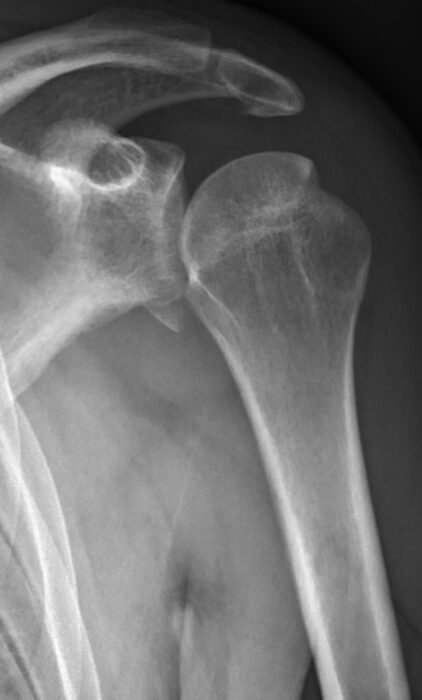
- A large Hill-Sachs defect in the head of the arm bone
- A failed previous stabilisation
A first dislocation needs assessment, not haste: reduction in the emergency department, then careful imaging, decides the risk of recurrence. Read about dislocated shoulder: symptoms, types and treatment and recurrent shoulder dislocation.
Conditions we treat
Recurrent dislocation
Repeated dislocation from a torn labrum and capsule at the front of the joint.
About recurrent dislocation →First dislocation in athletes
Early stabilisation for selected young patients at high risk of recurrence.
About dislocation →Bankart lesion
The labrum pulled off the socket rim — repaired arthroscopically with anchors and sutures.
Bankart vs Latarjet →Hill-Sachs defect
A dent in the back of the humeral head; may need filling with tendon (remplissage) with the Bankart repair.
Details →Glenoid bone loss
When significant rim bone is lost, an open Latarjet suits better than a Bankart repair alone.
When Latarjet →Failed previous stabilisation
Finding why it failed and choosing the right revision, often a Latarjet.
Success rates →Key numbers and treatment options
- In an analysis of 10 studies (1,324 patients), 39% had recurrent instability after a first anterior dislocation, and the risk was about 13 times higher in people aged 40 or under (Olds et al., BJSM 2015).
- In randomised trials of first-time dislocation, recurrence was 6.3% after surgical stabilisation versus 46.6% with a sling alone, and 30.8% of non-operative patients later needed surgery (Belk et al., AJSM 2023).
- Among 124 athletes, recurrence was 1.6% after Latarjet versus 16.1% after arthroscopic Bankart repair, with similar return-to-sport rates (Hurley et al., 2021).
- When 25% or more of the inferior glenoid diameter is lost, experts agree on bone grafting (such as Latarjet) rather than Bankart repair alone (Di Giacomo, Itoi and Burkhart, 2014).
At Prof. Dr. Ibrahim Shaarawi’s clinics in Nasr City, Mohandeseen and New Cairo (5th Settlement) we test shoulder stability and review your CT and MRI at the same visit, measuring bone loss to choose rehabilitation, Bankart repair or Latarjet.
Treating shoulder dislocation
| Treatment | When we use it | What to expect |
|---|---|---|
| Reduction, sling and rehabilitation | A first dislocation in non-athletes or older adults | Gradual return of movement while watching for recurrence |
| Arthroscopic Bankart repair | Recurrent dislocation, or a first dislocation in a young athlete with a Bankart tear and minimal bone loss | Small incisions; return to sport in roughly 4–6 months |
| Bankart with remplissage | A large (off-track) Hill-Sachs defect with minimal glenoid bone loss | Lower recurrence risk without open surgery |
| Latarjet procedure | Significant glenoid bone loss or a failed Bankart repair | The lowest recurrence rates, especially in contact sports |
Your treatment pathway, step by step
Diagnosis
Stability and laxity examination, X-rays, MRI for the labrum, and CT when bone loss is suspected.
Choosing the procedure
Bankart, Bankart with remplissage, or Latarjet — based on age, sport, bone loss and the Hill-Sachs defect.
The operation
Arthroscopic Bankart through 2–3 small portals in 1 to 1.5 hours, or Latarjet through a small incision at the front of the shoulder.
Early protection
A sling usually for 3 to 6 weeks with hand and elbow exercises and limited shoulder movement.
Motion and strength
A graded physiotherapy programme to regain full motion, then strengthen the cuff and shoulder-blade muscles.
Return to sport
Usually after 4 to 6 months, once strength and stability tests are passed — not simply after a set time.
Why arthroscopy for shoulder dislocation?
Arthroscopy shows the whole joint magnified on screen through portals of about one centimetre each, so the labrum, capsule, tendons and any Hill-Sachs defect can be assessed and treated in one session. The benefits are less pain, small scars, same-day or next-day discharge, and preservation of the front shoulder muscles. Open surgery (Latarjet) still has an important role when bone loss is significant.
After surgery: what to expect
The first weeks protect the repair with a sling and hand and elbow exercises; motion is regained gradually from about 6 weeks, followed by strengthening of the rotator cuff and shoulder-blade muscles. Most people return to desk work within a few weeks and to their sport within 4 to 6 months, depending on the sport and test results.
Watch: mistakes that can make shoulder arthroscopy fail
Success depends on more than the operation itself; in this video Prof. Dr. Ibrahim Shaarawi explains three common mistakes after shoulder and knee arthroscopy (in Arabic).
The stabilisation procedures we perform
| Procedure | What it fixes | Usually suits | Approximate cost |
|---|---|---|---|
| Arthroscopic Bankart | Reattaches the labrum and capsule with anchors and sutures | Recurrent dislocation without major bone loss | 60,000 EGP |
| Bankart with remplissage | Bankart + filling the Hill-Sachs defect with posterior tendon and capsule | Large Hill-Sachs defect with limited bone loss | Confirmed after assessment |
| Open Latarjet | Transfers a piece of coracoid bone to rebuild the socket rim | Major bone loss, failed surgery, high-risk contact sport | 80,000 EGP |
More in Bankart vs Latarjet.
What determines a successful result?
✅ Last medically reviewed by Prof. Dr. Ibrahim Shaarawi, Professor of Orthopaedic Surgery, on 5 October 2026
- Assessing bone loss before surgeryA Bankart repair alone fails more often with major glenoid bone loss; CT decides the choice.
- Choosing the right procedureAge, sport, laxity and the Hill-Sachs defect decide whether remplissage or Latarjet is needed.
- Accurate anchor placementFixing the labrum back on the rim in the right position restores the joint’s natural bumper.
- Respecting early restrictionsAvoiding the raised-and-turned-back arm position protects the repair while it heals.
- Not rushing back to sportReturning before strength and stability recover is a leading cause of re-dislocation.
Cost and booking
Arthroscopic Bankart repair costs about 60,000 EGP and the open Latarjet procedure about 80,000 EGP. The final price is confirmed after examination and imaging — see shoulder dislocation surgery cost in Egypt.
Frequently asked questions
What is arthroscopic shoulder dislocation surgery?
It stabilises the shoulder through small incisions by reattaching the torn labrum and capsule to the front of the socket with small anchors and sutures — known as an arthroscopic Bankart repair.
When do I need surgery for a dislocated shoulder?
When dislocations recur or the shoulder keeps feeling unstable, after a first dislocation in selected young athletes at high risk of recurrence, or when there is bone loss at the socket rim.
How much does shoulder dislocation surgery cost?
Arthroscopic Bankart repair costs about 60,000 EGP and the open Latarjet procedure about 80,000 EGP; the final price is confirmed after examination and imaging.
How long does the operation take?
An arthroscopic Bankart repair usually takes 1 to 1.5 hours, and most patients go home the same day or the next day.
When can I return to sport?
Non-contact sport usually after 4 to 6 months, and contact or throwing sport after about 6 months or more, once strength and stability tests are passed.
What is the difference between Bankart and Latarjet?
A Bankart repair fixes the soft tissues arthroscopically; a Latarjet transfers a piece of bone to replace lost socket bone and is preferred for major bone loss or failed previous surgery.
Book a shoulder assessment
If your shoulder has come out more than once or feels unstable, early assessment decides the right treatment before each new dislocation damages more cartilage and bone.
Related reading
References
- American Academy of Orthopaedic Surgeons (OrthoInfo). Chronic Shoulder Instability.
- Olds M, et al. Risk factors which predispose first-time traumatic anterior shoulder dislocations to recurrent instability in adults: a systematic review and meta-analysis. Br J Sports Med. 2015;49(14):913-22.
- Belk JW, et al. Shoulder Stabilization Versus Immobilization for First-Time Anterior Shoulder Dislocation: A Systematic Review and Meta-analysis of Level 1 Randomized Controlled Trials. Am J Sports Med. 2023;51(6):1634-1643.
- Sánchez Cruz D, et al. Individual risk factors for failure after arthroscopic Bankart repair within the Instability Severity Index Score (ISIS) and Glenoid Track Instability Management Score (GTIMS) frameworks: A systematic review and meta-analysis. J ISAKOS. 2026;18:101113.
- Di Giacomo G, et al. Evolving concept of bipolar bone loss and the Hill-Sachs lesion: from “engaging/non-engaging” lesion to “on-track/off-track” lesion. Arthroscopy. 2014;30(1):90-8.
- Buza JA, et al. Arthroscopic Hill-Sachs remplissage. J Bone Joint Surg Am. 2014;96(7):549-55.
- Hurley ET, et al. Arthroscopic Bankart repair versus open Latarjet for recurrent shoulder instability in athletes. Orthop J Sports Med. 2021;9(9):23259671211023801.
- Gaunt BW, et al. The American Society of Shoulder and Elbow Therapists’ consensus rehabilitation guideline for arthroscopic anterior capsulolabral repair of the shoulder. J Orthop Sports Phys Ther. 2010;40(3):155-68.
Medical disclaimer: this page is for medical education only and is not a substitute for consultation and clinical examination. Read the full medical disclaimer.