
Recovery after arthroscopic Bankart repair: a sling usually for 3 to 6 weeks, desk work within a couple of weeks, most motion back within 3 months, non-contact sport after 4 to 6 months, and contact or throwing sport after about 6 months or more — once stability and strength tests are passed.
✅ Last medically reviewed by Prof. Dr. Ibrahim Shaarawi, Professor of Orthopaedic Surgery, on 5 October 2026
Recovery timeline
| Phase | Approximate timing | What happens |
|---|---|---|
| Protection | Weeks 0–6 | Sling, hand and elbow exercises, limited shoulder motion, avoiding the raised-and-turned-back position |
| Regaining motion | Weeks 6–12 | Sling off, gradual return of range, light isometric strengthening |
| Strengthening | Months 3–4 | Rotator cuff and shoulder-blade strengthening with resistance bands |
| Sport-specific rehab | Months 4–6 | Sport drills and power work, gradually |
| Full return | 6 months or more | Contact and throwing sport after passing tests |
The day of surgery and the first days
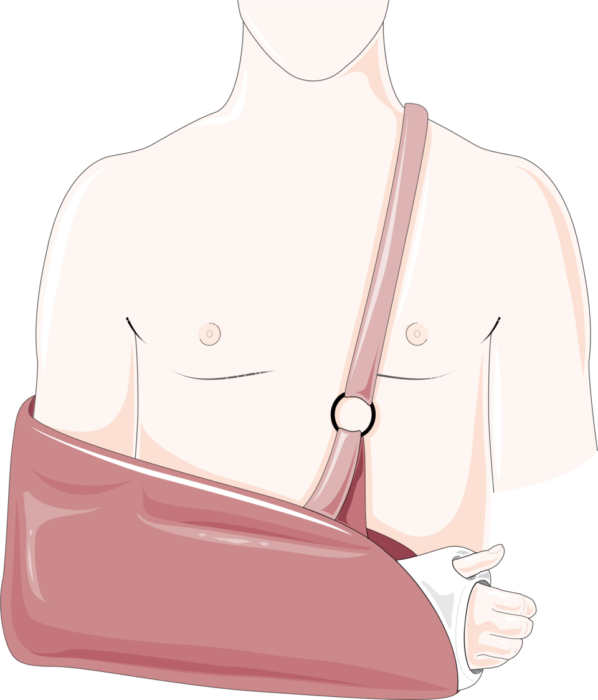
A Bankart repair is usually done under general anaesthesia with a nerve block that keeps the arm comfortable for many hours. Most patients go home the same or next day in a sling, with wound-care instructions and pain relief. The first week is about rest, ice, hand and elbow exercises, and keeping the small wounds clean and dry until the first check.
Pain after surgery
Pain is controlled early by the nerve block, then pain relief and ice. It improves steadily over two to three weeks; mild discomfort when motion exercises start is expected. Sudden severe pain, marked swelling or fever needs review.
Key restrictions in the early weeks
- Avoid raising the arm out to the side while turning it back (the throwing position) — the riskiest position for the repair.
- Do not lift weights or push up with the arm.
- Keep the sling on at night and outdoors as instructed.
- Do not start sport or upper-body gym work before your surgeon clears it.
Week by week
- Weeks 1–2: pain settling, sling on, hand and elbow exercises, first wound check.
- Weeks 3–6: limited shoulder motion guided by the physiotherapist; back to desk work or study.
- Weeks 6–12: sling off, most range regained, light daily activities, driving with your surgeon’s approval.
- Months 3–4: band strengthening; gym for legs and core, light arm work.
- Months 4–6 and beyond: sport-specific drills, then competition after testing.
Sleeping, driving and returning to work
- Sleeping: on your back or semi-reclined with the sling and a pillow under the elbow in the first weeks.
- Driving: usually once the sling is off and you control the arm, around 6 weeks, with your surgeon’s approval.
- Desk work: usually after 1–2 weeks.
- Heavy manual work: usually after 3 months or more.
Returning to sport and boxing
Running and light sport may start earlier on your surgeon’s advice. Boxing, martial arts, handball, goalkeeping and swimming usually need 6 months or more, once full motion and near-equal strength with the other shoulder are back and stability tests are passed. Returning too early is one of the leading causes of re-dislocation.
Key numbers to know
- Among 124 athletes, recurrence was 1.6% after Latarjet versus 16.1% after arthroscopic Bankart repair, with similar return-to-sport rates (Hurley et al., 2021).
- When 25% or more of the inferior glenoid diameter is lost, experts agree on bone grafting (such as Latarjet) rather than Bankart repair alone (Di Giacomo, Itoi and Burkhart, 2014).
- In randomised trials of first-time dislocation, recurrence was 6.3% after surgical stabilisation versus 46.6% with a sling alone, and 30.8% of non-operative patients later needed surgery (Belk et al., AJSM 2023).
| Treatment | When we use it | What to expect |
|---|---|---|
| Reduction, sling and rehabilitation | A first dislocation in non-athletes or older adults | Gradual return of movement while watching for recurrence |
| Arthroscopic Bankart repair | Recurrent dislocation, or a first dislocation in a young athlete with a Bankart tear and minimal bone loss | Small incisions; return to sport in roughly 4–6 months |
| Bankart with remplissage | A large (off-track) Hill-Sachs defect with minimal glenoid bone loss | Lower recurrence risk without open surgery |
| Latarjet procedure | Significant glenoid bone loss or a failed Bankart repair | The lowest recurrence rates, especially in contact sports |
At Prof. Dr. Ibrahim Shaarawi’s clinics in Nasr City, Mohandeseen and New Cairo (5th Settlement) we test shoulder stability and review your CT and MRI at the same visit, measuring bone loss to choose rehabilitation, Bankart repair or Latarjet.
Latarjet recovery compared with Bankart
| Arthroscopic Bankart | Open Latarjet | |
|---|---|---|
| Sling | Usually 3–6 weeks | Usually 2–4 weeks depending on the surgeon |
| What must heal | Labrum and capsule to bone | The transferred bone block |
| X-ray follow-up | As needed | To confirm bone-block healing |
| Return to sport | 4–6 months or more for contact sport | Usually 4–6 months depending on healing |
What slows recovery?
Skipping exercises — or rushing movement before the repair heals — smoking, which slows tissue healing, and poorly controlled diabetes can all delay recovery. Some patients develop extra stiffness needing more intensive physiotherapy, and some need more time to regain confidence before sport. The full exercise programme is in exercises after shoulder dislocation surgery.
Wound care and showering
- The wounds are small (about one centimetre each) and covered with adhesive dressings.
- Showering is usually allowed after a few days with the wounds protected by a waterproof cover, as your surgeon advises.
- To dress: put the operated arm into the sleeve first, then the other; undress in reverse.
- See your doctor if you notice redness, discharge or fever.
Signs that recovery is going well
- Pain improves week by week.
- Motion returns gradually for each phase without severe stiffness.
- No sensation of the shoulder slipping out.
- Strength improves steadily in the strengthening phase.
- Sleep improves after the first weeks.
Nutrition, smoking and healing
Healing of the labrum and capsule to bone is a biological process influenced by general health. A balanced diet with enough protein and vitamin D supports healing; smoking reduces tissue blood supply and delays it, so stopping before and after surgery is advised. Diabetes should be well controlled to lower the risk of infection and slow healing.
Returning to study or travel
Students often return to classes after one to two weeks in the sling, carrying bags on the other shoulder only. Air travel is usually possible after the first days, keeping the sling on and moving the hands and feet during the flight; tell your surgeon your travel dates so follow-up and physiotherapy can be arranged.
Video: 3 mistakes after shoulder arthroscopy that can cause failure
Frequently asked questions about recovery after Bankart repair
How long is recovery after arthroscopic shoulder dislocation surgery?
A sling for 3 to 6 weeks, most motion within 3 months, and return to sport usually after 4 to 6 months or more for contact sport.
When can I stop wearing the sling?
Usually after 3 to 6 weeks depending on the procedure and your surgeon’s instructions.
Is pain after the operation normal?
Yes, in the first weeks; it is managed with pain relief and ice and improves steadily.
Can I return to boxing after shoulder dislocation surgery?
Usually yes, after about 6 months or more and passing strength and stability tests; your surgeon decides the timing.
When can I drive?
Usually once the sling is off and you control the arm — around 6 weeks — with your surgeon’s approval.
To have your shoulder assessed, book a consultation, call +20 155 240 4488 or message us on WhatsApp at +20 155 554 7181.
Medically reviewed by Prof. Dr. Ibrahim Shaarawi, Professor of Orthopaedic Surgery. This article is general medical education and does not replace an examination or the plan your surgeon sets for you. See our medical disclaimer.
Related shoulder dislocation guides
For details of the operation see arthroscopic shoulder stabilisation surgery, and read:
- Arthroscopic shoulder stabilisation surgery
- Exercises after shoulder dislocation surgery
- Shoulder arthroscopy and dislocation surgery success rate
References
- Gaunt BW, et al. The American Society of Shoulder and Elbow Therapists’ consensus rehabilitation guideline for arthroscopic anterior capsulolabral repair of the shoulder. J Orthop Sports Phys Ther. 2010;40(3):155-68.
- American Academy of Orthopaedic Surgeons (OrthoInfo). Chronic Shoulder Instability.
- American Academy of Orthopaedic Surgeons (OrthoInfo). Shoulder Surgery Exercise Guide.