
The anterior cruciate ligament (ACL) is a strong band of tissue in the centre of the knee joint. It runs diagonally from the back of the thigh bone (femur) to the front of the shin bone (tibia), stops the tibia sliding forward and controls twisting. It is the most commonly injured knee ligament, usually during a sudden pivot or a bad landing.
Where is the ACL?
The ACL sits deep inside the knee, between the two rounded ends of the femur. It crosses the posterior cruciate ligament (PCL) in an X shape — “cruciate” means cross-shaped. Because it lies inside the joint fluid, it cannot be felt from the outside and does not show on a plain X-ray.
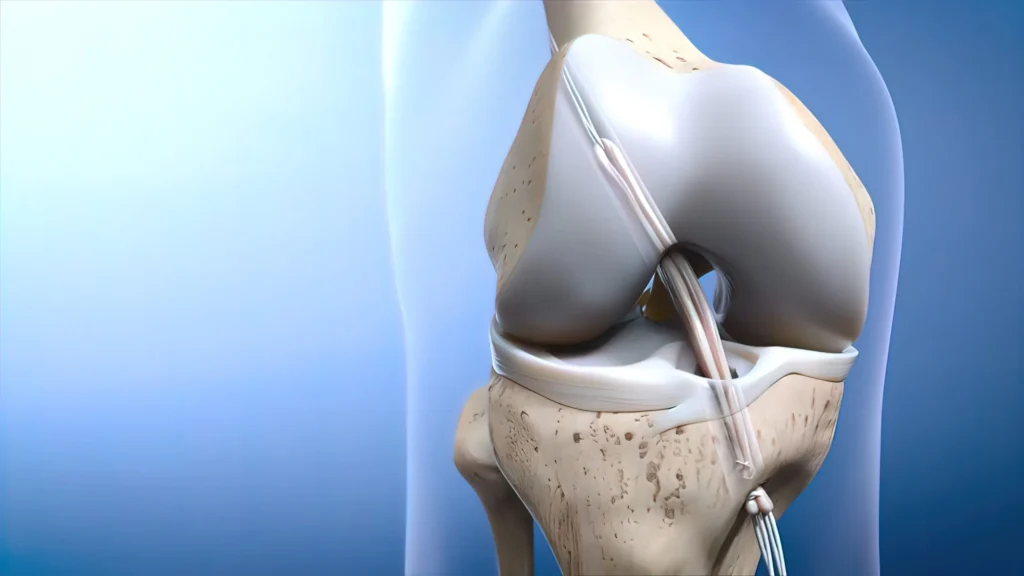
What is the ACL made of?
- Two bundles — the anteromedial and posterolateral bundles — that tighten at different angles of knee bend.
- Collagen fibres arranged to resist stretching, with a limited blood supply.
- Nerve endings that tell the brain where the knee is (proprioception), which is why balance training matters after injury.
- In adults it is about 3 cm long on average and roughly 7–12 mm wide.
ACL vs PCL vs meniscus: what’s the difference?
| ACL | PCL | Meniscus | |
|---|---|---|---|
| What it is | Ligament (bone to bone) | Ligament (bone to bone) | C-shaped cartilage cushion |
| Main job | Stops the tibia sliding forward; controls rotation | Stops the tibia sliding backward | Absorbs shock and spreads load |
| Typical injury | Pivoting or landing in sport | Direct blow to the front of a bent knee | Twisting, or wear with age |
| Typical feeling | Pop, rapid swelling, knee “gives way” | Pain at the back of the knee, instability on stairs | Joint-line pain, catching or locking |
Read more about the posterior cruciate ligament (PCL) and about arthroscopic meniscus surgery.
Can a torn ACL heal on its own?
A complete ACL tear rarely heals by itself. Joint fluid stops a stable healing clot forming between the torn ends, and the ligament’s blood supply is limited. A partial ACL tear can regain much of its stability with rehabilitation, and some people with a complete tear manage well without surgery — see ACL treatment without surgery.
What increases the risk of an ACL tear?
- Sports with cutting, pivoting and jumping: football, basketball, handball, skiing.
- Landing with the knee collapsing inward.
- Weak hip and thigh muscles or poor balance.
- Fatigue late in a match.
- A previous ACL injury on either side.
How can you protect your ACL?
- Warm up with a structured injury-prevention programme before training.
- Strengthen the hamstrings, quadriceps and hip muscles.
- Practise landing softly with knees over toes.
- Improve single-leg balance.
- Wear footwear suited to the playing surface.
Video: knee pain and ligament injuries
Frequently asked questions about the ACL
Where exactly is the ACL in the knee?
In the centre of the knee joint, running diagonally from the back-outer part of the femur to the front of the tibia, crossing the PCL in an X shape.
What does the ACL do?
It stops the shin bone sliding forward under the thigh bone and keeps the knee stable during twisting, cutting and landing.
Does the ACL show on an X-ray?
No. X-rays show bone and are used to rule out fractures. An MRI shows the ligament and cartilage, alongside the surgeon’s clinical examination.
Can you walk with a torn ACL?
Usually yes, once the early swelling settles, but the knee may give way when you twist or change direction. Repeated giving-way can damage the meniscus, so get it assessed.
Can a torn ACL heal without surgery?
A complete tear rarely heals, but many people regain function with rehabilitation. Surgery is usually advised for active people with instability.
To have your knee assessed, book a consultation, call +20 155 240 4488 or message us on WhatsApp at +20 155 554 7181.
Medically reviewed by Prof. Dr. Ibrahim Shaarawi, Professor of Orthopaedic Surgery. This article is general medical education and does not replace an examination or the plan your surgeon sets for you. See our medical disclaimer.
Related ACL guides
This article is part of our ACL guide. For surgical treatment see ACL reconstruction surgery, or continue with:
References
- Kiapour AM, Murray MM. Basic science of anterior cruciate ligament injury and repair. Bone Joint Res. 2014;3(2):20-31.
- American Academy of Orthopaedic Surgeons (OrthoInfo). Anterior Cruciate Ligament (ACL) Injuries.
- American Academy of Orthopaedic Surgeons (OrthoInfo). Posterior Cruciate Ligament Injuries.
- Benjaminse A, et al. Clinical diagnosis of an anterior cruciate ligament rupture: a meta-analysis. J Orthop Sports Phys Ther. 2006;36(5):267-88.