
This article is for patient education only. Never take any medication without a prescription from your treating physician. All medications listed have individual interactions and contraindications.
Knee osteoarthritis is one of the most common health problems in Egypt and the Arab world — especially in older adults and those who are overweight. Many patients search for Knee Osteoarthritis Medication Guide. This guide covers the most important medications available in Egyptian pharmacies, how they work, and when each is appropriate.
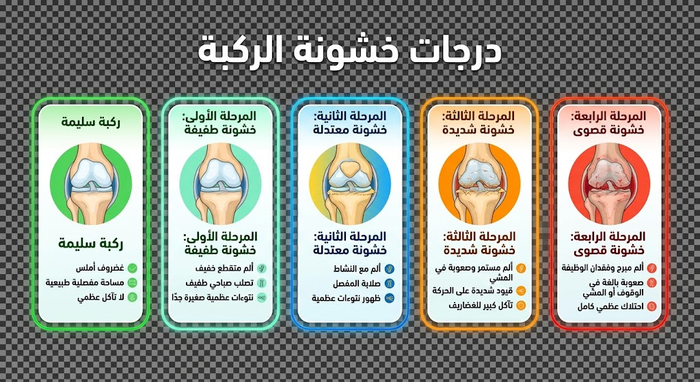
Grades of Knee Osteoarthritis
| Grade | Cartilage Status | Main Symptoms | X-ray Findings | Optimal Treatment | Are Drugs Sufficient Alone? |
|---|---|---|---|---|---|
| Grade 1 — Early | Limited damage — surface intact | Mild pain after exertion or at day’s end | No visible joint space narrowing | Exercise + weight loss + cartilage supplements | Yes — very effective |
| Grade 2 — Moderate | Partial erosion — fissuring | Regular pain + morning stiffness | Mild joint space narrowing | NSAIDs + hyaluronic acid injection + physiotherapy | Yes — primary option |
| Grade 3 — Advanced | Extensive erosion — partial bone exposure | Severe pain + swelling + limited movement | Marked narrowing + osteophytes | Corticosteroid/hyaluronic injection + drugs + surgical review | Partially — temporary support |
| Grade 4 — Severe | Near-complete destruction — bone on bone | Constant pain even at rest | Joint space obliterated | Total knee replacement | No — temporary relief only |
| * Based on Kellgren-Lawrence classification and AAOS / EULAR guidelines. Grade is determined by weight-bearing X-ray. The final treatment decision is made by the treating physician. | |||||
Is the Treatment Fixed?
No. Treatment is individualised based on: OA grade; patient age (younger patients may benefit from cartilage-stimulating therapies); weight and general health (obese patients need a weight-loss programme); comorbidities (diabetes or hypertension affect which drugs are safe); and individual treatment response.
Medication Plan — Key Components
NSAIDs (Anti-inflammatories) — Use Only One at a Time
- Diclofenac (Voltaren, Cataflam): 50 mg twice daily or 75 mg once daily after food. Typical duration: 1–2 weeks.
- Ibuprofen (Brufen, Advil): 400–600 mg every 6–8 hours with food. Maximum 2400 mg/day.
- Etoricoxib (Recoxi Bright): 90 mg once daily after main meal. Longer duration of action.
- Celecoxib (Celebrex): 200 mg once daily. Fewer gastric side effects than traditional NSAIDs.
Cartilage Supplements — Can Be Combined
- Glucosamine (Genofit, Jointa): 1500 mg/day in two divided doses with food. Takes 3–6 months for results.
- Chondroitin (Salfax Joint): 800–1200 mg/day. Usually combined with glucosamine.
- Collagen (CH Alpha): Once daily on an empty stomach.
Topical Medications
- Diclofenac gel (Voltaren Gel, Move): 3–4 times daily on the affected area. Fewer systemic side effects.
Intra-articular Injections (by specialist only)
- Corticosteroid: Rapid effect; duration 3–6 months (occasionally longer in early grades). Maximum 2–3 injections per year.
- Hyaluronic acid (Monovisc, Supplasin): Once or twice yearly; duration 6–12 months.
Supportive Medications
- Omeprazole (Omez): 20–40 mg morning on empty stomach — mandatory with all NSAIDs.
- B-complex vitamins (Neurobion): One tablet daily after breakfast.
- Calcium + Vitamin D (Calci D): One tablet daily with food.
Comprehensive Medication Comparison Table
| Drug / Class | Dose | Onset of Effect | Recommended Duration | Suitable Grade | Key Warning |
|---|---|---|---|---|---|
| Diclofenac (NSAID) | 50 mg ×2 or 75 mg ×1 | 1–3 days | 1–2 weeks (acute) | 1–3 | Never combine with another NSAID — gastric risk |
| Ibuprofen (NSAID) | 400–600 mg every 6–8 hr | 1–2 days | Short-term as needed | 1–3 | Max 2400 mg/day — gastric + renal risk |
| Celecoxib (COX-2) | 200 mg ×1 | 2–4 days | As needed | 1–3 | Safer for stomach — cardiovascular caution in elderly |
| Glucosamine | 1500 mg/day (2 doses) | 8–12 weeks | 3–6 months | 1–2 | Can combine with chondroitin — avoid in renal impairment |
| Chondroitin | 800–1200 mg ×1 | 8–12 weeks | 3–6 months | 1–2 | Prefer with glucosamine — combinable with NSAIDs |
| Diclofenac gel (topical) | 3–4× daily to joint | 1–3 days | As needed | 1–3 | Avoid broken skin — gastric side effects minimal |
| Corticosteroid injection | Single intra-articular dose | Days | 3–6 months per injection | 2–3 | Max 2–3 per year — tendon weakening risk |
| Hyaluronic acid injection | 1 injection (or course) | 2–4 weeks | 6–12 months | 2–3 | Specialist only — higher cost than corticosteroid |
| Omeprazole (gastric protection) | 20–40 mg morning (empty stomach) | 1–3 days | Throughout NSAID course | Mandatory with any NSAID | Do not take NSAIDs long-term without it |
| * Doses are for healthy adults. Adjustments required for renal, hepatic, or cardiac impairment. Source: EULAR OA Guidelines 2023, OARSI 2019, NICE NG226 2022. | |||||
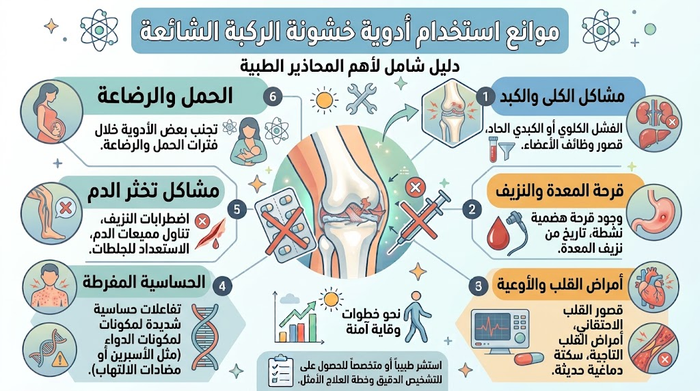
Key Contraindications
| Medical Condition | Restricted Drug | Reason | Suggested Alternative |
|---|---|---|---|
| Active peptic ulcer | All oral NSAIDs | Increased bleeding and perforation risk | Topical diclofenac + mandatory omeprazole |
| Renal impairment | NSAIDs + glucosamine (caution) | NSAIDs reduce renal perfusion | Paracetamol + topical only |
| Cardiovascular disease | COX-2 inhibitors (caution) | Possible increased cardiovascular event risk | Paracetamol + topical under cardiologist guidance |
| Pregnancy (third trimester) | All NSAIDs | Risk of fetal ductus arteriosus closure | Paracetamol under medical supervision |
| NSAID / aspirin allergy | All NSAID class | Cross-reactive allergic response | Paracetamol + topical |
| * For awareness only. Never modify or discontinue any medication without consulting your physician. Source: NICE NG226, EULAR OA Guidelines 2023, WHO Essential Medicines. | |||
Key Tips for Treatment Success
- Adherence: Take medications regularly at the prescribed doses for full effectiveness.
- Patience: Glucosamine and chondroitin take months to show results.
- Regular follow-up: Visit your orthopaedic specialist periodically to assess response and adjust treatment.
- Lifestyle change: Medication is most effective when combined with weight loss and physiotherapy.
- Avoid self-dosing: Never increase doses or combine multiple drugs without medical advice.

Frequently Asked Questions: Knee Osteoarthritis Medications
An authoritative guide to topical and oral NSAIDs, cartilage supplements, intra-articular injections, safety considerations, and treatment escalation.
What is the recommended first-line medication for knee osteoarthritis?
Current clinical practice guidelines from the Osteoarthritis Research Society International (OARSI) and the American College of Rheumatology (ACR) strongly endorse topical nonsteroidal anti-inflammatory drugs (NSAIDs), such as topical diclofenac, as the first-line pharmacologic intervention for knee osteoarthritis. Topical NSAIDs deliver localized analgesia directly to the synovial joint with minor systemic bioavailability (typically 1–10% of equivalent oral doses), drastically reducing the risk of gastrointestinal ulceration, acute renal impairment, and adverse cardiovascular events.
Is acetaminophen (paracetamol) still considered effective for knee osteoarthritis?
Recent high-quality systematic reviews and meta-analyses show that acetaminophen provides only a negligible effect size for osteoarthritis pain and function compared to placebo. Consequently, major guidelines have downgraded it from primary therapy. However, it remains a conditional option for short-term episodic relief in patients who have clear contraindications to NSAIDs, provided the total daily dose does not exceed 3,000 mg to mitigate hepatotoxicity risks.
When should oral NSAIDs be prescribed, and what precautions are needed?
Oral NSAIDs (e.g., celecoxib, naproxen, meloxicam) are recommended when topical formulations yield insufficient pain control. Prescribing rules include:
• Gastrointestinal Protection: Use a selective COX-2 inhibitor or co-prescribe a proton pump inhibitor (PPI) in patients with elevated GI bleed risk.
• Cardiovascular & Renal Monitoring: Baseline blood pressure, estimated glomerular filtration rate (eGFR), and cardiovascular history must be screened.
• Duration: Always utilize the lowest therapeutic dose for the shortest duration necessary during acute symptom flare-ups.
Do glucosamine and chondroitin sulfate actually rebuild knee cartilage?
No. Glucosamine and chondroitin sulfate—classified as Symptomatic Slow-Acting Drugs in Osteoarthritis (SYSADOA)—cannot reverse, regrow, or reconstruct loss of articular cartilage once established. While over-the-counter dietary formulations show mixed results in major clinical trials, pharmaceutical-grade crystalline glucosamine sulfate has demonstrated mild anti-inflammatory effects and modest symptom reduction over extended periods in patients with early (mild-to-moderate) radiographic disease.
What is the role of duloxetine in managing knee osteoarthritis pain?
Duloxetine is a centrally acting serotonin-norepinephrine reuptake inhibitor (SNRI) conditionally recommended for chronic musculoskeletal pain. It is particularly effective for patients with refractory knee pain who exhibit signs of nociplastic pain, central sensitization, or multi-site joint pain, as well as individuals with medical contraindications to traditional anti-inflammatory medications.
How effective and safe are intra-articular corticosteroid injections?
Intra-articular steroid injections (e.g., triamcinolone acetonide) provide potent, rapid pain relief and decrease inflammatory joint effusion, typically lasting between 2 and 8 weeks. They serve as an acute management tool to facilitate physical therapy participation. However, repetitive injections (more than 3 to 4 times annually) are discouraged due to randomized controlled data showing an association with accelerated cartilage volume loss over time.
What is the clinical evidence regarding hyaluronic acid (viscosupplementation)?
Hyaluronic acid (HA) injections mimic natural synovial fluid to enhance lubrication, viscoelasticity, and shock absorption within the knee joint capsule. While societal guideline recommendations vary, clinical consensus supports its utility in mild-to-moderate osteoarthritis (Kellgren-Lawrence grades 2–3) where it can provide prolonged pain relief for up to 6 months, functioning as a viable non-systemic bridge for patients unable to tolerate NSAIDs.
How does platelet-rich plasma (PRP) therapy compare to other injectable options?
Platelet-rich plasma (PRP) harnesses concentrated autologous bioactive platelets containing growth factors (such as TGF-beta, PDGF, and IGF-1) to downregulate intra-articular catabolic cytokines. Comparative trials and systematic reviews demonstrate that leukocyte-poor PRP offers superior and longer-lasting analgesic outcomes (often 6 to 12 months) compared to hyaluronic acid and corticosteroids in early-to-moderate disease, although results depend heavily on preparation methods.
Are opioid analgesics recommended for chronic knee osteoarthritis pain?
Routine use of oral opioids (e.g., oxycodone, morphine, codeine) is strongly discouraged by AAOS, ACR, and OARSI guidelines. Clinical studies show negligible long-term functional improvement alongside substantial risks of tolerance, dependency, cognitive impairment, sedation, and heightened fall rates in elderly populations. Weak atypical opioids like tramadol are considered only as a temporary salvage measure when surgical intervention is contraindicated and all other treatments have failed.
At what point does medication failure indicate a need for surgical consultation?
Surgical evaluation (such as high tibial osteotomy for unicompartmental disease or total knee arthroplasty) is indicated when:
• Patients experience persistent, intractable pain and functional disability despite 3 to 6 months of optimized multi-modal medical therapy (medications, structured physical therapy, and weight control).
• Radiographs reveal severe structural joint collapse (Kellgren-Lawrence grade 4 with bone-on-bone contact).
• The patient develops debilitating night pain, progressive fixed flexion contracture, or marked mechanical malalignment (varus/valgus deformity).
References
- NICE Guideline NG226. Osteoarthritis in over 16s: diagnosis and management. 2022. Available at: nice.org.uk
- AAOS OrthoInfo. Osteoarthritis of the Knee. 2023. Available at: orthoinfo.aaos.org
- Mayo Clinic Staff. Osteoarthritis – Diagnosis and treatment. 2024. Available at: mayoclinic.org
- Kolasinski SL, et al. 2019 ACR/AF Guideline for the Management of Osteoarthritis of the Hand, Hip, and Knee. Arthritis & Rheumatology. 2020;72(2):220–233. DOI: 10.1002/art.41142
- Bruyère O, et al. Updated algorithm recommendation for the management of knee osteoarthritis from ESCEO. Seminars in Arthritis and Rheumatism. 2019;49(3):337–350. DOI: 10.1016/j.semarthrit.2019.04.008
- Cleveland Clinic. Osteoarthritis of the Knee. 2023. Available at: my.clevelandclinic.org
- Rutjes AW, et al. Viscosupplementation for osteoarthritis of the knee. Annals of Internal Medicine. 2012;157(3):180–191. DOI: 10.7326/0003-4819-157-3-201208070-00473
- Medscape. Osteoarthritis Treatment & Management. 2024. Available at: emedicine.medscape.com