
Shoulder arthroscopy is a common intervention for treating shoulder joint pain. Although it is a minimally invasive procedure, being aware of the potential shoulder arthroscopy complications is essential before undergoing the operation.
What is Shoulder Arthroscopy?
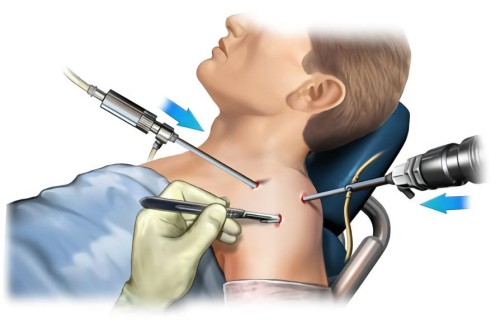
Shoulder arthroscopy is a surgical technique used to diagnose and treat shoulder problems by inserting a tiny camera and surgical instruments through very small skin incisions (portals). This type of surgery is considered less invasive compared to traditional open surgery, leading to a shorter recovery period and reduced postoperative pain. Modern arthroscopes enable the visualization of various areas inside the shoulder, helping the orthopedic and joint surgeon make accurate treatment decisions and execute them—such as repairing torn rotator cuff tendons and treating recurrent shoulder dislocation.

The Importance of Shoulder Arthroscopy
Shoulder arthroscopy plays a vital role in several areas of shoulder injury management, including:
- Diagnostic arthroscopy for injuries: Such as torn shoulder ligaments or cartilage, labral tears, and shoulder tendonitis.
- Repairing ligaments and tendons: Such as repairing or releasing affected shoulder tendons using shoulder suture anchors.
- Pain relief: By removing inflamed tissues.
This procedure can significantly contribute to improving the patient’s quality of life and restoring shoulder function more effectively.
What are the Risks/Complications of Shoulder Arthroscopy?
Although shoulder arthroscopy is largely considered a safe procedure with a very high success rate, there are some potential risks and chances of injury that patients should be aware of. These risks include:
- Anesthesia: Can cause unexpected adverse reactions.
- Nerve injury: Damage to the nerves surrounding the shoulder may occur.
- Bleeding: There is a possibility of internal bleeding within the shoulder or external bleeding from the incision.
- Wound infection and contamination.
- Shoulder joint stiffness.
Can the Risks of Shoulder Arthroscopy Be Avoided?
Yes, in most cases, complications can be avoided through careful preparation, having the surgery performed by a specialized shoulder surgeon, and ensuring proper postoperative follow-up. Monitoring symptoms and communicating closely with your doctor helps assess these risks, prevents them from occurring, and increases the chances of a rapid recovery.
Shoulder Arthroscopy vs. Open Surgery
| Comparison Criteria | Shoulder Arthroscopy | Traditional Open Surgery |
| Incision Size | 2–4 small portals (less than 1 cm) | Large surgical incision (5–10 cm or more) |
| Hospital Stay | One day or less (in most cases) | 2–5 days |
| Full Recovery Time | 4–8 weeks (depending on the procedure) | 3–6 months |
| Risk of Infection | Very low (<1%) | Relatively higher (1–3%) |
| Surgical Vision Clarity | Excellent with a high-definition camera | Direct vision with the naked eye |
| Postoperative Pain | Mild to moderate | Severe in the first few days |
| Surgical Scar | Very small (cosmetically superior) | Visible longitudinal scar |
How to Prevent the Risks of Shoulder Arthroscopy?
Basic Prevention Steps
To minimize potential harms during shoulder arthroscopy, several fundamental preventive steps should be followed:
- Choosing a Sports Medicine Specialist: You must ensure that the surgeon is specialized and has both local and international experience in performing these surgeries.
- Conducting Necessary Medical Tests: Ensure comprehensive medical tests are completed to evaluate your health condition before surgery; the most important include blood sugar levels, liver functions, and kidney functions.
- Good Communication with the Medical Team: It is essential to share accurate information regarding your medical history and current medications.
The Importance of Physical Therapy After Rotator Cuff Surgery
Providing appropriate postoperative care plays a major role in a successful recovery:
- Adhering to Medical Instructions: Following guidelines related to wound care and taking prescribed medications.
- Physical Therapy After Rotator Cuff Surgery: Physical therapy is essential post-surgery to restore function and reduce pain.
By following these measures, the chances of complications can be significantly reduced, leading to an improved recovery experience.
Recovery After Shoulder Arthroscopy
Tips for the Recovery Period
The recovery period after rotator cuff surgery is crucial for ensuring optimal healing. Here are the top 3 tips to follow:
- Rest: The body must be given a chance to heal by getting an adequate amount of rest.
- Pain Management: Use the medications and methods prescribed by your doctor to relieve pain.
- Maintaining Mobility: Perform light exercises to maintain your range of motion, strictly according to the directions of your orthopedic sports medicine consultant.
Shoulder Care After Surgery
Good shoulder care post-surgery contributes to a rapid recovery:
- Dressing Changes: Dressings must be changed according to the doctor’s instructions, and the wound must be kept dry.
- Avoiding Strenuous Activities: Avoid lifting heavy objects or engaging in sports activities before consulting your doctor.
Physical Therapy Protocol After Shoulder Arthroscopy — Week by Week
| Time Phase | Goals | Permitted Exercises | Prohibited Actions |
| Weeks 1–2 | Controlling pain and swelling | Breathing exercises + finger and wrist movements | Any active movement of the shoulder |
| Weeks 3–6 | Restoring passive range of motion | Passive shoulder movement with the therapist’s assistance | Lifting any weights |
| Weeks 7–12 | Gradual muscle strengthening | Strengthening rotator cuff muscles with light resistance | Intensive sports activities |
| Months 4–6 | Return to full activity | Functional training + sports rehabilitation exercises | Returning to the field without the surgeon’s clearance |
Potential Late Complications
Chronic Pain After Surgery
Chronic pain is one of the potential complications patients may experience after shoulder arthroscopy. In some cases, the pain can persist for a long time after the initial healing phase.
- Possible Causes: The pain may result from nerve damage or persistent tissue irritation.
- Managing Pain: It is important to communicate with your doctor regarding pain management options, such as medications or continued physical therapy.
Infection and Swelling
Infection and swelling are common potential complications after any surgical procedure, including shoulder arthroscopy.
- Warning Signs: These include fever, redness around the wound, or abnormal discharge (pus).
- Preventive Measures: Keeping the wound clean and changing dressings regularly can help reduce the risk of infection.
Recognizing these complications and acting swiftly if they occur is of utmost importance to ensure a safe and proper recovery.
Frequently Asked Questions
How safe is shoulder arthroscopy and what is the overall complication rate?
Shoulder arthroscopy is one of the most reliable and safe interventions in orthopedic sports medicine:
- Minimally Invasive Profile: It avoids detaching large muscular groups (such as the deltoid or subscapularis), resulting in minimal intraoperative blood loss and rapid tissue healing.
- Complication Rate: Large multicenter cohorts report an overall complication rate between 1% and 2%, with major structural or life-threatening adverse events remaining under 0.5%.
- Clinical Efficacy: Functional return-to-play and patient satisfaction rates for labral re-anchoring, rotator cuff repairs, and subacromial decompression regularly exceed 90% to 95%.
What are the most frequent complications following shoulder arthroscopy?
While severe complications are rare, orthopedic specialists monitor and manage several known clinical entities:
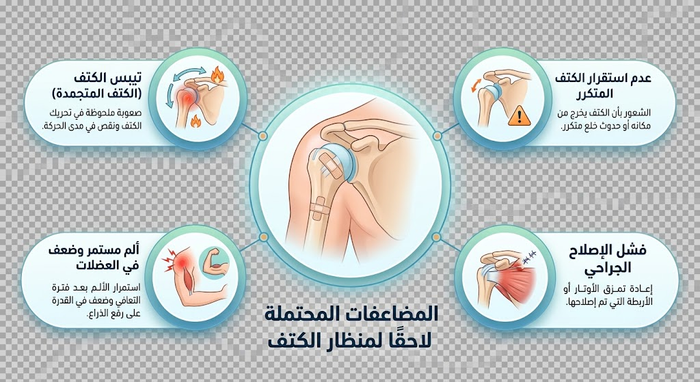
- Postoperative Stiffness: Fibrotic capsular adhesions (frozen shoulder) limiting terminal elevation and external rotation.
- Subcutaneous Fluid Extravasation: Self-limiting swelling across the chest, neck, and shoulder due to arthroscopic irrigation fluid.
- Transient Neuropraxia: Temporary numbness or motor weakness related to traction or regional nerve blocks.
- Surgical Site Infection: Rare superficial portal or deep intra-articular bacterial contamination.
- Tendon Healing Failure: Failure of biological tendon-to-bone integration, particularly in massive rotator cuff tears.
- Hardware Irritation: Suture anchor loosening, pullout, or articular cartilage scuffing.
Why does post-surgical shoulder stiffness occur, and how can it be prevented?
Secondary stiffness represents the most common postoperative rehabilitation challenge:
- Pathophysiology: Surgical trauma, bone debridement, and suture placement stimulate intra-articular myofibroblasts, forming fibrous bands across the rotator interval and axillary pouch.
- Elevated Risk Groups: Patients with pre-existing adhesive capsulitis, metabolic disease (diabetes, thyroid dysfunction), or those placed under prolonged, uninterrupted immobilization.
- Prevention & Management: Immediate initiation of passive range-of-motion protocols (Codman’s pendulum exercises, supine forward elevation, and gentle external rotation) once surgical repair security allows.
What causes swelling in the neck, chest, and shoulder after arthroscopy?
Periarticular soft-tissue swelling is an expected, transient effect of the arthroscopic technique:
- Saline Infusion: Sterile isotonic saline is pumped into the joint at physiological pressures (typically 40 to 60 mmHg) to clear bone dust, control bleeding, and provide optic clarity.
- Tissue Infiltration: A portion of this fluid naturally extravasates through portal openings into the pectoralis and supraclavicular fascial planes.
- Spontaneous Drainage: The lymphatic system absorbs and excretes this excess saline via normal renal clearance within 48 to 72 hours, requiring no drainage intervention.
Can nerve injury or arm numbness happen after shoulder arthroscopy?
Neurological symptoms are almost always temporary, with permanent nerve damage being extraordinarily rare:
- Regional Interscalene Block: The most common source of postoperative arm heaviness and numbness is the regional nerve block, which resolves naturally within 18 to 24 hours.
- Traction Neuropraxia: Mild mechanical stretch on the brachial plexus during arm positioning can cause temporary paresthesias that resolve spontaneously over days or weeks.
- Direct Mechanical Damage: Direct laceration of primary nerve trunks (axillary, suprascapular, or musculocutaneous) occurs in less than 0.1% of procedures due to standardized safe portal placement.
What is the incidence of infection in shoulder arthroscopy and which bacteria are involved?
Shoulder keyhole surgery carries one of the lowest infection rates in orthopedic practice:
- Reported Incidence: Documented at 0.1% to 0.4%, substantially lower than open shoulder reconstructive procedures.
- Flushing Mechanism: Continuous multi-liter irrigation dynamically clears out potential bacterial inoculants throughout the operation.
- Primary Organism: The most frequent pathogen is Cutibacterium acnes, an anaerobic organism deep within shoulder sebaceous follicles. Preventative IV antibiotics and thorough skin preparation provide primary protection.
What factors increase the risk of rotator cuff tendon re-tear after arthroscopic repair?
Tendon-to-bone biological healing depends on both systemic factors and biomechanical protection:
- Biological Risk Factors: Massive retracted tears (> 3 to 5 cm), advanced fatty infiltration of the muscle belly, age over 65, and active tobacco smoking impair footprint microvascularization.
- Biomechanical Compliance: Premature discontinuation of the abduction sling, active overhead reaching, or heavy lifting before 6 to 8 weeks exposes the healing tendon to destructive tensile loads that can compromise anchor fixation.
Are blood clots (DVT or Pulmonary Embolism) a significant risk after shoulder arthroscopy?
Thromboembolic complications are exceedingly rare in upper-limb arthroscopy:
- Incidence Rate: Literature reports an incidence below 0.1% across international surgical registries.
- Positioning Advantage: Semi-seated beach-chair or lateral positioning avoids the major venous stasis seen in lower-limb arthroplasty.
- Thromboprophylaxis: Routine mechanical calf compression during surgery combined with immediate same-day ambulation generally eliminates the need for chemical anticoagulants in low-risk patients.
What problems can arise from suture anchors and implants used in the shoulder?
Modern implant technology has significantly reduced implant-related failure rates:
- Anchor Pullout: Can occur in osteoporotic bone if anchors are inserted at shallow angles or under excessive mechanical tension.
- Chondral Wear: Malpositioned anchors protruding into the glenohumeral joint space can cause mechanical abrasion of the cartilage.
- Modern Materials: The shift toward all-suture soft anchors, UHMWPE braided sutures, and PEEK composite materials has minimized osteolysis, foreign-body reactions, and cartilage complications.
What critical red-flag signs warrant immediate evaluation after shoulder arthroscopy?
Seek immediate evaluation by your surgical team or an emergency service if you experience:
- Infection Signs: Body temperature exceeding 38°C (100.4°F), spreading redness around portal wounds, or purulent drainage soaking through dressings.
- Structural Failure: A sudden audible pop or tearing sensation accompanied by severe, acute pain.
- Persistent Neurovascular Deficits: Cold, pale fingers or complete motor and sensory loss in the hand lasting past 48 hours.
- Systemic Embolic Symptoms: Sudden shortness of breath, sharp chest pain, or asymmetric swelling, firmness, and pain in either calf.
References
- American Academy of Orthopaedic Surgeons (AAOS) — OrthoInfoShoulder Arthroscopy — Last updated: 2022https://orthoinfo.aaos.org/en/treatment/shoulder-arthroscopy/
- Cleveland ClinicShoulder Arthroscopy: Procedure Details, Recovery & Risks — 2023https://my.clevelandclinic.org/health/treatments/17455-shoulder-arthroscopy
- Hospital for Special Surgery (HSS)Shoulder Arthroscopy: What to Expect — 2023https://www.hss.edu/condition-list_shoulder-arthroscopy.asp
- Mayo ClinicRotator Cuff Injury: Diagnosis and Treatment — 2023https://www.mayoclinic.org/diseases-conditions/rotator-cuff-injury/diagnosis-treatment/drc-20350251
- Medscape — Orthopedic SurgeryShoulder Arthroscopy: Complications and Outcomes — 2022https://emedicine.medscape.com/article/1899939-overview
- NICE (National Institute for Health and Care Excellence, UK)Arthroscopic procedures for shoulder disorders — Guidance — 2022https://www.nice.org.uk/guidance/ipg395
- Journal of Shoulder and Elbow Surgery (ScienceDirect)Waterman BR et al. — Complications of shoulder arthroscopy in the United States: analysis of a population-based cohort — JSES 2013; 22(11):1667–1673https://www.sciencedirect.com/science/article/pii/S1058274613002449
- PubMed / NCBIWeber SC et al. — Complications associated with arthroscopic shoulder surgery — Arthroscopy 2002; 18(2 Suppl 1):88–95https://pubmed.ncbi.nlm.nih.gov/11855930/