
The question regarding Walking After Knee Replacement Surgery is one of the most common inquiries from patients suffering from knee osteoarthritis. In this article, we will explore everything related to walking after total knee replacement (arthroplasty) surgery.
When to start walking after knee replacement surgery?
Knee replacement is a surgical procedure performed for individuals suffering from severe pain or an inability to perform daily activities due to joint wear (osteoarthritis). Following this surgery, walking is a fundamental part of the recovery process. But when can a patient actually start walking?
Generally, patients are allowed to begin walking on the exact same day of the surgery or the very next day, under the supervision of Dr. Ibrahim Shaarawi.
A critical factor influencing the timing of ambulation is the type of joint implanted. If the surgery utilizes primary or secondary knee joint techniques, the patient can walk immediately using a walker and may soon progress to walking without crutches or a walker to facilitate movement in a short time. Conversely, if the surgery is highly complex—such as cases involving associated bone fractures or severe ligament injuries—the patient may require a longer period before being permitted to bear weight and walk.
▶ (The experience of one of Dr. Ibrahim Shaarawi’s patients walking to the mosque immediately after the surgery, thanks to God.)
▶
Additionally, each patient must consider their body’s unique response to the treatment. Adapting to physical exertion post-surgery depends heavily on how well the muscles and joints recover. Therefore, it is strictly necessary to initiate walking under the supervision of a specialized orthopedic knee doctor, as this promotes proper healing and helps avoid potential complications.
How to walk after knee replacement surgery?
After undergoing a knee replacement, it is vital for the patient to follow correct walking techniques to ensure proper recovery and prevent further complications, especially in the early stages. The patient must be prepared to use assistive devices such as crutches or walkers to facilitate movement and safely support their weight. Walking typically begins with short, slow movements, a method that improves balance and minimizes excessive pressure on the new joint.
A crucial aspect to consider when beginning to walk is adjusting your body posture. The body should be kept upright, and the steps should be small. It is recommended that the patient balances their body weight evenly across both legs without straining the recovering joint. Over time, both the duration and distance of the walks can be gradually increased based on healing progress.
(Note: The patient can expect a noticeable increase in the length of the operated limb, as the joint is restored to its natural, un-eroded anatomical height.)
Safe walking techniques are an integral part of recovery. Patients must exercise caution when navigating different flooring; walking on flat, dry surfaces is highly preferable to avoid slipping or falling. Furthermore, engaging in muscle-strengthening exercises prior to walking is highly advised, as these exercises help restore the muscular strength required for proper ambulation.
When using a single crutch or cane, the patient must remember a golden rule: the crutch must be held in the hand opposite to the operated leg. This allows the patient to shift weight away from the recovering joint, ensuring proper biomechanical pressure distribution. By adhering to these guidelines and moving carefully, patients can vastly improve their walking experience and mitigate the risk of post-operative injuries.
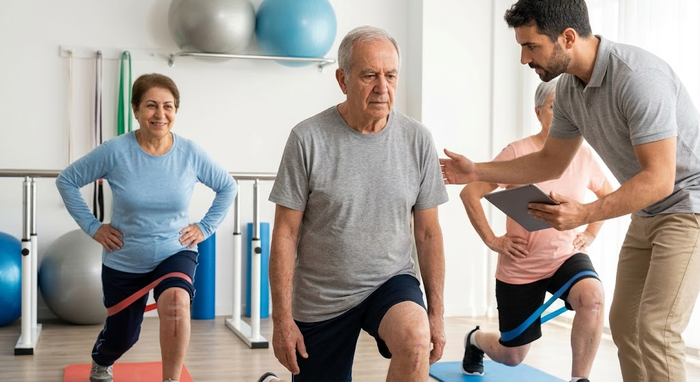
Recovery and Walking Timeline After Knee Replacement
| Phase | Timeframe | Expected Gait Pattern | Assistive Device | Functional Goal |
|---|---|---|---|---|
| 1. Early Mobilization | 0–48 hours post-surgery | Short steps beside the bed, then inside the room. | Medical Walker + Specialist assistance | Standing and transferring from bed to chair. |
| 2. Protected Walking | 3–14 days | Walking inside the house; short, frequent distances. | Walker or axillary crutches | Walking 50–100 meters on a flat surface. |
| 3. Crutch Transition | 2–4 weeks | Gradual outdoor walking; longer strides. | Single crutch in the opposite hand | Safely climbing 5–8 stairs. |
| 4. Independent Walking | 4–8 weeks | Walking without assistive devices on flat ground. | None (or a light cane for confidence) | Continuous walking for 400–500 meters. |
| 5. Normal Gait Restoration | 8–16 weeks | Walking with equal and symmetrical strides. | None | Walking 1–2 km; returning to social activities. |
Note: This timeline is indicative and varies based on the patient’s age, preoperative muscle strength, and adherence to the rehabilitation program. Transitioning between phases is strictly done with the treating surgeon’s approval.
The walking pattern (gait) after knee replacement surgery
Initially, a patient’s walking pattern (gait) may appear altered or unnatural. Most individuals experience difficulty moving due to the expected post-operative pain and swelling in the treated area. However, this discomfort rapidly subsides, and the patient usually returns to a normal gait within a few weeks of the operation.
As the biological healing process advances, the gait visibly improves, and patients reduce their reliance on assistive devices. Physical therapy programs incorporate specific strength and flexibility exercises that are instrumental in regaining natural movement. Completely normalizing the gait may take several weeks to a few months, depending on individual physiological factors.
Pain and swelling are the primary variables affecting the walking pattern. In some instances, patients may experience lingering soreness with intermittent periods of relief during recovery. Developing effective pain management strategies is an essential motivational component for achieving a more natural gait. Furthermore, psychological factors—such as anxiety or fear of falling and re-injury—can temporarily hinder gait improvement.
Overall, diligent physical therapy, strict adherence to medical guidelines, and strong family support are vital for refining the walking pattern and fully restoring daily activities.

The importance of physical therapy after knee replacement
Physical therapy and regular exercise are foundational elements in the recovery process to achieve the highest possible success rate for a total knee arthroplasty. Post-surgery, patients frequently face mobility limitations and muscular atrophy (loss of strength); hence, physical therapy serves as the primary catalyst for restoring knee function. It revolves around specific exercises and stretches designed to improve the range of motion, alleviate pain, and rebuild muscle strength.
Various modalities of physical therapy, including targeted exercises and aquatic therapy, significantly boost patients’ physical capacities. By diligently practicing walking, patients actively develop proprioception (balance and coordination). Regular ambulation, monitored by a professional when necessary, enhances blood flow to the surgical site, accelerating tissue healing. Repetitive, structured walking practices effectively stimulate the muscles and joints to function synergistically.
In addition to physical therapy, patients must adopt a healthy, nutrient-rich diet to promote biological healing. Proper nutrition is critical for supplying the necessary building blocks to support general health and the cellular recovery process. Depending on the orthopedic surgeon’s clearance, other low-impact activities like stationary cycling, swimming, or light resistance training can be incorporated. These daily habits play an immense role in accelerating rehabilitation and facilitating a swift return to routine activities.
Dr. Ibrahim Shaarawi
Visiting Professor of Orthopedics and Joint Surgery / Ohio State University
Consultant of Orthopedics and Joint Surgery / Faculty of Medicine, Ain Shams University
Medical Disclaimer: This article is intended strictly for health education and is not a substitute for professional medical consultation, diagnosis, or treatment. Appropriate treatment methods, surgical procedures, and medical interventions vary from patient to patient based on the specific pathology, clinical examination, radiographic findings, and medical history. Please consult a specialized orthopedic doctor for a personalized evaluation and treatment plan.
Frequently Asked Questions
When do patients begin walking after total knee replacement (TKR) surgery?
Under modern surgical protocols, patients begin standing and walking on the day of surgery:
- Modern centers employ Enhanced Recovery After Surgery (ERAS) protocols, mobilizing patients within 4 to 6 hours after surgery once motor block from regional spinal anesthesia subsides.
- Working alongside an inpatient physical therapist, patients stand, stabilize their balance, and take measured steps inside the hospital room using a front-wheeled walker.
- Early weight-bearing activates natural musculoskeletal reflexes, confirms implant stability, and eliminates the prolonged bed rest common in earlier decades.
What are the primary clinical benefits of early same-day ambulation after knee replacement?
Immediate postoperative ambulation serves as an active therapeutic intervention that optimizes multiple physiological systems:
- Thromboembolism Prophylaxis: Active calf muscle contractions compress the deep veins, accelerating venous return and drastically lowering the incidence of deep vein thrombosis (DVT) and pulmonary embolism (PE).
- Arthrofibrosis Prevention: Early continuous motion prevents the formation of dense intra-articular fibrotic adhesions, ensuring better long-term knee flexion angles.
- Quadriceps Reactivation: Overcomes arthrogenic muscle inhibition, restoring voluntary neural control over the vastus medialis and rectus femoris.
- Faster Hospital Discharge: Facilitates rapid functional independence, allowing safe discharge home within 24 to 48 hours post-op.
When can a patient transition from a walker to a cane or crutches?
The transition between assistive devices is guided by functional muscular milestones:
- Walker Usage (Weeks 1 to 3): A standard front-wheeled walker provides bilateral upper-extremity stability, ensuring balance while gait mechanics normalize.
- Readiness Criteria: The patient can transition once they achieve a steady unassisted single-leg stance and execute a straight leg raise without extension lag.
- Proper Cane Technique: When transitioning to a single-point cane or Canadian crutch (typically around weeks 2 to 4), the device is held in the contralateral hand (opposite the operated knee) to balance center-of-mass forces and avoid an asymmetric Trendelenburg gait.
When can a patient walk completely unassisted without any walking aids?
Unassisted ambulation timelines depend on patient conditioning and consistent physical rehabilitation:
- Indoor Independence (Weeks 4 to 6): Most patients safely stop using canes or crutches for short distances within the home between postoperative weeks 4 and 6.
- Community Ambulation (Weeks 6 to 12): Walking outdoors, navigating uneven terrain, and completing shopping errands unassisted typically stabilizes by months 2 to 3.
- Key Prerequisites: Do not discard walking aids prematurely if an antalgic limp persists; using the cane until gait symmetry is fully restored prevents compensatory lower back and hip strain.
Is full weight-bearing safe immediately after modern knee replacement surgery?
Yes, full weight-bearing as tolerated (FWBAT) is standard and safe from day one:
- Bone Cement Curing: In cemented total knee arthroplasty, high-viscosity polymethylmethacrylate (PMMA) achieves full structural curing and maximum mechanical strength within 10 to 15 minutes in the operating room.
- Prosthetic Engineering: The cobalt-chromium and titanium femoral and tibial components are designed to withstand multiples of body weight immediately.
- Purpose of Walking Aids: Assistive devices (walkers, canes) are required to compensate for temporary quadriceps inhibition and proprioceptive deficits—not because the prosthesis is at risk of shifting under load.
What is the correct technique for navigating stairs after knee replacement?
Physical therapists train patients using the standard orthopedic rule: “Up with the good, down with the bad”:
- Ascending Stairs (Good Leg Leads):
1. Step up first with the non-operated (healthy) leg to bear body weight.
2. Straighten the strong leg to bring the operated leg up to the same step.
3. Bring the cane or crutch up to that step while maintaining a secure grip on the handrail. - Descending Stairs (Operated Leg Leads):
1. Lower the cane or crutch down to the lower step first.
2. Step down with the operated leg, bearing weight through the handrail and cane.
3. Bring the healthy leg down to join the operated leg on the same step.
How should a patient manage joint swelling and heat in the knee after walking?
Localized swelling, mild warmth, and tightness after walking are expected tissue responses during the first 3 to 6 months of healing. Effective management involves:
- Cryotherapy (Ice Application): Place a cold pack wrapped in a dry cloth over the anterior knee for 15 to 20 minutes immediately after walking sessions to reduce reactive inflammation.
- Proper Leg Elevation: Recline with the lower leg elevated on pillows placed under the ankle and calf, positioning the knee above heart level. Avoid placing pillows directly beneath the knee crease, which can cause flexion contracture.
- Pacing and Load Regulation: Balance active walking bouts with equal rest periods; sudden increases in joint effusion indicate that daily distance should be temporarily scaled back.
How far and how long should a patient walk each day during the initial recovery weeks?
Gradual, structured walking progression optimizes recovery without overloading periarticular tissues:
- Weeks 1 & 2: Short, frequent indoor walks lasting 5 to 10 minutes every 2 to 3 hours while awake, prioritizing upright posture and heel-to-toe gait mechanics over distance.
- Weeks 3 to 6: Dedicated walking sessions of 15 to 20 minutes, 2 to 3 times daily on flat, level surfaces in supportive running or walking shoes.
- Weeks 7 to 12: Continuous outdoor walking of 30 to 45 minutes daily, progressively adding slight inclines while monitoring joint comfort and swelling.
When is it safe to resume driving and low-impact sports after knee replacement?
Resuming physical activities requires adequate reflex speed, muscle strength, and implant protection:
- Driving Clearance: If the left knee was replaced and the car is an automatic, driving is often safe by weeks 2 to 3. If the right knee was operated on, patients must wait 4 to 6 weeks until brake reaction time normalizes and all narcotic pain medications have been discontinued.
- Recommended Low-Impact Activities (Weeks 6 to 8+): Stationary upright cycling, swimming (flutter kick), water aerobics, and flat-surface walking.
- High-Impact Activities to Avoid: High-impact running, singles tennis, and contact sports are permanently restricted to prevent accelerated wear of the polyethylene bearing insert and avoid periprosthetic loosening.
What warning signs while walking warrant an immediate call to the orthopedic surgeon?
Discontinue ambulation and seek immediate medical evaluation if you develop:
- Signs of Deep Vein Thrombosis (DVT): Increasing, localized calf tenderness, induration (firmness), swelling, and erythema that does not improve with leg elevation.
- Surgical Site Infection Signs: Spreading redness around the incision, new or persistent wound drainage (cloudy or purulent fluid), or an oral temperature exceeding 38°C (100.4°F).
- Acute Mechanical Complications: Sudden onset of severe, sharp pain, an audible structural crack or pop during weight-bearing, a newly developed inability to bear weight, or noticeable angular deformity of the knee joint.
References
Total Knee Replacement — AAOS OrthoInfo (2023)- Activities After Total Knee Replacement — AAOS OrthoInfo (2021)
- Knee Conditioning Program — AAOS OrthoInfo (2023)
- Knee Replacement — Mayo Clinic (2024)
- Knee Replacement (Arthroplasty): What It Is & Recovery Time — Cleveland Clinic (2025)
- Knee Replacement Surgery — HSS (2024)
- Total Joint Replacement Rehabilitation — Medscape (2022)