
Quick answer
Osteoporosis in women usually has no symptoms until a fracture. Key signs are a fracture after a minor fall (wrist, spine or hip), height loss of more than 3–4 cm, a stooped back, or sudden back pain from a vertebral fracture. Risk rises after menopause; every woman aged 65 or over — and younger women with risk factors — should have a bone density test.
✅ Last medically reviewed by Prof. Dr. Ibrahim Shaarawi, Professor of Orthopaedic Surgery, on 5 October 2026
Women make up most of the osteoporosis patients I treat. About one in three women over 50 will have a fracture caused by osteoporosis during her lifetime, yet many are diagnosed only after the first break. This guide explains the signs to watch for and what to do, as part of our guide to osteoporosis.
Why are women at higher risk?
Women have smaller, thinner bones and lose bone rapidly in the first 5–10 years after menopause, when oestrogen falls. Vitamin D deficiency adds to the problem and is common among Egyptian women — in a Cairo study 43% of women of childbearing age were deficient. See vitamin D deficiency.
Symptoms and signs of osteoporosis in women
- A fracture after a minor fall, most often of the wrist, spine or hip.
- Gradual height loss and a stooped (kyphotic) back from vertebral compression fractures.
- Sudden back pain after bending, lifting or even coughing.
- Back stiffness or reduced mobility in advanced cases.
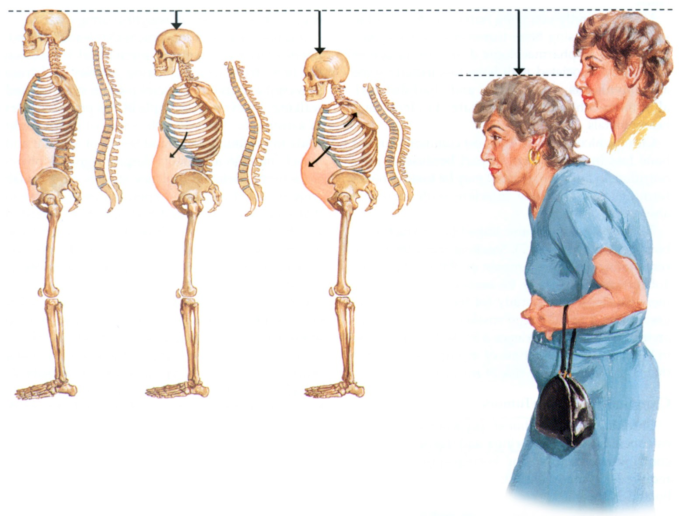
Does osteoporosis cause pain?
Osteoporosis itself does not usually hurt; pain comes from fractures. Diffuse aching bones with muscle weakness point instead to osteomalacia from vitamin D deficiency, which needs blood tests.
Video: preventing fractures after 50
When should a woman have a bone density test?
- Every woman aged 65 or older.
- Earlier after menopause with risk factors: low body weight, smoking, a parent with a hip fracture, menopause before 45, or steroid use.
- Any fracture after a minor fall after age 50.
- Conditions such as rheumatoid arthritis, hyperparathyroidism or malabsorption.
How to read the result is explained in the bone density (DEXA) test.
Warning signs that need prompt assessment
| Sign | What it may mean |
|---|---|
| Sudden severe back pain after bending or lifting | A vertebral compression fracture |
| Height loss over 3–4 cm or a stooped back | Multiple vertebral fractures |
| A wrist fracture after a minor fall | A common first sign of osteoporosis |
| Groin pain and inability to stand after a fall | A hip fracture — femoral neck fracture in older adults |
| Diffuse bone pain and muscle weakness | Possibly osteomalacia rather than osteoporosis |
Key numbers to know
- In the FREEDOM trial, Prolia cut new vertebral fractures by 68% (2.3% vs 7.2%) and hip fractures by 40% (Cummings et al., NEJM 2009).
- In the HORIZON trial, yearly zoledronic acid cut vertebral fractures by 70% and hip fractures by 41% over 3 years (Black et al., NEJM 2007).
- Calcium supplements lowered overall fracture risk by about 11% in randomised trials but did not reduce hip fractures (Bolland et al., BMJ 2015).
| Treatment | When we use it | Notes |
|---|---|---|
| Calcium, vitamin D, exercise and fall prevention | Everyone with or at risk of osteoporosis | The foundation, but not enough alone in established osteoporosis |
| Bisphosphonate tablets | Osteoporosis without multiple fractures | Taken correctly on an empty stomach |
| Zoledronic acid (yearly infusion) | People preferring a yearly dose with good kidney function | Cut vertebral fractures by 70% in HORIZON |
| Prolia injection every 6 months | High fracture risk or moderate kidney disease | Must not be stopped abruptly without a follow-on drug |
| Bone-building drugs (teriparatide or romosozumab) | Severe osteoporosis and multiple fractures | Followed by a maintenance drug after the course |
| Fracture surgery (fixation or replacement) | When a hip or other fracture occurs | Together with starting osteoporosis treatment to prevent the next fracture |
At Prof. Dr. Ibrahim Shaarawi’s clinics in Nasr City, Mohandeseen and New Cairo (5th Settlement) we review your vitamin D, calcium and bone density results and examine the cause of pain or fracture before deciding on the right dose or osteoporosis treatment.
Prevention and treatment
- Weight-bearing and resistance exercise.
- 1,200 mg calcium daily after 50, mainly from food, and 600–800 IU vitamin D (more if deficient).
- Medicines when indicated: bisphosphonates, the 6-monthly osteoporosis injection (Prolia), yearly zoledronic acid, or bone-building drugs for severe cases.
- Fall prevention at home — preventing falls and fractures in older adults.
Frequently asked questions about osteoporosis in women
What are the first signs of osteoporosis in women?
Often there are none; the first sign may be a wrist or spinal fracture after a minor fall, or height loss and a stooped back.
Does osteoporosis cause aches all over the body?
Usually not; osteoporosis hurts only when a bone breaks. Diffuse bone pain with muscle weakness may be osteomalacia from vitamin D deficiency.
At what age does osteoporosis start in women?
Bone loss begins around age 35 and accelerates in the first years after menopause, so risk rises after 50.
When should women have a bone density scan?
At 65 for all women, and earlier after menopause with risk factors or after a fracture from a minor fall.
Can osteoporosis in women be treated?
Yes. Bisphosphonates, Prolia and zoledronic acid clearly reduce fractures, together with vitamin D, calcium, exercise and fall prevention.
To have your bones assessed and your tests reviewed, book a consultation, call +20 155 240 4488 or message us on WhatsApp at +20 155 554 7181.
Medically reviewed by Prof. Dr. Ibrahim Shaarawi, Professor of Orthopaedic Surgery. This article is general medical education and does not replace an examination or the treatment plan your doctor sets for you. See our medical disclaimer.
Related vitamin D and bone health guides
Related guides in our osteoporosis series:
- Osteoporosis
- The 6-monthly osteoporosis injection (Prolia)
- The bone density (DEXA) test
- Vitamin D and fractures in older adults
- Preventing falls and fractures in older adults
- Femoral neck fracture in older adults
- Vitamin D deficiency
- Osteomalacia
References
- Kanis JA, et al. European guidance for the diagnosis and management of osteoporosis in postmenopausal women. Osteoporos Int. 2019;30(1):3-44.
- Camacho PM, et al. AACE/ACE Clinical Practice Guidelines for the Diagnosis and Treatment of Postmenopausal Osteoporosis — 2020 Update. Endocr Pract. 2020;26(Suppl 1):1-46.
- Gerges MES, et al. Vitamin D level in a sample of Egyptian females of childbearing age attending a family medicine center. Int J Clin Pract. 2021;75(4):e13738.
- Cummings SR, et al. Denosumab for prevention of fractures in postmenopausal women with osteoporosis. N Engl J Med. 2009;361(8):756-65.
- American Academy of Orthopaedic Surgeons (OrthoInfo). Osteoporosis.