
Quick summary: Hyaluronic acid knee injections are generally safe and aim to relieve osteoarthritis pain. Hyaluronic Acid Knee Injections Side Effects include temporary pain and swelling at the injection site and mild stiffness lasting a few days. In very rare cases (under 3%), an acute inflammatory flare or bacterial infection may occur, requiring urgent medical evaluation.
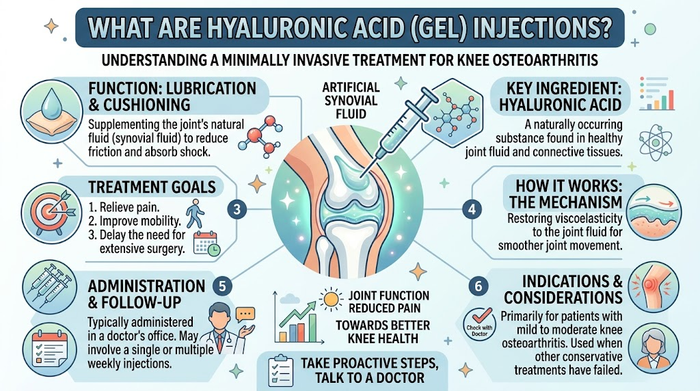
What Are Hyaluronic Acid (Gel) Injections?
Hyaluronic acid injections — known colloquially as “gel injections” or “oil injections” — are one of the most important conservative treatment options for patients with knee osteoarthritis. They work by replenishing the depleted synovial fluid within the knee joint. Dr. Ibrahim Shaarawi explains that the goal is not merely pain relief but rather reducing friction and mechanically facilitating movement.
The core concept: joint lubrication = cartilage protection + improved range of motion.
What Are the Side Effects of Hyaluronic Acid Knee Injections?
Like any interventional medical procedure, gel injections carry potential side effects, divided into common and temporary reactions versus rare and serious complications.
Common and Temporary Hyaluronic Acid Knee Injections Side Effects
Mild side effects occur as a natural bodily response to the needle and the introduction of new material into the joint. According to 2024 AAOS guidelines, approximately 11% to 15% of patients experience mild side effects that resolve within two to three days, including:
- Mild pain or a burning sensation at the needle insertion site.
- Slight swelling or temporary puffiness due to increased fluid volume in the knee.
- Mild joint stiffness and difficulty fully bending the knee in the first 48 hours.
Rare and Serious Complications
In exceptional cases, complications may develop that require medical intervention. According to a study published in the Journal of Bone and Joint Surgery (JBJS), an acute inflammatory reaction known as pseudosepsis occurs in fewer than 3% of cases (specifically with highly cross-linked formulations). These rare side effects include:
- Bacterial infection (septic arthritis): an extremely rare risk of less than 1 in 10,000 cases when proper sterile technique is followed.
- Hypersensitivity reactions: some gel injections are derived from rooster combs, which may cause allergic reactions in patients with poultry allergies (though biofermented alternatives are now available).
- Intra-articular bleeding: particularly in patients taking blood thinners without prior discontinuation.
How to Prevent Side Effects from Gel Knee Injections
Dr. Ibrahim Shaarawi emphasizes that proper technique is fundamental. To prevent these side effects:
- Apply ice packs for 15 minutes every few hours during the first two days post-injection.
- Avoid strenuous activities (running, heavy lifting, prolonged standing) for 48 hours.
- Use ultrasound-guided injection — statistics show that blind injections miss the joint space in approximately 20–30% of cases, increasing pain and reducing efficacy.
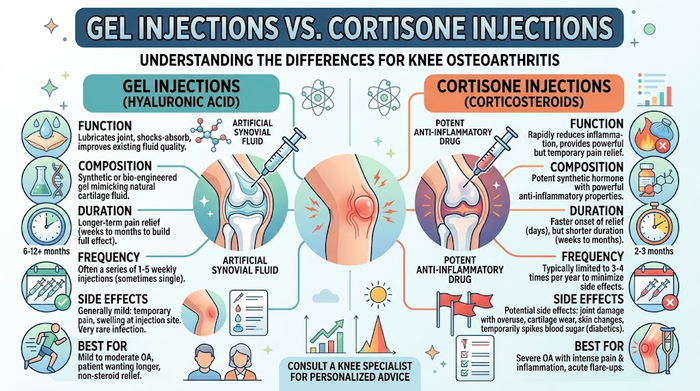
Gel Injections vs. Cortisone Injections
Gel injections (the biological option):
- Advantage: high safety profile for cartilage with long-lasting effect (6–12 months).
- Disadvantage: slow onset (takes weeks to feel improvement).
- Goal: lubrication and flexibility.
Cortisone injections (the powerful anti-inflammatory):
- Advantage: remarkably fast onset (days) with powerful pain relief.
- Disadvantage: short duration (weeks) and risk of cartilage damage with repeated use.
- Goal: stopping acute inflammation.
Expert verdict: gel injections are better for long-term treatment and joint protection, while cortisone is a solution for acute inflammatory crises.
Expected Timeline for Improvement
- Weeks 1–2: the patient may not feel immediate improvement; some local soreness is expected.
- Months 1–2: noticeable improvement begins; peak effect (full lubrication).
- After 6 months: re-evaluation. If no improvement has occurred, surgical intervention may be the solution.
Contraindications — When Should the Doctor Refuse to Inject?
- Active skin infection: wounds or skin inflammation near the knee prevent injection to avoid introducing infection into the joint.
- Active joint inflammation: severe swelling and redness must be treated first before injection.
- Poultry allergy: a history of hypersensitivity to poultry products or eggs (for certain injection brands).
- Advanced osteoarthritis (Grade 4): complete cartilage loss (bone-on-bone contact) — the benefit is virtually nil and joint replacement is the solution.
Dr. Ibrahim Shaarawi’s Safety Protocol
- Injection type selection: using high molecular weight injections for longer retention and reduced inflammation risk.
- Strict sterilization and guidance: full surgical-grade sterilization, with ultrasound guidance in applicable cases for precise needle placement.
- Post-procedure rest: complete rest for 24 hours and avoidance of strenuous activities to allow the material to settle within the synovial membrane.
Do Side Effects Vary by Injection Type?
Absolutely. Many people search for “knee injection side effects” in general, but the risks differ significantly between hyaluronic acid, cortisone, and platelet-rich plasma (PRP). Hyaluronic acid carries the mildest risk profile with temporary local reactions; cortisone risks include blood sugar spikes, localized cartilage damage with repeated use, and localized osteoporosis; while PRP causes moderate post-injection pain for several days due to the intentional therapeutic inflammatory response.
How Much Do Hyaluronic Acid Knee Injections Cost?
“How much do gel knee injections cost?” is one of the most frequently asked questions. There is no single fixed price, as costs vary considerably based on:
- Brand and country of origin: European and American injections (e.g., Synvisc, Hyalgan) cost more than local or Asian alternatives.
- Molecular weight: single high molecular weight injections given once yearly are more expensive than those requiring 3–5 injection courses.
- Physician fees and technology: ultrasound guidance adds to the procedure cost but ensures more accurate results and fewer complications.
Who Should Not Receive Gel Knee Injections?
To minimize risks, these injections are contraindicated in:
- Patients with active bacterial infection in the knee joint or surrounding skin.
- Those with severe poultry/egg allergy (if using avian-derived hyaluronic acid).
- Grade 4 osteoarthritis patients with complete cartilage loss — research indicates no meaningful benefit, and total knee replacement is the optimal solution.
When Should You Seek Urgent Medical Attention After Injection?
Contact the clinic or seek emergency care immediately if you experience:
- Severe, sudden pain that does not respond to standard painkillers and worsens after day 3.
- Significant redness and noticeable warmth in the knee (a strong sign of inflammation or infection).
- Fever or chills.
- Persistent numbness or sudden weakness in the leg.

Dr. Ibrahim Shaarawi
Consultant & Lecturer of Orthopedic Surgery — Ain Shams University
Professor of Orthopedic Surgery — Ohio University Hospitals
Frequently Asked Questions
Are hyaluronic acid knee injections generally considered safe?
Yes, intra-articular hyaluronic acid viscosupplementation demonstrates an excellent safety profile. Sodium hyaluronate is a natural polysaccharide naturally synthesized within synovial tissue, meaning systemic toxicity, organ damage, and immunogenic rejections are virtually non-existent. Most reported adverse effects are mild, transient local tissue responses that subside spontaneously within 24 to 48 hours.
What are the most common, mild side effects after a knee injection?
The majority of patients experience mild, self-limiting local symptoms around the treated knee:
- Injection-Site Discomfort: Localized dull ache or soreness caused by the needle passing through the skin and capsule.
- Mild Joint Effusion: Slight swelling or a sensation of fullness resulting from the sudden addition of 2 to 6 mL of viscous hydrogel into the joint.
- Transient Stiffness: A temporary feeling of mechanical tightness during bending and ambulation.
- Minor Redness & Warmth: Slight surface erythema, manageable with cold compresses.
What is a post-injection flare reaction, and how is it managed?
A post-injection flare is an acute local inflammatory reaction occurring in 1% to 5% of patients:
- Presentation: Usually manifests between 24 and 72 hours post-procedure with noticeable joint swelling, increased local temperature, and a transient spike in pain intensity.
- Mechanism: Driven by temporary synoviocyte reactivity and transient pressure changes inside the joint capsule.
- Clinical Management: Joint rest, avoiding weight-bearing activities, applying cold packs wrapped in a towel for 15 minutes 3 times daily, and short courses of oral acetaminophen or nonsteroidal anti-inflammatory drugs (NSAIDs) resolve the flare within 2 to 4 days.
What is pseudoseptic arthritis (severe acute inflammatory reaction)?
Pseudoseptic arthritis (also termed severe acute inflammatory reaction) is an uncommon, sterile immunologic reaction observed in approximately 1% to 3% of patients:
- Clinical Characteristics: Rapid onset (24 to 72 hours post-injection) of marked joint effusion, severe throbbing pain, localized warmth, and near-complete loss of weight-bearing ability.
- Etiology: Linked more frequently to ultra-high-molecular-weight, chemically cross-linked gels or repeated injections in sensitized individuals.
- Key Difference: Synovial fluid aspiration reveals elevated leukocyte counts but zero bacteria, negative Gram stains, and sterile bacterial cultures. It resolves rapidly after therapeutic arthrocentesis and targeted anti-inflammatory therapy without long-term cartilage sequelae.
How do doctors distinguish between pseudoseptic arthritis and true septic arthritis?
Accurate differentiation between sterile pseudosepsis and bacterial septic arthritis is critical:
- Time to Symptom Onset: Pseudosepsis develops hyperacutely within 24 to 72 hours post-injection. True bacterial sepsis typically takes longer to establish, commonly manifesting between 4 and 10 days post-procedure.
- Systemic Markers & Fever: Patients with pseudosepsis rarely develop systemic high fevers or rigors. Septic arthritis is classically accompanied by systemic fever, chills, malaise, and marked elevations in blood C-reactive protein (CRP) and ESR.
- Synovial Fluid Culture: Diagnostic aspiration (arthrocentesis) followed by microscopy and microbial culture provides the definitive verdict: pseudoseptic fluid yields negative Gram stains and no bacterial colonies.
Can patients with poultry or egg allergies experience reactions to knee injections?
Yes, formulation origin plays a significant role in allergic reactivity:
- Avian-Derived Formulations: Extracted from avian tissues (such as rooster combs). While purified, they can retain trace avian cellular proteins capable of triggering localized or systemic IgE-mediated allergic reactions in patients allergic to feathers, eggs, or poultry.
- Bacterial Biofermentation Formulations: Synthesized via laboratory biofermentation using non-pathogenic bacterial strains (e.g., Streptococcus equi). These products are free from animal proteins and are the clinically preferred choice for patients with known avian or egg allergies.
What complications occur if the injection is accidentally placed outside the joint?
Inadvertent extra-articular injection occurs in up to 15% to 20% of palpation-guided (blind) procedures:
- Soft-Tissue Irritation: Depositing thick viscoelastic gel into the infrapatellar fat pad (Hoffa’s fat pad), subcutaneous tissue, or periarticular ligaments triggers intense localized burning, focal swelling, and extended soreness.
- Loss of Therapeutic Benefit: Because the hyaluronic acid is trapped outside the synovial lining, it cannot coat the damaged hyaline cartilage, resulting in treatment failure.
- Prevention: Performing knee injections under dynamic musculoskeletal ultrasound guidance ensures verified real-time needle placement directly into the suprapatellar pouch or patellofemoral articulation.
Can hyaluronic acid injections cause long-term cartilage or bone damage?
No. Hyaluronic acid does not accelerate cartilage breakdown or induce bone loss:
Unlike high-frequency intra-articular corticosteroid injections—which have been linked in clinical literature to potential cartilage volume loss, subchondral bone thinning, and systemic endocrine suppression when used excessively—hyaluronic acid provides protective, non-cytotoxic physical cushioning. It supports chondrocyte viability, reduces friction forces between degenerating surfaces, and promotes endogenous synovial fluid health without tissue catabolism.
What red-flag symptoms require immediate emergency orthopedic evaluation?
While serious complications are exceedingly rare, patients should contact their physician or emergency services immediately if they experience:
- Spiking systemic fever (> 38.3°C / 101°F) accompanied by chills, shivering, or persistent nausea.
- Rapidly spreading cutaneous redness or red streaks radiating away from the knee.
- Continuous drainage, purulent fluid, or cloudy discharge oozing from the needle entry puncture.
- Severe, intractable pain that escalates rather than improves 48 hours after treatment.
- Complete inability to support any weight on the leg or joint locking several days post-procedure.
What precautions should be followed after a knee injection to minimize side effects?
Following post-procedural aftercare guidelines reduces the incidence and severity of adverse reactions:
- 48-Hour Relative Rest: Refrain from running, jogging, high-impact gym workouts, heavy weightlifting, and extended standing during the initial 48 hours.
- Cold Therapy: Apply an ice pack wrapped in a dry cloth for 15 minutes 2 to 3 times on the first day to minimize capillary dilation and local edema.
- Maintain Puncture Hygiene: Keep the injection bandage clean and dry for 24 hours, avoiding hot baths, swimming pools, or saunas to prevent bacterial contamination.
- Ultrasound Guidance: Request that intra-articular administration be guided by musculoskeletal ultrasound to ensure exact needle positioning and minimize soft-tissue trauma.
References
AAOS OrthoInfo — Viscosupplementation Treatment for Knee Arthritis (2024)
https://orthoinfo.aaos.org/en/treatment/viscosupplementation-treatment-for-knee-arthritis/- Cleveland Clinic — Knee Gel Injections (Viscosupplementation): Uses & Side Effects (2024)
https://my.clevelandclinic.org/health/procedures/knee-gel-injections-viscosupplementation - Mayo Clinic — Hyaluronic Acid (Injection Route) (2024)
https://www.mayoclinic.org/drugs-supplements/hyaluronic-acid-injection-route/description/drg-20074557 - HSS — What to Know About Knee Gel Injections (Viscosupplementation) (2024)
https://www.hss.edu/health-library/conditions-and-treatments/knee-gel-injections-viscosupplementation - Charalambous CP, et al. — Differential characteristics and management of pseudoseptic arthritis following hyaluronic acid injection: a systematic review. Journal of Clinical Orthopaedics and Trauma (2021)
https://www.sciencedirect.com/science/article/pii/S2059775421000419 - Defined Health / Arthroscopy, Sports Medicine, and Rehabilitation — Ultrasound-Guided Knee Injections Are More Accurate Than Blind Injections: A Systematic Review of Randomized Controlled Trials (2021)
https://pubmed.ncbi.nlm.nih.gov/34430899/ - Ferreira RM, et al. — Severe acute localized reactions after intra-articular hyaluronic acid injections: a narrative review and physician’s guide. Journal of Cartilage & Joint Preservation (2024)
https://www.sciencedirect.com/science/article/pii/S2667254524000234 - AAOS — Management of Osteoarthritis of the Knee (Non-Arthroplasty) Clinical Practice Guideline, 3rd Ed. (2024)
https://www.aaos.org/globalassets/quality-and-practice-resources/osteoarthritis-of-the-knee/oak3cpg.pdf