
Internal fixation of fractures using plates and screws is one of the most common and successful procedures in orthopedic surgery. Nevertheless, many patients hesitate due to concerns about the potential long-term Complications of Plates and Screws in Orthopedic Surgery.
In this comprehensive medical guide, we discuss everything about internal fixation hardware — from shapes and types, to pain associated with cold weather, to the optimal timing for removal.
What Are the Potential Complications of Plates and Screws?
Before diving into details, it is important to clarify that the term “side effects” may sound alarming, but medically we refer to “complications” — and these are rare.
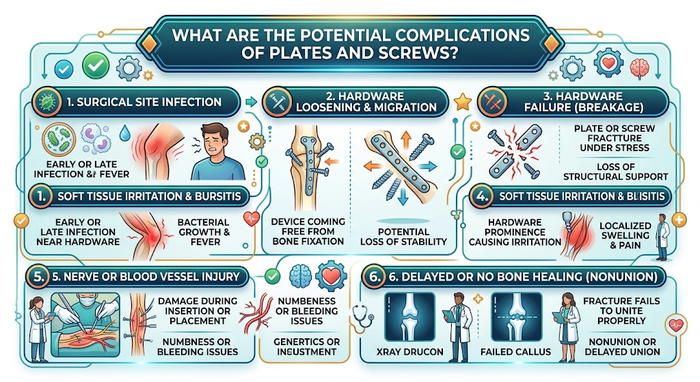
The most notable complications include infection around the plate, screw loosening (migration from position), or the patient feeling a foreign body under the skin — especially in thin individuals.
In very rare cases, an allergic reaction to the metal may occur, which requires medical intervention. Understanding these points helps you manage the post-operative period correctly.
1. When Is the Right Time to Remove Plates and Screws?
“When can I have my plate removed?” is the most frequently asked question in orthopedic clinics. The answer depends entirely on the fracture status and the patient’s age.
In general, surgeons prefer to leave plates and screws in place as long as they do not cause pain or discomfort. Modern metals are inert and do not react with the body.
However, when removal is decided, the appropriate timing is usually between one and two years after surgery. Complete fracture healing must be confirmed on X-ray before considering removal.
In children, plates and screws are typically removed sooner to ensure they do not interfere with bone growth. In elderly patients, we usually prefer to leave them in place to avoid subjecting the patient to another surgery, unless there is a compelling medical reason.
2. Types of Plates and Screws
Medical technology has advanced enormously, leading to a wide variety of materials and designs used for fracture fixation.
The main types by material are:
1. Stainless Steel: The traditional, strong option — widely used for its durability and reasonable cost. However, it may interfere with the clarity of future MRI scans in the same area.
2. Titanium: The more modern and lighter option. It is more biocompatible and reduces the rates of allergy-related complications. It is also completely safe inside MRI machines.
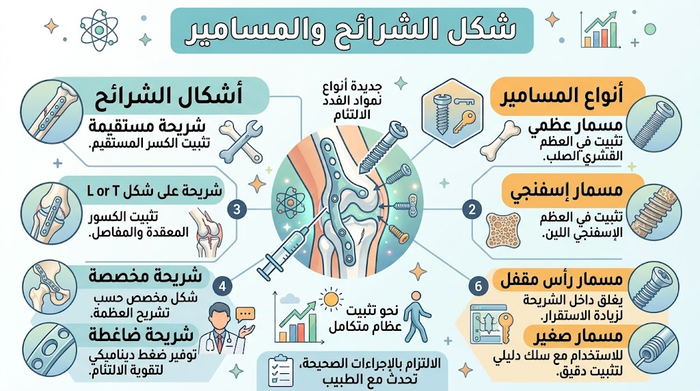
By function, there are “compression plates” that help bring the fracture ends together, and “locking plates” that provide very strong angular stability and are used in cases of osteoporosis.
3. Shape and Design of Plates and Screws
Some may imagine plates and screws as random pieces of metal, but in reality they represent precision medical engineering.
Plates are designed to mimic the anatomical contours of human bones (anatomical plates). Each bone in the body has a plate specifically designed for it — a femoral plate differs entirely in shape and thickness from a forearm or clavicle plate.
The plate is typically a thin metal sheet containing holes through which screws pass to fix the bone. Screw heads are designed to sit flush within the plate so they do not protrude and injure surrounding tissues, reducing post-operative pain and friction.
4. Pain After Plates and Screws
Post-operative pain is normal and expected, and differs from permanent side effects of the hardware.
In the first weeks, pain results from the surgical wound and the fracture itself — not from the plate.
However, pain may persist longer in some cases. The cause is usually friction of tendons or muscles against the screw head or the edge of the plate. This mechanical pain typically appears when moving the joint near the fracture or with direct pressure on the plate location.
If pain persists and is accompanied by swelling or redness, the patient should see the doctor immediately to rule out a minor bacterial infection — treatable but requiring prompt intervention.
5. Plate and Screw Pain in Winter
Many patients report increased pain in cold weather — known as winter hardware pain.
The scientific reality is not that the metal “freezes” inside the body, as some believe — the body’s internal temperature keeps the plate warm.
The real cause is changes in barometric pressure that accompany winter and dropping temperatures. This pressure change causes very slight expansion in the tissues and fluids surrounding the joint and old fracture site.
With internal scar tissue or a rigid foreign body (the plate) that does not expand at the same rate as surrounding tissues, internal pressure builds up, which the brain interprets as pain or “twinges.”
This pain can be managed by keeping the affected area warm, using warm compresses, and maintaining movement to promote blood circulation.
6. Success Rate of Plate and Screw Surgery
Internal fixation surgery is one of the most successful operations in modern medicine.
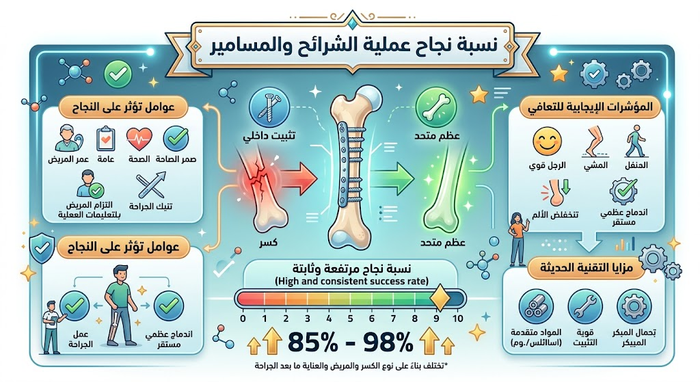
The success rate exceeds 90% to 95% in most cases, with the hardware performing excellently in restoring bone alignment and function.
Success depends on several factors, the most important being the surgeon’s skill in choosing the appropriate plate type and placing it accurately. The patient’s bone quality also plays an important role — patients with osteoporosis may require longer healing times.
Patient compliance with post-operative instructions — especially regarding physiotherapy and gradual weight-bearing — is the decisive factor in achieving complete recovery and avoiding any hardware complications.
Failure of bone healing (nonunion) or plate breakage are very rare complications, usually resulting from excessive early loading on the affected limb before fracture healing.
Should You Be Worried?
In conclusion, having plates and screws in your body is a temporary or permanent therapeutic solution for a fracture, and the benefits you gain from restoring your mobility far outweigh any concerns.
Most patients live their lives completely normally with these implants — and many forget they are even there.
If you experience any unusual pain or have questions about plate removal, do not hesitate to consult your specialist surgeon.
Last updated: May 2026 — Medically reviewed by Prof. Ibrahim Shaarawi, Lecturer of Orthopedic Surgery, Faculty of Medicine, Ain Shams University.
Frequently Asked Questions
Are plates and screws generally safe to remain in the body permanently?
Yes, modern internal fixation devices exhibit exceptional biological inertness:
- Contemporary implants are forged from medical-grade commercially pure titanium, titanium alloys (Ti-6Al-4V), or vacuum-melted surgical stainless steel (316L).
- These metals establish a stable, spontaneous surface passivation layer (titanium dioxide or chromium oxide) that prevents corrosion, chemical leaching, and systemic toxicity.
- In the vast majority of clinical cases, retained hardware remains physiologically silent and functional for the patient’s entire lifespan without requiring secondary intervention.
What are the most frequent complications associated with plates and screws?
When complications do arise after open reduction and internal fixation (ORIF), they typically fall into distinct categories:
- Symptomatic Hardware Prominence: Local pain and mechanical discomfort caused by thin soft-tissue envelopes overlying superficial bones (e.g., clavicle, lateral malleolus, proximal ulna, distal radius).
- Soft-Tissue & Tendon Impingement: Screw tips extending through the far cortex or prominent plate margins irritating or abrading adjacent gliding tendons (such as the extensor pollicis longus or Achilles tendon).
- Joint Stiffness: Periarticular scarring and adhesive arthrofibrosis restricting joint range of motion.
- Bacterial Colonization: Biofilm formation on the implant surface resulting in persistent surgical site infection.
What is the phenomenon of stress shielding caused by rigid metal plates?
Stress shielding is a biomechanical alteration of normal bone remodeling:
- Elastic Modulus Discrepancy: Cortical bone has an elastic modulus of 10–20 GPa, whereas stainless steel (approx. 200 GPa) and titanium (approx. 110 GPa) are substantially stiffer.
- Wolff’s Law Violation: Because the plate carries the dominant share of axial loads, the underlying cortex is deprived of the dynamic strain cycles necessary to trigger bone accretion.
- Localized Cortical Osteopenia: Over months, the bone underneath a rigid non-locked or locked plate experiences progressive bone resorption, which can transiently increase fragility if the plate is removed abruptly.
Why do patients frequently feel aching or throbbing around implants in cold weather?
Physical and physiological factors explain cold-weather implant sensitivity:
- Thermal Conductivity Disparity: Metals conduct and lose heat much faster than biological soft tissues and bone; implants drop in temperature more rapidly when exposed to environmental cold.
- Microscopic Thermal Contraction: Variations in temperature and barometric atmospheric pressure induce microscopic dimensional shifts between the metallic surface and surrounding tissues.
- Periosteal Nociceptive Activation: The periosteum is densely innervated with sensitive unmyelinated C-fibers. Temperature drops and pressure differentials stimulate these mechanoreceptors, manifesting as a deep, aching, or dull throbbing sensation.
What are the clinical warning signs of an orthopedic implant infection?
Implant-related infections can manifest early (acute post-surgical) or months later (delayed hematogenous spread):
- Cardinal Signs: Progressive spreading erythema around the scar, noticeable localized hyperthermia, indurated swelling, and continuous drainage of serosanguinous or purulent fluid.
- Systemic Manifestations: Unexplained spikes in body temperature, chills, and elevated inflammatory markers (C-reactive protein and ESR).
- Biofilm Barrier: Microorganisms (particularly Staphylococcus aureus and Staphylococcus epidermidis) construct an extracellular polymeric slime (biofilm) over the implant, protecting bacteria from systemic antibiotics and frequently mandating surgical hardware removal to achieve complete cure.
Can individuals develop an allergic reaction or metal hypersensitivity to plates and screws?
Yes, although uncommon, delayed-type (Type IV) metal hypersensitivity can develop:
- Precipitating Antigens: Trace amounts of nickel, chromium, and cobalt present in surgical stainless steel alloys are the primary culprits in sensitized individuals with known jewelry or contact metal allergies.
- Clinical Presentation: Recurrent localized or generalized eczematous skin eruptions, chronic joint effusion, persistent unexplained pain, or delayed soft-tissue healing with sterile cultures.
- Clinical Prevention: Patients with documented severe nickel or cobalt allergies are managed primarily with titanium or ceramic-coated implants, which possess near-zero immunogenic reactivity.
Why do orthopedic plates snap or screws loosen inside the bone?
Implants are internal splints designed for temporary load-sharing, not permanent load-bearing:
- The Race Against Time: The primary biological objective is for the bone to achieve clinical union before the metal reaches its mechanical fatigue threshold.
- Mechanisms of Failure: If healing is delayed (nonunion) due to smoking, poor vascularity, or premature aggressive weight-bearing, repeated cyclic loading induces metal fatigue.
- Catastrophic Breakage: Over thousands of walking strides, micro-cracks propagate through the plate across screw holes (stress concentration points), culminating in sudden implant breakage, screw stripping, or loss of fracture reduction.
Should orthopedic plates and screws always be removed after a fracture heals?
Current evidence-based orthopedic guidelines advise against routine hardware removal:
Asymptomatic hardware should remain undisturbed to avoid the inherent risks of anesthesia, surgical exposure, and structural bone disruption. Extraction is justified only under specific clinical indications:
- Intolerable pain and mechanical irritation caused by prominent hardware beneath the skin.
- Active, deep-seated bacterial implant infection.
- Mechanical interference with joint mobility or progressive tendon abrasion.
- Pediatric patients, to prevent bone overgrowth over implants or tethering of active physis (growth plates).
What are the surgical risks of hardware removal surgery?
Removing well-healed internal fixation is a technically demanding procedure associated with documented risks:
- Iatrogenic Nerve Damage: Dissecting through dense postoperative fibrous scar tissue increases the hazard of stretching or severing adjacent peripheral sensory or motor nerves.
- Stripped or Incarcerated Screws: Extensive bony remodeling and bone ingrowth can lock screws tightly into plate holes (cold welding), causing screw heads to strip or shear off during extraction attempts.
- Risk of Refracture: Extracting screws leaves open cortical drill holes that act as stress risers. Torsional bone strength is reduced by 30% to 40% immediately post-op; patients must protect the limb from high-impact activities for 6 to 12 weeks until new bone fills the defects.
Do plates and screws interfere with MRI scans or trigger airport metal detectors?
Modern orthopedic hardware rarely impedes diagnostic imaging or daily travel:
- Magnetic Resonance Imaging (MRI): Modern titanium and surgical steel hardware are non-ferromagnetic or weakly paramagnetic. They are categorized as MRI-conditional and completely safe in standard 1.5-Tesla and 3.0-Tesla scanners without risk of movement or hazardous thermal heating. They produce only localized image distortion (susceptibility artifacts) directly adjacent to the metal.
- Airport Security: Most modern walk-through metal detectors and millimeter-wave body scanners are calibrated to detect large masses of high-iron ferromagnetic material; individual plates and screws rarely activate alarms.
References
AAOS OrthoInfo — Internal Fixation for Fractures (2024)
https://orthoinfo.aaos.org/en/treatment/internal-fixation-for-fractures/- AAOS OrthoInfo — Fractures (Broken Bones) (2024)
https://orthoinfo.aaos.org/en/diseases–conditions/fractures-broken-bones/ - Cleveland Clinic — Open Reduction & Internal Fixation (ORIF) (2024)
https://my.clevelandclinic.org/health/procedures/open-reduction-and-internal-fixation-orif - Cleveland Clinic — Bone Fractures: Types, Symptoms & Treatment (2024)
https://my.clevelandclinic.org/health/diseases/15241-bone-fractures - PubMed — A Systematic Review of Titanium versus Stainless Steel Implants (2021)
https://pubmed.ncbi.nlm.nih.gov/34746670/ - ScienceDirect — Benefits of Hardware Removal After Plating (2018)
https://www.sciencedirect.com/science/article/abs/pii/S0020138318303115 - PubMed — Changes in Barometric Pressure and Ambient Temperature Influence Osteoarthritis Pain (2007)
https://pubmed.ncbi.nlm.nih.gov/17466654/ - PubMed — Locking Plate Technology: Current Concepts (2007)
https://pubmed.ncbi.nlm.nih.gov/17288090/