
Quick answer
Both techniques achieve the same end result: dividing the ligament that compresses the median nerve. Endoscopic release, through a smaller wrist incision, may give less wound pain and a slightly faster early return, while mini-open release (2–3 cm) gives a full direct view of the nerve and suits most cases, including complex ones. Long-term results are similar. We offer both; mini-open is our usual choice and endoscopic release is reserved for selected cases.
✅ Last medically reviewed by Prof. Dr. Ibrahim Shaarawi, Professor of Orthopaedic Surgery, on 5 October 2026
“Can the nerve be released by keyhole without a cut?” is a common question. In reality the endoscope also needs a small incision, and what matters most is an accurate diagnosis and precise surgery. Here is an honest comparison, as part of our guide to carpal tunnel release and hand nerve surgery.
What happens in carpal tunnel release?
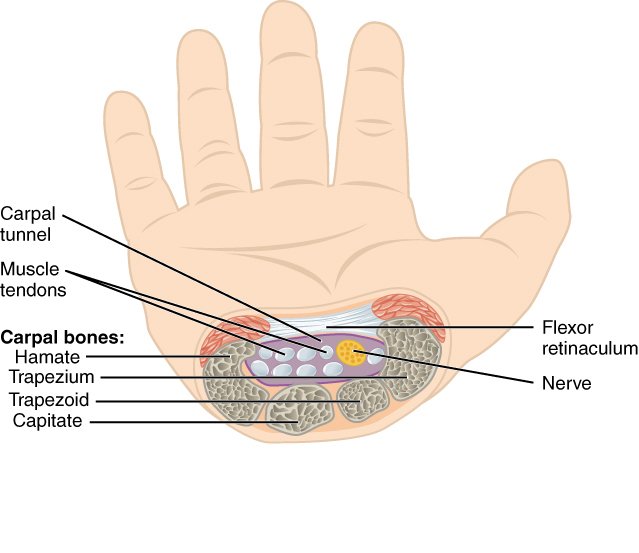
The median nerve runs with the flexor tendons through a tunnel at the wrist roofed by a strong ligament (the transverse carpal ligament). Surgery divides this ligament, enlarging the tunnel and relieving pressure on the nerve, without touching the nerve itself. It is usually a day case under local anaesthesia.
Mini-open release
- A 2–3 cm incision in the palm.
- Full direct view of the ligament, nerve and any additional cause of compression (cyst, tenosynovitis, anatomical variant).
- Suits almost all cases, especially severe and recurrent ones.
- Pillar pain may last several weeks.
Endoscopic release
- One or two small incisions at the wrist crease; the ligament is divided from inside using a camera.
- May reduce wound pain and scar tenderness in the first weeks.
- Needs specific training and equipment and does not suit every case.
- A slightly higher rate of temporary nerve irritation in some studies.
Video: median nerve release surgery
Head-to-head comparison
| Mini-open | Endoscopic | |
|---|---|---|
| Incision | 2–3 cm in the palm | 1–2 cm at the wrist |
| Anaesthesia | Usually local | Local or as appropriate |
| Early wound pain | Slightly more | Slightly less |
| Return to work | Within weeks | Slightly faster in some studies |
| Long-term result | Excellent | Similar |
| Risks | Scar tenderness, pillar pain | Slightly more transient nerve irritation |
| Usually suits | Most cases, complex and recurrent cases | Selected cases without additional causes |
A Cochrane review found that endoscopic release gives similar symptom relief with a slightly faster return to activities, and long-term follow-up of a Swedish randomised trial showed similar results between the techniques after more than ten years.
Key numbers to know
- Carpal tunnel syndrome is the most common peripheral nerve entrapment worldwide (Padua et al., Lancet Neurology 2016).
- In a Cochrane review of 14 randomised trials (1,231 patients, 84% women), surgery roughly doubled the chance of long-term improvement compared with splinting, and 44% of the splint group were later referred for surgery (Lusa et al., Cochrane 2024).
- A steroid injection clearly improved symptoms at 10 weeks, but 73% of patients given the higher dose still had surgery within a year, versus 92% after placebo (Atroshi et al., Annals of Internal Medicine 2013).
- Across 28 studies (2,586 hands), endoscopic and open release had the same long-term results; endoscopic patients returned to work about 8 days sooner, with 45% fewer minor complications (Vasiliadis et al., Cochrane 2014).
At Prof. Dr. Ibrahim Shaarawi’s clinics in Nasr City, Mohandeseen and New Cairo (5th Settlement) we examine the hand and review your nerve study at the same visit, confirming where and how badly the nerve is trapped before choosing a splint, injection or release.
When we prefer mini-open release
- Severe cases with muscle wasting.
- Recurrent symptoms after previous surgery.
- Suspected cyst, tumour or tenosynovitis.
- Anatomical variants or old wrist fractures.
When endoscopic release may suit you
- A typical case without additional causes of compression.
- A patient who needs an early return to palm-loading work.
- After discussing benefits and risks with your surgeon.
Cost
Nerve release surgery costs 35,000–50,000 EGP depending on the hospital, anaesthesia and technique — see carpal tunnel release cost in Egypt, and for recovery recovery after carpal tunnel release.
Frequently asked questions about endoscopic carpal tunnel release
Is endoscopic carpal tunnel release better?
Not in the final result; it may give less pain and a slightly faster return in the first weeks, but long-term results are similar, and mini-open release suits more cases.
Can carpal tunnel surgery be done without an incision?
No — even endoscopic release needs a small incision at the wrist. The difference is the size and position of the incision.
What are the risks of endoscopic release?
Mainly temporary nerve irritation, slightly more often than with open release, and rarely nerve injury or incomplete ligament release.
How long is recovery after endoscopic release?
Most patients resume light tasks within days and desk work within one to two weeks, possibly slightly faster than open release.
Which technique does Prof. Dr. Ibrahim Shaarawi use?
We perform both; mini-open release is our usual choice because it gives a full view of the nerve, and endoscopic release is used in selected cases after assessment.
To have your hand assessed and your nerve tests reviewed, book a consultation, call +20 155 240 4488 or message us on WhatsApp at +20 155 554 7181.
Medically reviewed by Prof. Dr. Ibrahim Shaarawi, Professor of Orthopaedic Surgery. This article is general medical education and does not replace an examination or the treatment plan your surgeon sets for you. See our medical disclaimer.
Related hand nerve and tendon guides
Related guides on carpal tunnel surgery:
- Carpal tunnel release and hand nerve surgery
- Recovery after carpal tunnel release
- Carpal tunnel release success rate
- Carpal tunnel release cost in Egypt
- Carpal tunnel syndrome
References
- Vasiliadis HS, et al. Endoscopic release for carpal tunnel syndrome. Cochrane Database Syst Rev. 2014;(1):CD008265.
- Zuo D, et al. Endoscopic versus open carpal tunnel release for idiopathic carpal tunnel syndrome: a meta-analysis of randomized controlled trials. J Orthop Surg Res. 2015;10:12.
- Atroshi I, et al. Extended Follow-up of a Randomized Clinical Trial of Open vs Endoscopic Release Surgery for Carpal Tunnel Syndrome. JAMA. 2015;314(13):1399-1401.
- Graham B, et al. The American Academy of Orthopaedic Surgeons Evidence-Based Clinical Practice Guideline on: Management of Carpal Tunnel Syndrome. J Bone Joint Surg Am. 2016;98(20):1750-1754.
- Louie D, et al. Long-term outcomes of carpal tunnel release: a critical review of the literature. Hand (N Y). 2012;7(3):242-6.