
There is no single “best hip replacement” for everyone — the best implant is the one that suits your age, activity, bone quality and the reason for surgery. Hip implants differ in four ways: what is replaced (the whole joint or only the femoral head), cup design (standard or dual mobility), bearing surfaces (metal or ceramic), and fixation and stem length. This guide explains each type, who it suits and its cost, with a detailed page for each as part of our guide to hip replacement surgery.
What an artificial hip looks like
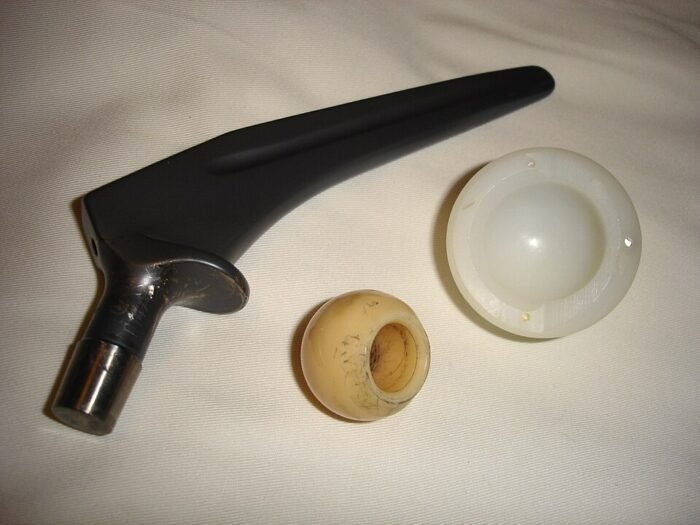
The natural hip is a ball (the femoral head) moving inside a socket (the acetabulum) in the pelvis. An artificial hip copies this design with four main parts:
- Stem: a metal shaft fixed inside the thigh bone.
- Head: a metal or ceramic ball fitted on top of the stem.
- Cup: a metal hemisphere fixed in the pelvic socket.
- Liner: a polyethylene or ceramic layer inside the cup on which the head moves.
1. By what is replaced: total hip vs hemiarthroplasty
Total hip replacement
Both the femoral head and the socket are replaced. It is the standard treatment for hip arthritis, avascular necrosis and rheumatoid arthritis, and for femoral neck fractures in active, independent patients. It is one of the most successful operations in modern medicine for relieving pain and restoring movement. It costs 100,000–120,000 EGP.
Hemiarthroplasty (half hip replacement)
Only the femoral head and neck are replaced; the natural socket stays. It is used mainly for femoral neck fractures in older, less active patients. There are two kinds: unipolar (one head) and bipolar (a small head inside a large one). Details in bipolar hip hemiarthroplasty; it costs 80,000–90,000 EGP.
2. By cup design: standard vs dual mobility
In a dual mobility (tripolar) hip a large liner moves inside the metal cup and the small head moves inside the liner, so the effective diameter is large and dislocation is much less likely. It is chosen for patients at higher risk of dislocation: older adults after fractures, neurological disease and revision surgery. Details in dual mobility (tripolar) hip replacement; it costs 150,000–180,000 EGP.
Video: what an artificial hip joint looks like
3. By bearing surface: when is ceramic used?
| Bearing | Advantages | Usually suits |
|---|---|---|
| Metal on polyethylene | Longest track record, lowest cost | Older and moderately active patients |
| Ceramic on polyethylene | Less wear than metal | Younger, more active patients |
| Ceramic on ceramic | Lowest wear | Young active patients |
Ceramic’s real value is for patients who will live with their hip for decades. Details and cost in ceramic hip replacement.
4. By fixation: cemented or cementless
| Cemented | Cementless | Hybrid | |
|---|---|---|---|
| How it fixes | Immediately with bone cement | Bone grows onto the implant | Cemented stem, cementless cup |
| Usually suits | Older adults and osteoporosis | Younger people with good bone | Many older adults |
Reviews show no major overall difference between the methods; fixation is chosen by age and bone quality. Read cemented hip replacement and cementless hip replacement.
5. By stem length
A standard stem is used in most first-time operations, a short stem may be used in young people to preserve bone, and a long stem is used in revision surgery, fractures around a previous implant and major bone loss, bypassing weak bone to fix in healthy bone. Details in long-stem hip replacement.
Comparison table: which type suits your case?
| Situation | Implant usually favoured |
|---|---|
| Hip arthritis in an active patient | Total hip (ceramic may suit younger patients) |
| Femoral neck fracture, older and less active | Cemented bipolar hemiarthroplasty |
| Femoral neck fracture, active and independent | Total hip, possibly dual mobility |
| Neurological disease, weak muscles, high dislocation risk | Dual mobility hip |
| Young adult with avascular necrosis | Cementless total hip, often with ceramic |
| Loose previous implant or fracture around it | Revision with a long stem |
For displaced femoral neck fractures in older adults, the international HEALTH trial found only a small difference between total hip and hemiarthroplasty in the need for further surgery at two years, so the choice depends on how active the patient was before the fracture. See femoral neck fracture in older adults.
Hip replacement prices in Egypt by type
| Implant | Approximate price |
|---|---|
| Total hip (conventional) | 100,000–120,000 EGP |
| Bipolar hemiarthroplasty | 80,000–90,000 EGP |
| Dual mobility (tripolar) hip | 150,000–180,000 EGP |
| Ceramic hip | 195,000–240,000 EGP |
| Revision surgery / long stem | Confirmed after assessment |
The price usually covers the implant, the operation and a short hospital stay, and varies with the implant, the hospital and your general health; the final price is confirmed after examination and X-rays. An implant should not be chosen on price alone — the right one is what suits your age, activity and bone quality. More on cost in hip replacement cost in Egypt.
How long does the implant last?
A large Lancet analysis of worldwide joint registries found that about three quarters of hip replacements are still working after 15–20 years and about 58% after 25 years. Implant survival depends on the patient’s age, activity and weight, the bearing surfaces and fixation, and the precision of component positioning. Keeping a healthy weight, avoiding high-impact sport, treating any infection in the body promptly and attending regular X-ray follow-up all help the implant last as long as possible, and pick up loosening early, before it causes bone loss.
Frequently asked questions about types of hip replacement
What is the best type of hip replacement?
There is no best type for everyone; the best is the one that suits your age, activity, bone quality and reason for surgery, chosen by your surgeon after examination and X-rays.
What is the difference between a total hip and a hemiarthroplasty?
A total hip replaces the femoral head and the socket; a hemiarthroplasty replaces only the head and is mostly used for femoral neck fractures in older adults.
What is a tripolar hip replacement?
A total hip with a dual mobility cup that lowers dislocation risk, for patients at higher risk of dislocation.
Is a ceramic hip better?
Ceramic wears less and suits younger, active patients; for older, less active patients a conventional hip is usually enough at lower cost.
How much do the different hip implants cost?
Total hip 100,000–120,000 EGP, bipolar hemiarthroplasty 80,000–90,000 EGP, dual mobility 150,000–180,000 EGP and ceramic 195,000–240,000 EGP.
To have your hip assessed, book a consultation, call +20 155 240 4488 or message us on WhatsApp at +20 155 554 7181.
Medically reviewed by Prof. Dr. Ibrahim Shaarawi, Professor of Orthopaedic Surgery. This article is general medical education and does not replace an examination or the plan your surgeon sets for you. See our medical disclaimer.
Related hip replacement guides
Each type has its own detailed page in our guide to hip replacement surgery:
- Hip replacement surgery
- Bipolar hip hemiarthroplasty
- Dual mobility (tripolar) hip replacement
- Ceramic hip replacement
- Long-stem hip replacement
- Cemented hip replacement
- Cementless hip replacement
References
- López-López JA, et al. Choice of implant combinations in total hip replacement: systematic review and network meta-analysis. BMJ. 2017;359:j4651.
- HEALTH Investigators. Total hip arthroplasty or hemiarthroplasty for hip fracture. N Engl J Med. 2019;381(23):2199-208.
- Darrith B, et al. Outcomes of dual mobility components in total hip arthroplasty: a systematic review of the literature. Bone Joint J. 2018;100-B(1):11-9.
- Hu D, et al. Ceramic-on-ceramic versus ceramic-on-polyethylene bearing surfaces in total hip arthroplasty. Orthopedics. 2015;38(4).
- Abdulkarim A, et al. Cemented versus uncemented fixation in total hip replacement: a systematic review and meta-analysis of randomized controlled trials. Orthop Rev (Pavia). 2013;5(1):e8.
- Evans JT, et al. How long does a hip replacement last? A systematic review and meta-analysis of case series and national registry reports with more than 15 years of follow-up. Lancet. 2019;393(10172):647-54.