
Hip arthritis (hip osteoarthritis) is the gradual wear of the cartilage that protects the hip joint, so the bones rub together and cause pain, stiffness and difficulty moving. This article covers the symptoms, grades, causes and diagnosis; treatment options in detail are in hip arthritis treatment.
Symptoms of hip arthritis
Symptoms vary between people and develop gradually as the cartilage wears. Common symptoms include:
- Pain in the groin, thigh or buttock that may spread to the knee and can be worse in the morning or after rest.
- Stiffness — difficulty moving or bending the hip, especially after waking or sitting.
- Clicking or grinding when moving the hip.
- Muscle weakness and difficulty walking or standing.
- Difficulty putting on shoes and socks or sitting on low seats, and a limp in advanced stages.
Causes and risk factors
- Age: risk increases with age.
- Sex: women are more often affected.
- Genetics: a family history of osteoarthritis.
- Previous injury: fractures or dislocations of the hip.
- Joint deformities: some developmental hip abnormalities.
- Obesity: extra load on the hips.
- Some occupations: repetitive movements or heavy lifting.
Diagnosis
Hip arthritis is usually diagnosed from your history, a physical examination and plain X-rays. An MRI may be requested to rule out other causes with similar symptoms, such as avascular necrosis — see core decompression of the femoral head.
Grades of hip arthritis
| Grade | X-ray findings | Typical symptoms |
|---|---|---|
| 0 | Normal joint | None |
| 1 (doubtful) | Doubtful joint-space narrowing, possible small osteophytes | Mild, intermittent pain |
| 2 (mild) | Definite osteophytes, possible narrowing | Pain with activity, short morning stiffness |
| 3 (moderate) | Clear narrowing, multiple osteophytes, sclerosis | Frequent pain, trouble with shoes and low seats |
| 4 (severe) | Severe narrowing or loss of joint space, large osteophytes, deformed femoral head | Pain at rest and at night, limp, shorter stride |
The X-ray grade alone does not decide treatment; the decision depends on how much pain affects your life. Treatment for each grade is in hip arthritis treatment, and when hip replacement surgery is needed.
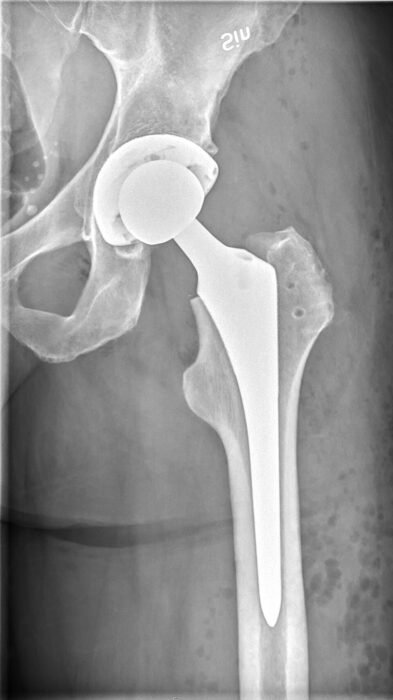
Video: what an artificial hip looks like
Prevention and living with hip arthritis
- Keep a healthy weight and exercise regularly.
- Avoid injuries to the hip and get early treatment for hip problems.
- Use a stick or frame if needed, and avoid activities that increase pain.
- Wear supportive, comfortable shoes.
- See an orthopaedic surgeon early to plan treatment.
Is hip arthritis serious?
Hip arthritis is not life-threatening, but it affects movement and quality of life. It is treated successfully with non-surgical measures in earlier stages and with hip replacement — an operation with few complications — in advanced stages.
Frequently asked questions about hip arthritis
What are the symptoms of hip arthritis?
Groin, thigh or buttock pain that may spread to the knee, morning stiffness, clicking, trouble with shoes and low seats, and a limp in advanced stages.
What are the grades of hip arthritis?
From 0 to 4 on X-ray, from a normal joint to severe arthritis with loss of joint space and deformity.
Is hip arthritis serious?
It is not life-threatening but affects movement and quality of life; it is treated successfully with conservative care or hip replacement.
Why does hip pain spread to the knee?
The nerves of the hip share pathways with those of the thigh and knee, so pain is sometimes felt in the knee.
How is hip arthritis diagnosed?
By examination and plain X-rays; an MRI may be requested to rule out other causes such as avascular necrosis.
To have your hip assessed, book a consultation, call +20 155 240 4488 or message us on WhatsApp at +20 155 554 7181.
Medically reviewed by Prof. Dr. Ibrahim Shaarawi, Professor of Orthopaedic Surgery. This article is general medical education and does not replace an examination or the plan your surgeon sets for you. See our medical disclaimer.
Related hip replacement guides
Advanced arthritis is treated with hip replacement surgery. Read also:
- Hip replacement surgery
- Hip arthritis treatment
- Core decompression of the femoral head
- Femoral neck fracture in older adults
- Preventing falls and fractures in older adults
References
- Kellgren JH, Lawrence JS. Radiological assessment of osteo-arthrosis. Ann Rheum Dis. 1957;16(4):494-502.
- American Academy of Orthopaedic Surgeons (OrthoInfo). Osteoarthritis of the Hip.
- National Institute for Health and Care Excellence (NICE). Joint replacement (primary): hip, knee and shoulder. NICE guideline NG157. 2020.