
Shoulder arthroscopy has high success rates, generally reported between 90% and 95% depending on the procedure and the patient. For arthroscopic shoulder dislocation surgery (Bankart repair), the success rate — meaning no further dislocation — is usually 85% to 95%. Results are best when surgery is done before repeated dislocations have worn the bone, when the right procedure is chosen, and when rehabilitation is followed carefully.
What is shoulder arthroscopy?
Shoulder arthroscopy is keyhole surgery: a small camera and fine instruments are passed through portals of about one centimetre, so the surgeon can see the whole joint magnified on screen and treat problems inside it. Common arthroscopic procedures include rotator cuff repair, subacromial decompression for impingement, and stabilisation for recurrent dislocation.
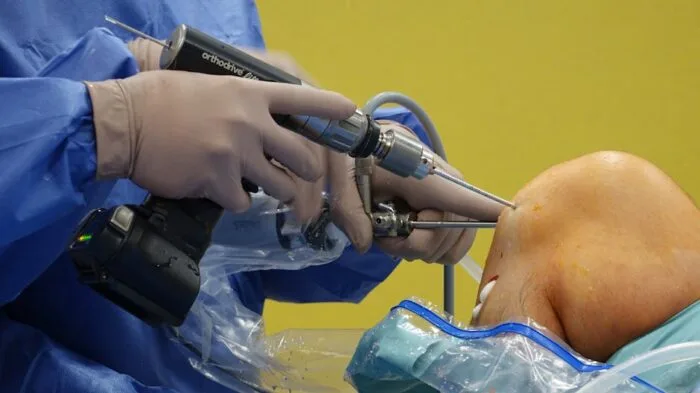
Success rates by procedure
| Procedure | What “success” means | Key factors |
|---|---|---|
| Arthroscopic Bankart repair (dislocation) | No further dislocation; usually 85–95% | Bone loss, Hill-Sachs size, age, sport, rehabilitation |
| Rotator cuff repair | Pain relief, strength and tendon healing | Tear size and chronicity, tissue quality, age |
| Subacromial decompression | Relief of impingement pain | Correct diagnosis and rehabilitation |
| Latarjet (open) | Low recurrence in high-risk cases | Bone-block healing and screw position |
Success rate of shoulder dislocation surgery
After an arthroscopic Bankart repair, most patients have a stable shoulder and return to their activities. Recurrence is more likely with untreated glenoid bone loss, a large engaging Hill-Sachs defect, young age with contact sport, and an early return to play. That is why assessment before surgery matters: adding remplissage for a large Hill-Sachs defect, or choosing a Latarjet for major bone loss, lowers the risk of failure. Comparative studies in athletes show the Latarjet reduces recurrence in high-risk cases.
| Factor | Effect on success |
|---|---|
| Glenoid bone loss | The more bone lost, the lower the success of a Bankart repair alone |
| Large Hill-Sachs defect | Raises recurrence unless remplissage is added |
| Young age and contact sport | Higher risk that needs careful procedure choice |
| Number of dislocations before surgery | Delay with repeated dislocations adds damage |
| Commitment to rehabilitation | An early return to sport is a leading cause of failure |
Recovery after shoulder arthroscopy
Recovery depends on the procedure. After decompression, movement may return within weeks; after a Bankart or rotator cuff repair, a sling protects the repair for several weeks, motion returns over about 3 months, and strength and return to sport take 4 to 6 months or more. Pain usually settles over the first few weeks, and results keep improving for months.
Possible complications
Shoulder arthroscopy is one of the safest orthopaedic procedures, and serious complications are uncommon. Possible problems include stiffness, persistent pain, infection (rare), nerve irritation, and — after stabilisation — recurrent dislocation in a minority of patients. Details are in shoulder arthroscopy complications.
How to improve your chances of success
- Choose a surgeon experienced in shoulder arthroscopy and stabilisation.
- Have the right imaging before surgery — including CT when bone loss is suspected.
- Follow the sling and movement restrictions in the early weeks.
- Commit to the physiotherapy programme at every phase.
- Do not rush back to contact sport before strength and stability are restored.
Shoulder arthroscopy cost
Cost depends on the procedure. For shoulder dislocation, arthroscopic Bankart repair costs about 60,000 EGP and open Latarjet about 80,000 EGP — see shoulder dislocation surgery cost in Egypt.
Advice if you are considering shoulder arthroscopy
Make sure the diagnosis is clear, understand exactly what will be done and why, ask about the rehabilitation plan and timeline, and plan time off work and sport accordingly. A realistic understanding of the recovery is one of the strongest predictors of satisfaction after shoulder surgery.
What does a successful result feel like?
- The shoulder feels stable in daily activities and sport positions.
- Pain has settled, including at night.
- Range of motion is close to the other side.
- Strength returns gradually through the strengthening phase.
- You can return to your chosen activity without fear of the shoulder slipping out.
Why some operations fail
When stabilisation fails, the usual reasons are glenoid bone loss that was not addressed, an engaging Hill-Sachs defect, a new significant injury, or returning to contact sport too early. Revision starts with CT to find the cause, and a Latarjet is often the best revision option because it rebuilds the missing bone. More in Bankart vs Latarjet.
How long do results last?
After a well-chosen and well-performed stabilisation, most shoulders stay stable in the long term. The main threats are a new significant injury and returning to high-risk sport before the shoulder is ready. Keeping up cuff and shoulder-blade exercises as a maintenance programme helps protect the result.
Video: a successful arthroscopic shoulder repair
Frequently asked questions about shoulder arthroscopy success
What is the success rate of shoulder arthroscopy?
Generally 90% to 95% depending on the procedure and the patient.
What is the success rate of shoulder dislocation surgery?
Usually 85% to 95% for no further dislocation after arthroscopic Bankart repair, depending on bone loss, the Hill-Sachs defect, age, sport and rehabilitation.
Can the shoulder dislocate again after surgery?
Yes, in a minority of cases, especially with untreated bone loss or an early return to contact sport.
How can I improve my chances of success?
Choose an experienced surgeon, get the right imaging beforehand, follow the physiotherapy programme and avoid rushing back to sport.
When will I see the result?
Pain improves within weeks, and full motion and strength return over 3 to 6 months depending on the procedure.
To have your shoulder assessed, book a consultation, call +20 155 240 4488 or message us on WhatsApp at +20 155 554 7181.
Medically reviewed by Prof. Dr. Ibrahim Shaarawi, Professor of Orthopaedic Surgery. This article is general medical education and does not replace an examination or the plan your surgeon sets for you. See our medical disclaimer.
Related shoulder dislocation guides
For stabilisation surgery details see arthroscopic shoulder stabilisation surgery, and read:
- Arthroscopic shoulder stabilisation surgery
- Bankart vs Latarjet
- Shoulder arthroscopy complications
- Rotator cuff repair
References
- American Academy of Orthopaedic Surgeons (OrthoInfo). Shoulder Arthroscopy.
- American Academy of Orthopaedic Surgeons (OrthoInfo). Chronic Shoulder Instability.
- Hurley ET, et al. Arthroscopic Bankart repair versus open Latarjet for recurrent shoulder instability in athletes. Orthop J Sports Med. 2021;9(9):23259671211023801.
- Burkhart SS, De Beer JF. Traumatic glenohumeral bone defects and their relationship to failure of arthroscopic Bankart repairs. Arthroscopy. 2000;16(7):677-94.