
Primary bone cancer is a rare tumor. Core Symptoms of Bone Cancer in Women include persistent nocturnal bone pain, localized swelling, and structural weakness leading to sudden fractures. While primary bone cancer is slightly more prevalent in men, secondary (metastatic) bone cancer originating from breast tumors is the most common threat to women. Treatment relies on joint-preserving limb-salvage surgery, alongside biological and radiation therapies tailored to the tumor’s stage and type.
Early Symptoms of Bone Cancer in Women
Symptoms often overlap with age-related changes like postmenopausal osteoporosis. Key warning signs require precise diagnosis:
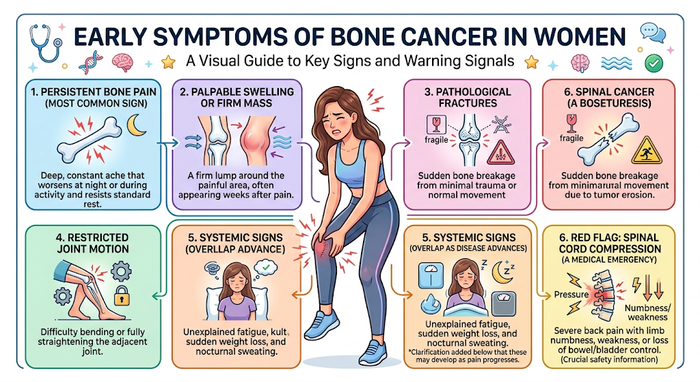
- Persistent Bone Pain: The most common symptom. A deep ache that worsens at night or with activity and resists standard rest.
- Palpable Swelling: A firm mass around the painful area, typically appearing weeks after initial pain.
- Pathological Fractures: Tumor-induced bone erosion causes structural weakness, leading to fractures from minimal trauma.
- Late Systemic Symptoms: Unexplained fatigue, sudden weight loss, or night sweats.
Immediate evaluation by an orthopedic oncologist is necessary to prevent symptom progression.
Common Bone Pain in Women vs. Tumor Pain
| Condition | Pain Behavior | Key Feature | Urgency |
| Postmenopausal Osteoporosis | Worsens with standing/loading; relieved by lying down. | Gradual back curvature and height loss. | Routine follow-up |
| Osteoarthritis | Linked to movement/stairs; relieved by rest. | Brief morning stiffness and joint crepitus. | Routine follow-up |
| Muscle/Stress Fracture | Starts after clear exertion; improves over weeks. | Localized pain at a specific point. | Evaluate within a month |
| Benign Bone Tumor | Night pain that responds distinctly to NSAIDs. | Stable size over time. | Evaluate within 2 weeks |
| Primary Malignant Tumor | Escalating pain unresponsive to rest or painkillers. | Firm, progressively growing swelling. | Immediate evaluation |
| Bone Metastases (e.g., Breast) | Deep back or pelvic pain worsening at night. | History of breast or thyroid cancer. | Immediate evaluation |
Red Flag: Numbness, leg weakness, or loss of bowel/bladder control combined with back pain is a medical emergency indicating potential spinal cord compression. Any bone pain that changes behavior (e.g., shifting from movement-related to resting/night pain) requires an X-ray before starting conservative treatment.
Causes of Bone Cancer
The exact cellular mutation mechanism remains under investigation, but clinical research identifies specific risk factors:
- Prior Radiation Therapy: High-dose radiation for breast or cervical cancer increases risk in the exposed area.
- Benign Bone Disorders: Paget’s disease of bone elevates bone turnover and occasionally undergoes malignant transformation.
- Genetic Syndromes: Rare mutations like Li-Fraumeni syndrome and hereditary Retinoblastoma.
Types of Bone Cancer in Women
| Cancer Type | Medical Definition | Most Affected Demographics (Women) |
| Primary Bone Cancer | Originates in bone or cartilage (Osteosarcoma, Chondrosarcoma). | Osteosarcoma (teens/young adults), Chondrosarcoma (women >40). |
| Secondary (Metastatic) | Malignant tumors spreading from other organs. Breast cancer is the primary cause. | Adults and seniors (history of breast, lung, or thyroid cancer). |
Prevention of Bone Cancer in Women
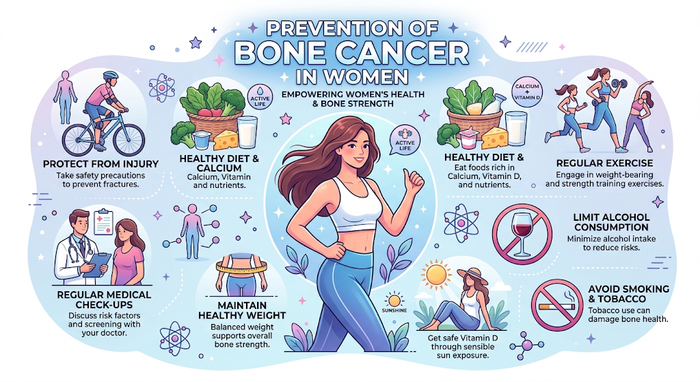
Primary bone cancer lacks modifiable risk factors, but secondary risks can be mitigated:
- Breast Cancer Screening: Regular mammograms prevent advanced tumors from metastasizing to bone.
- Monitoring Bone Diseases: Continuous medical tracking for women with Paget’s disease.
- Radiation Safety: Limit unnecessary high-dose X-ray exposure.
Cost of Diagnosis and Treatment of Bone Tumors in Egypt 2026
Bone Tumor Diagnosis & Treatment Cost Calculator (Egypt 2026)
Interactive cost estimation for diagnostic workups, biopsies, surgical resections, and megaprosthetic reconstructions in Egyptian Pounds (EGP) and US Dollars (USD)
| Clinical Procedure / Cost Component | Estimated Cost (EGP) | Equivalent (USD approx.) |
|---|
Clinical Evaluation Calculator for Bone Tumors in Women
Interactive protocol to determine diagnostics, specific surgeries, and targeted therapy pathways.
- Patient Age: 20–45 years (Youth)
- Anatomical Location: Around the knee (distal femur / proximal tibia)
- Suspected Tumor Source: Primary bone tumor (Osteosarcoma / Ewing’s / Chondrosarcoma)
- Pain Pattern: Mild or non-specific pain
- Cortical Bone Erosion (X-ray/CT): Less than one-third of bone diameter (< 1/3)
- Result Output: Case analysis and proposed surgical/diagnostic pathways.
Motor Rehabilitation Protocol After Limb-Salvage Surgery
| Phase | Timing | Therapeutic Goal | Weight-Bearing |
| Wound Protection | Weeks 1-2 | Wound healing, DVT prevention, adjacent joint mobility. | None |
| ROM Restoration | Weeks 3-6 | Passive to active mobility; prevent joint adhesions. | Partial (assisted) |
| Strength Building | Weeks 7-12 | Strengthen surrounding muscles; restore balance. | Gradual to Full |
| Return to Life | Month 3+ | Independent walking, ADLs, low-impact sports. | Full |
Warning: Running, jumping, and contact sports are permanently prohibited after tumor endoprosthesis implantation. Delaying rehab for chemotherapy is a common clinical error leading to permanent joint stiffness.
Treatment of Bone Cancer in Women
Multidisciplinary Tumor Boards dictate treatment based on histological biopsy, tumor grade, and staging:
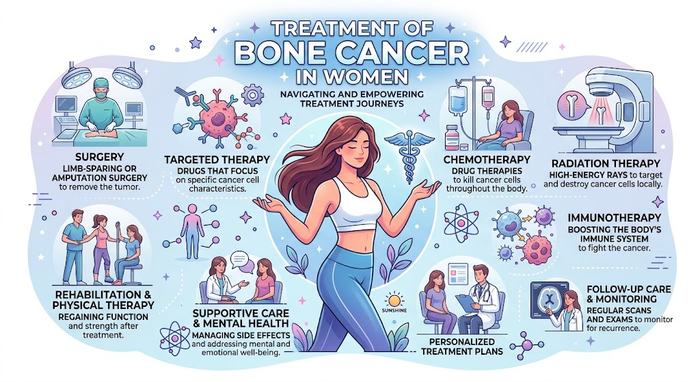
- Surgery: The primary standard is limb-salvage surgery, replacing resected bone with modular metallic megaprostheses or bone grafts to avoid amputation.
- Chemotherapy: Administered neoadjuvantly (to shrink tumors pre-op) and adjuvantly (to destroy micrometastases). Highly effective in Osteosarcoma and Ewing Sarcoma.
- Radiation Therapy: Utilized for unresectable tumors or palliative pain control in metastatic disease.
- Targeted/Biological Therapy: RANKL inhibitors (Denosumab) and Bisphosphonates target specific genetic pathways and protect the skeleton from osteolytic damage caused by metastases.
Is Bone Cancer More Common in Men or Women?
- Primary Bone Cancer: Marginally more common in men, specifically osteosarcoma during rapid male skeletal growth spurts.
- Secondary (Metastatic) Bone Cancer: Significantly higher in women. The global prevalence of breast cancer, combined with its high biological bone tropism, drives higher metastatic bone disease rates in female populations.
Frequently Asked Questions
What is the earliest and most common symptom of bone cancer in women?
The hallmark early sign of bone cancer is persistent, deep bone pain. In its initial stages, the pain may present as an intermittent dull ache, but it steadily progresses over time with specific red-flag features:
- Nocturnal exacerbation: Pain typically intensifies at night or while lying flat in bed, frequently waking the patient from sound sleep.
- Unrelated to exertion: The discomfort occurs independently of physical activity, sports strain, or mechanical stress.
- Refractory to basic analgesics: Standard over-the-counter pain medications (such as paracetamol or NSAIDs) offer minimal or temporary relief.
How can women distinguish between bone cancer pain and osteoporosis or arthritis?
Differentiating bone malignancy from common age-related skeletal disorders is critical:
- Osteoporosis: A progressive metabolic bone density loss that is completely painless on its own until an actual fracture (such as a vertebral compression fracture) takes place.
- Osteoarthritis / Rheumatoid Conditions: Discomfort is localized directly inside joint capsules, is worst upon waking with joint stiffness, and classically loosens or improves with gentle warmth and progressive movement.
- Malignant Bone Pain: A focal, boring ache centered deep within the bone shaft itself rather than the joint line. It does not improve with activity or rest, escalates during the night, and may be accompanied by a palpable mass or unexplained systemic weight loss.
What localized skin changes and visible swellings indicate a bone tumor?
As tumor cells erode through the outer bone cortex and breach the periosteum, prominent physical changes often emerge:
- Palpable Bone Mass: A firm, hard, non-mobile lump fixed directly to the underlying bone. It may initially be painless but becomes increasingly tender as it stretches surrounding tissues.
- Localized Heat & Erythema: The skin overlying the lesion may feel warm or hot to the touch due to heightened metabolic activity and abnormal tumor blood vessels.
- Engorged Superficial Veins: Dilated, prominent blue venous networks visible directly under the skin surface over the lesion.
What is a pathological bone fracture and how does it happen?
A pathological fracture is a structural bone break resulting from minimal, low-energy force or routine daily activity that would never compromise a healthy bone—such as coughing, rolling over in bed, or walking down a curb. Tumor cells disrupt the normal balance between osteoblasts and osteoclasts, hollowing out the structural trabeculae and thinning the rigid outer cortical shell. When cortical integrity is lost, the bone collapses under physiological body weight, frequently affecting the femur, humerus, or vertebrae.
Which bones are most frequently affected by tumors and metastases in women?
The anatomical distribution depends on whether the tumor is primary or secondary:
- Primary Bone Cancers (e.g., Osteosarcoma, Ewing Sarcoma): Predominantly involve the rapidly growing metaphyses of long bones, particularly around the knee joint (distal femur and proximal tibia) and the shoulder region (proximal humerus).
- Secondary Bone Metastases (e.g., from Breast, Lung, or Renal Cancer): Most commonly target the red-marrow-rich axial skeleton, led by the thoracic and lumbar spine, pelvis, ribs, skull, and proximal femur.
What systemic (whole-body) warning signs can accompany bone cancer?
In addition to focal skeletal findings, malignant bone disease frequently triggers constitutional symptoms mediated by systemic tumor necrosis and cytokine release:
- Unintentional Weight Loss: Rapid, unexplained loss of body weight without diet changes.
- Severe Fatigue & Malaise: Persistent exhaustion that does not improve after adequate sleep or rest.
- Profuse Night Sweats: Waking drenched in perspiration requiring clothing or bedding changes.
- Unexplained Low-Grade Fevers: Recurrent temperature spikes without an identifiable bacterial or viral infection.
What are the symptoms of hypercalcemia associated with bone tumors?
When extensive osteolytic tumor deposits destroy bone matrix, large volumes of calcium flood the systemic circulation, causing hypercalcemia of malignancy:
- Renal & Fluid Symptoms: Extreme thirst (polydipsia), severe dry mouth, and excessive, frequent urination (polyuria) leading to rapid dehydration.
- Gastrointestinal Distress: Loss of appetite, intractable nausea, recurrent vomiting, and severe constipation.
- Neuromuscular & Cognitive Signs: Profound generalized muscle weakness, lethargy, mental confusion, memory deficits, and in severe untreated cases, cardiac arrhythmias or coma.
What are the warning signs of spinal cord compression in bone metastases?
Metastatic Spinal Cord Compression (MSCC) is a critical oncologic emergency that occurs when vertebral tumors collapse into the spinal canal or expand into the epidural space:
- Severe, progressive back pain that worsens when coughing, straining, or lying supine.
- Radicular band-like pain radiating along the ribs, abdomen, or down the legs.
- Bilateral leg numbness, paresthesias (“pins and needles”), or motor weakness causing unsteady walking or foot drop.
- Sudden loss of bladder or bowel sphincter control (urinary retention or fecal incontinence). Immediate surgical decompression or targeted radiation is mandatory within 24–48 hours to prevent irreversible paralysis.
Should breast cancer survivors be concerned about new, isolated bone pain?
Yes. While everyday aches, strains, and joint stiffness from aromatase inhibitors or tamoxifen are common, bone remains the single most frequent organ for breast cancer recurrence. Any new, localized bone ache—especially in the spine, ribs, hips, or shoulders—that lasts for more than two weeks, worsens at rest, or disrupts sleep should never be dismissed as simple arthritis. It requires prompt cross-sectional evaluation via MRI, PET-CT, or nuclear bone scan.
When should a woman urgently consult an orthopedic oncology specialist?
You should seek an immediate consultation with an orthopedic oncology surgeon if you experience any of the following clinical red flags:
- Bone pain persisting for more than two weeks that intensifies at night and fails to respond to ordinary pain relievers.
- A firm, steadily enlarging swelling or lump anchored to a bone or joint.
- A sudden fracture occurring after trivial or non-traumatic movement.
- Neurological symptoms such as leg weakness, numbness, or loss of urinary control alongside back pain.
- Any new localized bone pain in a woman with a medical history of breast, thyroid, lung, or kidney cancer.
Medical References
- American Cancer Society (ACS): Bone Cancer Early Detection, Diagnosis, and Types
- Journal of Clinical Oncology (JCO): Management of Bone Metastases in Breast Cancer
- American Academy of Orthopaedic Surgeons – OrthoInfo. Metastatic Bone Disease (2026)
- Hospital for Special Surgery (HSS). Metastatic Bone Disease (2020)
- Cleveland Clinic. Osteosarcoma (Osteogenic Sarcoma) (2024)
- Cleveland Clinic. Bone Cancer (2026)
- Mayo Clinic. Bone cancer: Symptoms and causes (2026)
- NICE Clinical Knowledge Summaries. Bone and soft tissue sarcoma: recognition and referral (2021)
- UK Guidelines for the Management of Bone Sarcomas (Gerrand C, et al.). Clinical Sarcoma Research, 2016
- Limb-salvage versus amputation in osteosarcoma: a meta-analysis. Oncology Letters, 2023