
Quick answer
De Quervain’s tenosynovitis is inflammation and narrowing of the sheath around two thumb tendons at the thumb side of the wrist, causing pain on lifting and moving the thumb. It is common in new mothers and heavy hand or phone users. It is diagnosed with the Finkelstein test and treated with a thumb-and-wrist splint, anti-inflammatories and a steroid injection; persistent cases need tendon release surgery through a small incision.
✅ Last medically reviewed by Prof. Dr. Ibrahim Shaarawi, Professor of Orthopaedic Surgery, on 5 October 2026
A young mother with sharp wrist pain whenever she lifts her baby is the classic De Quervain’s patient. It differs from trigger finger, although both are “tendon entrapments”. Here is the diagnosis and treatment in order, as part of our guide to carpal tunnel release and hand nerve surgery.
What is De Quervain’s tenosynovitis?
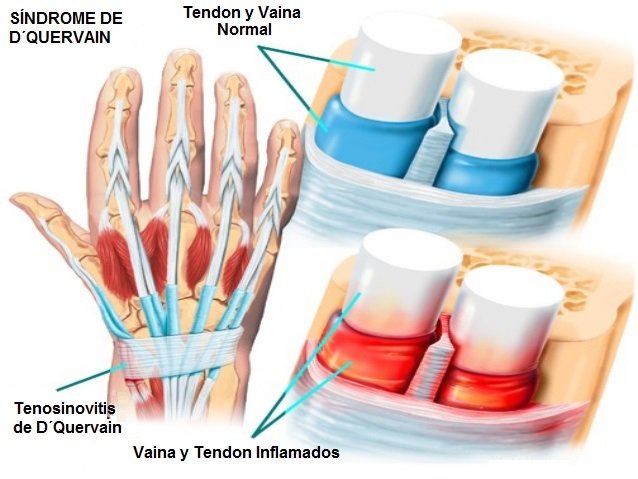
At the thumb side of the wrist, two tendons (abductor pollicis longus and extensor pollicis brevis) run through a narrow tunnel covered by a sheath. When the sheath thickens, the tendons rub against it with every thumb movement, causing pain and swelling.
Symptoms
- Pain at the thumb side of the wrist on gripping, wringing and lifting a baby.
- Swelling or a small bump over the tendons.
- A catching or creaking feeling on moving the thumb.
- Difficulty holding objects or turning keys.
Causes and risk factors
- New mothers and breastfeeding (repeated lifting and hormonal changes).
- Women aged 30–50.
- Repetitive thumb use: phones, writing, housework, crafts.
- Rheumatoid arthritis and diabetes.
- A direct wrist injury.
Video: hand tendon release
Diagnosis: the Finkelstein test
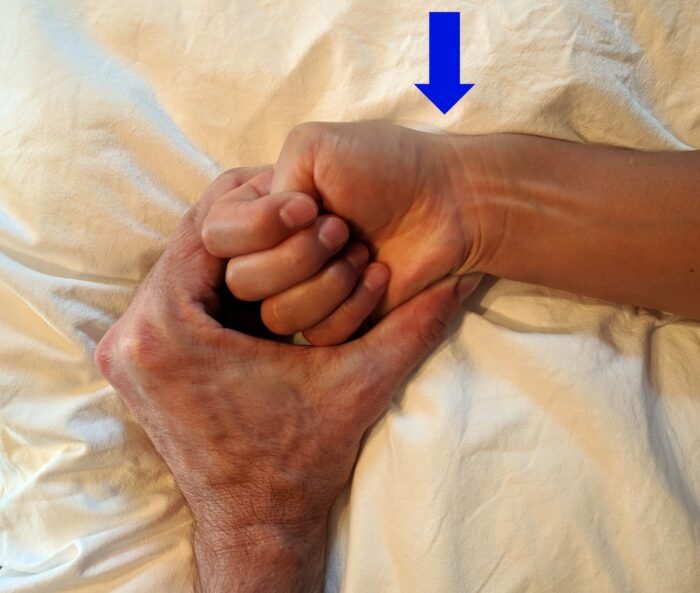
You tuck the thumb into the palm and tilt the wrist towards the little finger; sharp pain at the thumb side of the wrist is a positive test. X-rays are rarely needed, except to exclude thumb-base arthritis or a scaphoid fracture; ultrasound can show the thickened sheath.
| Condition | Pain location | How we tell |
|---|---|---|
| De Quervain’s | Thumb side of the wrist | Positive Finkelstein test |
| Thumb-base arthritis | Base of the thumb in the palm | Grinding on joint movement, X-ray |
| Trigger thumb | Palm side of the thumb base | Thumb catches on straightening |
| Scaphoid fracture | “Snuffbox” after a fall | X-ray, sometimes MRI |
Key numbers to know
- In De Quervain’s tenosynovitis, for every two patients treated with a steroid injection one more improves than with a splint alone — about three times the chance of improvement (Ashraf and Devadoss, 2014).
- In a Cochrane review of 14 trials (1,260 patients, about 70% women), triggering returned within 6–12 months in 38.5% after a steroid injection versus only 6.5% after open release (Fiorini et al., Cochrane 2018).
| Treatment | When we use it | What to expect |
|---|---|---|
| Rest and a thumb-wrist splint | Early cases | Less pain by limiting thumb movement |
| Steroid injection into the tendon sheath | Most cases | Better than a splint alone for many patients |
| De Quervain’s release (first compartment release) | Persistent pain after injection | A small incision under local anaesthesia, protecting the sensory nerve branch |
At Prof. Dr. Ibrahim Shaarawi’s clinics in Nasr City, Mohandeseen and New Cairo (5th Settlement) we examine the finger or wrist and grade the tendon problem at the same visit, then choose a splint, injection or release according to the grade.
Non-surgical treatment
- A thumb-and-wrist splint for 3–6 weeks to rest the tendons.
- Short-term oral or topical anti-inflammatories.
- Modifying triggering activities and how you lift your baby.
- A steroid injection into the tendon sheath — one of the most effective treatments; one or two injections settle many cases.
When is surgery needed?
If pain persists after splinting and injections for several months, or keeps recurring, we perform first dorsal compartment release: a small incision at the wrist under local anaesthesia to open the tight sheath, protecting the superficial radial nerve and checking for an internal septum separating the tendons. Light use resumes within days and full use within weeks. Tendon release costs 25,000–30,000 EGP — see trigger thumb release cost.
Frequently asked questions about De Quervain’s tenosynovitis
What is De Quervain’s tenosynovitis?
Inflammation and narrowing of the sheath around two thumb tendons at the thumb side of the wrist, causing pain on gripping, lifting and moving the thumb.
How do I know if I have De Quervain’s?
Pain at the thumb side of the wrist that worsens with lifting, and a positive Finkelstein test: thumb in the palm with the wrist tilted towards the little finger reproduces the pain.
Does De Quervain’s go away on its own?
It can improve with rest and fewer triggering movements, especially after breastfeeding ends, but many people need a splint or injection.
Do steroid injections work for De Quervain’s?
Yes, they are among the most effective treatments, and one or two injections settle many cases.
How much does De Quervain’s surgery cost?
Tendon release costs 25,000–30,000 EGP with Prof. Dr. Ibrahim Shaarawi, confirmed after examination.
To have your hand assessed and your nerve tests reviewed, book a consultation, call +20 155 240 4488 or message us on WhatsApp at +20 155 554 7181.
Medically reviewed by Prof. Dr. Ibrahim Shaarawi, Professor of Orthopaedic Surgery. This article is general medical education and does not replace an examination or the treatment plan your surgeon sets for you. See our medical disclaimer.
Related hand nerve and tendon guides
Related guides on hand tendons:
- Carpal tunnel release and hand nerve surgery
- Trigger finger
- Hand and finger tendinitis
- Trigger thumb release cost
References
- Satteson E, Tannan SC. De Quervain Tenosynovitis. In: StatPearls. Treasure Island (FL): StatPearls Publishing; 2023.
- Ashraf MO, Devadoss VG. Systematic review and meta-analysis on steroid injection therapy for de Quervain’s tenosynovitis in adults. Eur J Orthop Surg Traumatol. 2014;24(2):149-57.
- American Academy of Orthopaedic Surgeons (OrthoInfo). De Quervain’s Tendinosis.